

Oaklawn stewards expected to issue rulings on Charlatan, Gamine next week
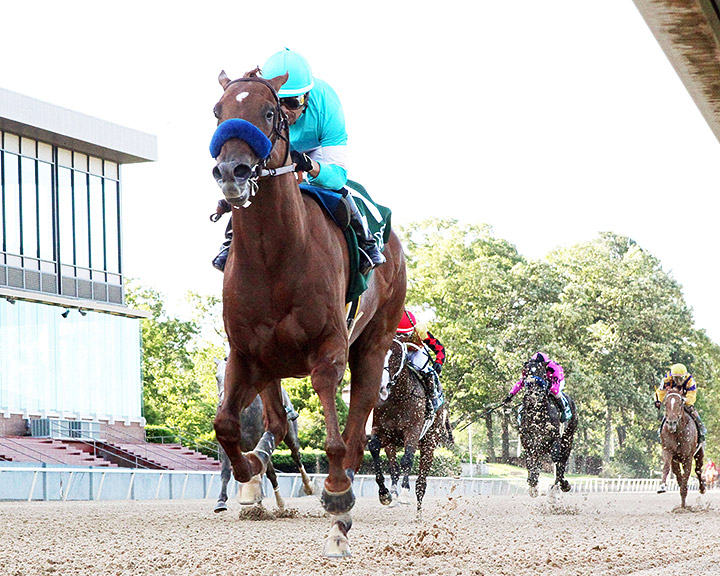
Rulings by stewards at Oaklawn Park into medication violations by two horses trained by Bob Baffert who won races on May 2 at Oaklawn are expected to be issued next week, a spokesman for the Arkansas Department of Finance and Administration, which oversees the state’s racing commission, said Tuesday.
The horses are Charlatan, who won a division of the Arkansas Derby, and the filly Gamine, who won an allowance race that day and most recently won the Acorn Stakes at Belmont Park.
The results of both split samples have not been made public by the Arkansas Racing Commission, but were first reported Monday by The New York Times, which cited “a person familiar with the results.” They were later acknowledged by the attorney representing Baffert, who in statement said the substance was lidocaine.
Scott Hardin, spokesman for department, said in an email Tuesday that “while we can’t yet share any information regarding this as the stewards have not issued a ruling, we do anticipate rulings may be issued next week by stewards.”
:: KENTUCKY DERBY 2020: Derby Watch, point standings, prep schedule, news, and more
Lidocaine is a medication that is legal to use on horses, but has a recommended withdrawal time so as to not be viable on race day. As a result, both horses could be disqualified. If Charlatan is disqualified, runner-up Basin, scheduled to run Saturday in the Blue Grass at Keeneland, would be placed first. If Gamine is disqualified, promoted to first would be Speech, who subsequently was second in the Santa Anita Oaks and is scheduled to run Saturday in the Ashland Stakes at Keeneland.
Charlatan and Gamine recently had split samples confirmed for a medication violation after their May 2 races at Oaklawn Park. The initial tests became public in late May. Baffert’s attorney on Monday said the cause was “innocent exposure” from cross-contamination owing to an employee using a pain patch for human use.
W. Craig Robertson III of Lexington, Ky., Baffert’s attorney, put out a statement late Monday owing, he said, to the results of the split sample being leaked, which he said was a violation of protocol of the racing commission.
“The only reason we put out a statement is because someone else put the results out,” Robertson said in a telephone interview. “None of this is supposed to be public yet. Someone within the commission leaked the primary results, and now this.”
Robertson said he was informed of the split sample results Friday. He did not dispute the findings. Rather, he said the positives, for the medication lidocaine, was “innocent exposure and not intentional administration.”
According to the statement, Charlatan and Gamine tested positive for trace amounts of lidocaine.
“It is our belief that both Gamine and Charlatan were unknowingly innocently exposed to lidocaine by one of Bob’s employees,” the statement said. “The employee previously broke his pelvis and had been suffering from back pain over the two days leading up to May 2. As a result, he wore a Salon Pas patch on his back that he personally applied. That brand of patch contains small amounts of lidocaine. It is believed that lidocaine from that patch was innocently transferred from the employee’s hands to the horses through the application of tongue ties by the employee that was handling both horses leading up to May 2.”
Although the employee is not identified, Baffert’s top assistant, Jim Barnes, was with the horses at Oaklawn, and Barnes fractured his pelvis in September 2017.
The statement says that Gamine tested for 185 picograms of lidocaine and Charlatan 46 picograms. A picogram is one-trillionth of a gram.
Gamine ran in race 7 on May 2. Charlatan was in race 11. Nadal, a third Baffert runner on that card, won the other division of the Arkansas Derby, race 13. His test was clean.
“It is our understanding that the trace amounts of lidocaine found in both Gamine and Charlatan would not have had any effect on either horse – much less a performance-enhancing one,” the statement said. “The extreme sensitivity of modern-day testing can now pick up trace levels of innocent contaminants that have no effect on a horse.”