

Judge in Baffert-Churchill case expected to issue decision on injunction before Feb. 28
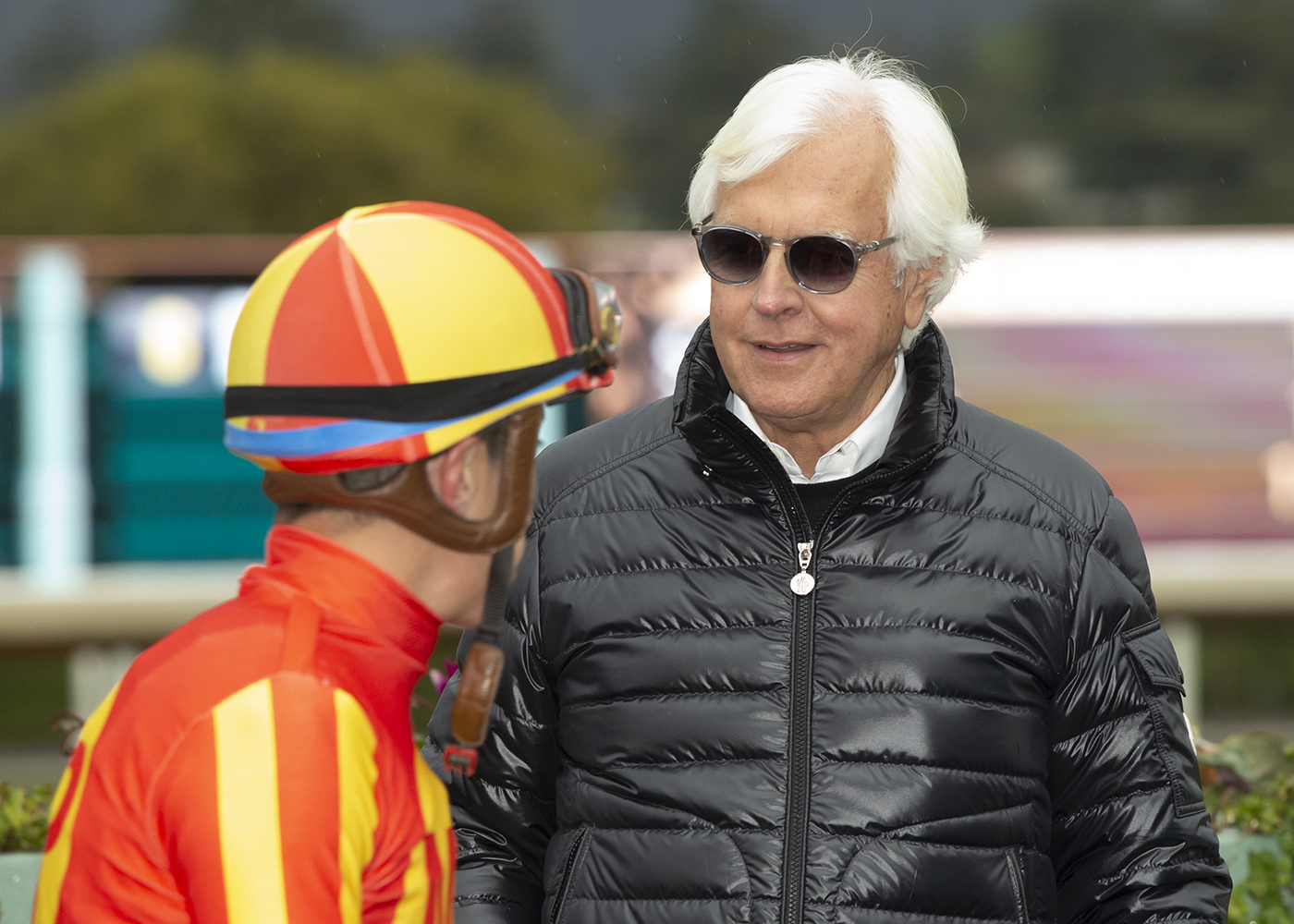
LOUISIVILLE, Ky. – A two-day hearing in a U.S. District Court to weigh arguments on whether Churchill Downs can continue to ban trainer Bob Baffert from this year’s Kentucky Derby concluded Friday afternoon, and a decision on a request by Baffert’s attorneys for a temporary injunction is expected within the next several weeks, if not sooner.
Judge Rebecca Grady Jennings of the U.S. District Court for the Western District of Kentucky did not provide a specific window for when she might rule on the motion for the temporary injunction, though attorneys present for the case said that her language indicated that she would issue a ruling well before a Feb. 28 deadline that would require owners of Baffert-trained Derby contenders to transfer them to other trainers in order to earn points in qualifying races.
The hearing was initially allotted four hours on Thursday, but Jennings allowed the hearing to be continued to Friday after both sides were unable to complete their opening arguments in the allotted time. On Friday, the continuation stretched well past its allotted time as well, as Jennings consistently reminded the parties to stick to arguments and testimony pertaining to the legal issues directly bearing on the motion for the temporary injunction.
At the heart of the issue is whether a private company like Churchill Downs Inc. can exclude a licensed trainer from its facilities and whether Jennings should be compelled to issue a temporary injunction when Baffert’s attorneys did not seek redress until 17 months after the ban was first put in place. On the first issue, courts have consistently held that private companies have broad exclusionary rights, but Baffert’s attorneys attempted during the hearing to argue that the state’s “entwinement” with Churchill as the company’s regulator diminished those rights.
Jennings opened the hearing on Thursday with a directive for the two sides to hew closely to the legal issues surrounding the motion, and she repeated that request at the close of the hearing Thursday. Then, on Friday, immediately after entering the court, she used even more forceful language to implore the sides not to dwell on the violation at the heart of the matter – a positive drug test for the Baffert-trained Medina Spirit after the horse won the 2021 Kentucky Derby.
“We spent an inordinate amount of time yesterday discussing whether there was a violation of KHRC rules,” Jennings said. “We are not going to talk about that today. We don’t need to talk about that today. . . . I tried to do that yesterday, and I’m being more clear today, hopefully.”
The brunt of the hearing on Friday was taken up by the testimony of Baffert, appearing on the stand for the third time in the various hearings and appeals that have involved the Medina Spirit matter since the positive was announced one week after the 2021 Derby.
Baffert was called first by the legal team representing Churchill Downs. Orin Snyder, a New York-based attorney, led the questioning, and he peppered Baffert with inquiries into his actions and comments in the days after learning that Medina Spirit had tested positive.
That line of questioning led to the playing in court of a phone call Baffert had with Kentucky’s chief steward in which he called Kentucky “a cesspool,” as well as a re-hashing of the comments Baffert made in public claiming that Medina Spirit had never been administered betamethasone, followed by Baffert’s admission several days later that the horse had indeed been administered an ointment containing the drug.
Snyder also pointed to Baffert’s statements in several releases issued by the trainer that acknowledged he had said damaging comments about the industry, in an attempt to provide a basis for Churchill’s action to the ban the trainer. Churchill has said previously that the ban was based on a record of positive drug tests from Baffert-trained horses, including a positive for betamethasone in a horse he trained, Gamine, after the 2020 Kentucky Oaks at Churchill Downs.
Snyder also drilled hard on Baffert’s statements in several affidavits that the Churchill ban would “effectively put me out of business,” pointing to Baffert’s voluminous record of wins at tracks around the world since the ban was put in place. Baffert countered that his operation is geared toward getting horses to the Kentucky Derby, and that the statements were based on the long-term damage that the ban would have on his ability to attract more clients to his business.
“It’s a big, big blow,” Baffert said. “I should have been doing much, much better.”
Baffert’s barn is currently stocked with promising 3-year-olds, and the failure to get a preliminary injunction could indeed be a big blow to his barn this year. The Baffert-trained Arabian Knight, owned by Amr Zedan, also the owner of Medina Spirit, is the 6-1 early favorite for the Derby on Daily Racing Form’s Derby Watch, and six other horses trained by Baffert appear on the 20-horse list, including Cave Rock, the third choice at 12-1, and National Treasure, the co-fifth choice at 15-1. Zedan also owns two other horses on the list, the 30-1 shot Hejazi and Arabian Lion, who is listed at 50-1.
:: KENTUCKY DERBY 2023: Derby Watch, point standings, prep schedule, news, and more
Baffert had initially challenged the Churchill ban early in 2022, but he withdrew the suit five weeks after filing it, at a time when his lawyers acknowledged that they had been rebuffed by Churchill in their attempts to reach a negotiated settlement on the ban. He refiled the suit in December, and Jennings made a point in her directions to the parties to address the timing of the new suit, given the pressure that it has put on her court to deliver a verdict.
Late in 2022, Churchill modified its qualifying system to earn points toward a start in this year’s Derby to prevent horses trained by Baffert from participating in the Derby unless they are transferred out of his barn by Feb. 28. Last year, prior to the modification, two horses trained by Baffert were transferred out of his barn just prior to the Santa Anita Derby on April 9, and both horses, Taiba and Messier, ended up starting in that year’s Kentucky Derby.
Clark Brewster, one of Baffert’s attorneys, used his cross-examination of his client to play up Baffert’s accomplishments over his 40-year Hall of Fame career before segueing into the circumstances surrounding the Medina Spirit positive. Once again, Jennings swiftly interjected, telling Brewster to limit his questioning to the “legal issues at hand.”
Brewster eventually began questioning Baffert about his record in the Derby, his reverence for the race, and his current crop of 3-year-olds, including the investment of those horses’ owners in their quests to get a Derby winner. He also questioned Baffert about any communications the trainer had had with Churchill officials in which he would have been able to provide a defense prior to the track issuing the ban. Baffert said he had had none.
The only other witness to take the stand was Mike Anderson, president of Churchill Downs, called by Churchill’s legal team. Anderson described the steps that Churchill took before deciding, on May 9, to issue an “indefinite ban” of Baffert, including a description of a meeting that day among top Churchill executives after Baffert acknowledged the positive at a press conference held at his barn at the track. Anderson then described Churchill’s decision on June 2 to retroactively apply a two-year ban to Baffert through the 2023 Kentucky Derby.
When asked what the ban was based on, Anderson said: “A lack of respect for the rules and regulations. A lack of understanding or a disrespect for the rules and regulations.” He also said that Baffert’s positives in the Oaks and Derby, two races held nine months apart in 2020 and 2021 because of the disruption caused by the COVID-19 pandemic, “caused our brand harm.”
“The public perception of integrity is very important to us,” Anderson said.
On cross-examination, Brewster hammered away at whether Anderson and the other executives had done their own investigation into the positives, in an attempt to introduce concerns over whether Churchill had based on the ban on a faulty understanding of the circumstances behind the two betamethasone positives and other positives for regulated medications over the preceding five years. He also asked Anderson whether Churchill has any procedures or protocols for deciding on a ban of a trainer, in an attempt to argue that Baffert should have basic due-process protections regardless of Churchill’s status as a private company.
“As a private business, we have the right to issue suspensions [sic] to participants and patrons that we don’t want at our facility,” Anderson replied.
Following Anderson’s testimony, Jennings began to close the hearing. In doing so, she said that she may issue a ruling not only on the motion for the preliminary injunction, but also on Churchill’s motion for a dismissal of the case.
:: Want to learn more about handicapping and wagering? Check out DRF's Handicapping 101 and Wagering 101 pages.