

Hopes for full grandstand and starting gate as seaside meet begins
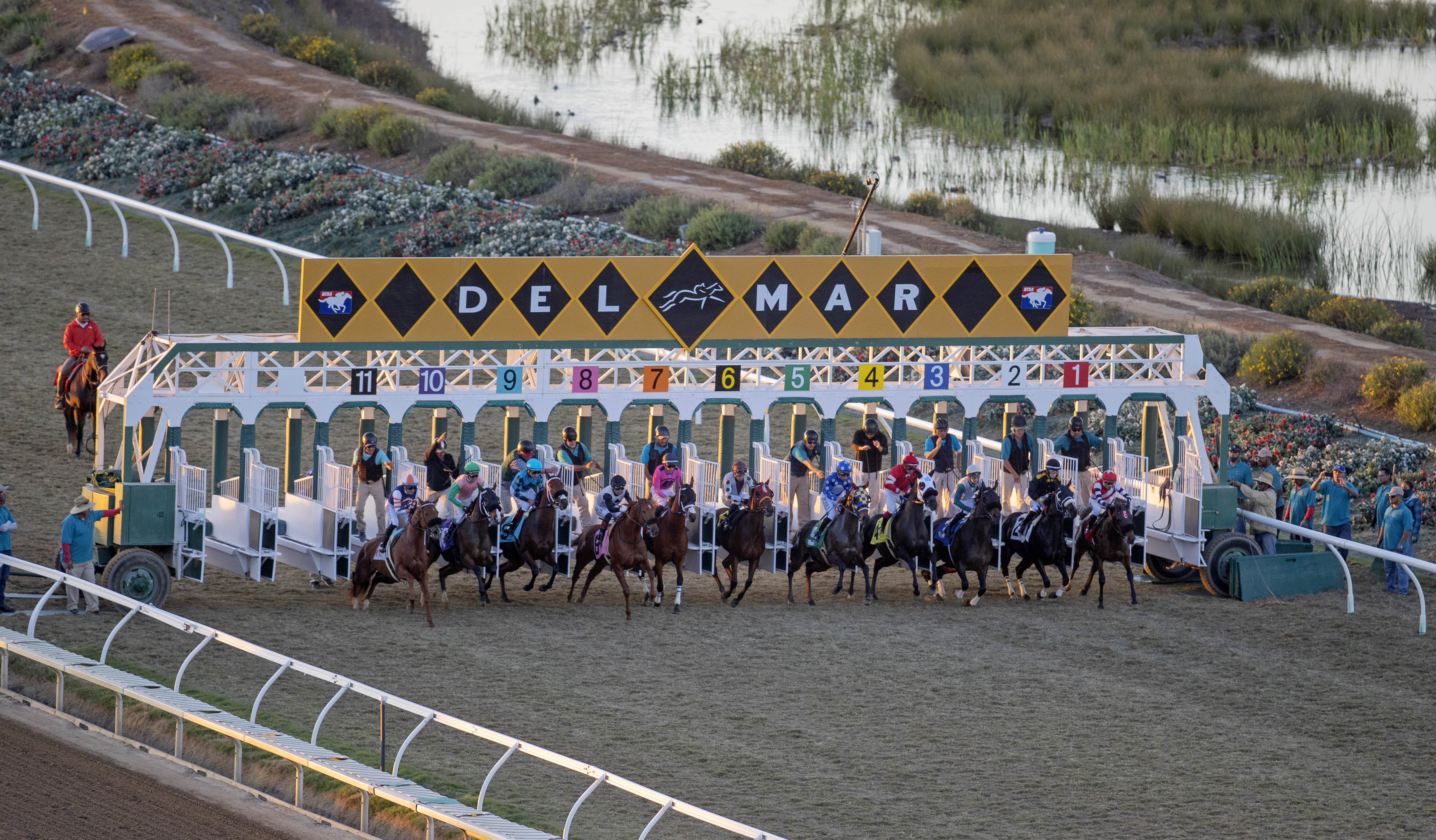
California racing’s summer vacation at Del Mar has its eagerly awaited start on Friday.
With the exception of a sold-out opening day, there are no audience restrictions similar to what was in place in 2020 and at times last year. The barn area is full, and so are the entries on Friday with as many as 110 runners in 10 races, beginning at 2 p.m. Pacific.
Del Mar, located on the Pacific Ocean just north of San Diego, announced a sell-out for opening day earlier this month, and has limited the audience to approximately 21,750 in an effort to promote a better customer experience. When opening-day attendance has soared past 40,000, fans found it difficult to move about, get drinks or food, or make bets.
:: DRF's Del Mar headquarters – Stakes schedule, previews, recaps, past performances, and more
This is the first year since 2019 that Del Mar will operate a summer meeting without any constraints from the pandemic. Attendance in the summer of 2020 was non-existent at the start of the meeting, and later in the meet owners with runners were allowed to attend. The 2021 meeting began with crowds limited to customers who had reserved seats, a policy that was relaxed as the season progressed to allow walk-up customers.
All-sources handle reached a record $21.3 million for opening day last year, and the figure could be challenged on Friday with an attractive card of full fields. There are four turf races, including the $100,000 Oceanside Stakes for 3-year-olds at a mile.
Through the season, which concludes on Sept. 11, bettors will be looking at a lineup of jockeys that differs slightly from last year. Flavien Prat, who won or tied for leading rider at five of the last six summer meetings, left the circuit in the spring for the East Coast. His absence has led riders such as Ramon Vasquez and Florent Geroux to relocate to California and challenge locally based stalwarts such as Juan Hernandez, Tyler Baze, Drayden Van Dyke, and Abel Cedillo for leading mounts and the riding title. Van Dyke won the title at the 2018 summer meeting.
Peter Miller led all trainers with 26 wins last summer, and recently returned from a six-month hiatus. He will face challenges from Phil D’Amato, the leading trainer at the Santa Anita winter-spring meeting, and perennial contenders Doug O’Neill and John Sadler. Hall of Famer Bob Baffert, who returned to training earlier this month after a 90-day suspension, is expected to have his typical high-profile position.
They will all be racing for record overnight purses, a benefit of an all-sources handle of more than $570.7 million from the 31-day 2021 summer season. This summer’s season will cover 31 racing days and will extend a week past Labor Day for the first time since 2003.
The Saturday, Sept. 3 program on Labor Day weekend is the most lucrative day of the season, with five stakes worth a total of $2.025 million. The program is led by the Grade 1 Pacific Classic, a $1 million race for 3-year-olds and up at 1 1/4 miles that is scheduled to include top older horse Flightline in his first test at the distance.
With the season going a week past Labor Day, the meeting’s two main races for 2-year-olds – the Grade 1 Del Mar Debutante for fillies and Grade 1 Del Mar Futurity – will be the highlight of racing on Sept. 10-11.
Most stables will focus on overnight races, which will have increased prize money. A maiden special weight race will be worth $80,000, an increase from $70,000 in 2021. A $20,000 claiming race for maidens will be worth $30,000 compared to $25,000 last year, while a purse for a $32,000 claiming race has risen from $45,000 to $51,000.
The track’s ship and win program will offer a $5,000 starter bonus and a 50 percent purse bonus in overnight races on dirt to the owners of horses who have not run in California in the preceding 12 months and are not first-time starters. For turf races, there will be a $4,000 starter bonus and a 40 percent enhancement of purses earned in overnight races.
The higher purses and other incentives are designed to increase field size. Last summer, fields averaged 8.45 runners per race compared to 7.99 in 2019 and 8.36 in 2020. The 2021 figure was the highest for a summer meeting since the 2017 season averaged 8.58 runners.
Duplicating average field size from 2021 would be a measure of success for this summer’s meeting.