
Hawk escort helps keep replay drone from being grounded
DEL MAR, Calif. – One of the most important 3-year-olds at Del Mar this summer weighs approximately 1.5 pounds and has feathers.
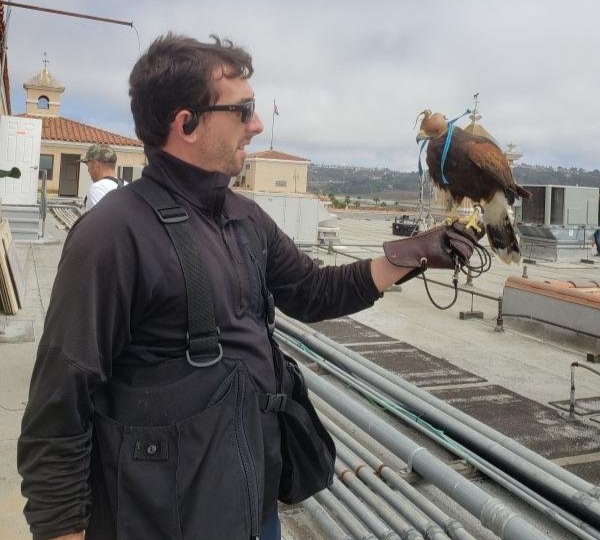
A Harris’s hawk and his handler, Conor Bucalo, have been positioned on the rooftop since late July as part of the three-man team operating the drone that records the races. Images from the drone provide an overhead view shown to the public during replays and are used by stewards to review inquiries.
While the drone offers racing fans another perspective, they also have piqued the interest of a few local seagulls. The presence of Bucalo’s hawk has helped keep seagulls away.
:: DRF's Del Mar headquarters – Stakes schedule, previews, recaps, past performances, and more
Drones have been in use at California tracks since 2021 but were inactive for much of the first two weeks of the Del Mar meeting, which began July 22, because of harassment from seagulls. Del Mar’s racetrack is about a quarter-mile from the Pacific Ocean, and seagulls are frequent visitors to the track, including the rooftop.
Colin Thomas, who heads the drone team and owns and operates the equipment involved in the operation, said seagulls were flying too close to the drone for safety in late July. The drone was grounded out of fear a seagull would knock the expensive machine from the sky.
Those pesky seagulls kept Thomas and his team sidelined longer than he would have preferred.
“It felt like an eternity,” he said over the weekend. “It seems they have gotten used to us.”
Bucalo, 28, has a flock of nine hawks and has used more than one of the birds in recent days at Del Mar. He has a four-acre property in nearby Temecula, Calif., where he keeps the birds, occasionally letting them out for flight.
For the most part, the hawks stay close to Bucalo’s home.
“I had one that took off for 24 hours and spent the night somewhere,” he said. “They don’t have to come back. They come back because they have a good thing going. They have food and water.”
The hawk Bucalo brought to Del Mar on Saturday and Sunday is a 3-year-old acquired when it was 75 days old.
Thomas and camera operator Andrew Garrett work as a team during races. The drone is flown from a rooftop base as the field reaches the gate. Thomas, 32, positions the drone at a height of approximately 200 feet and flies the machine behind the field. Garrett, 38, operates the small camera on the bottom of the drone during the race.
The drone view is often shown to the public after the races and during telecasts on TVG.
Steward Kim Sawyer said use of drone footage has been an asset for inquiries, offering a perspective on sections of the track, such as when fields enter and exit the turn, that are not as well covered by various television angles.
“It covers the blind spots,” Sawyer said. “It gives us more of a true shot.”
Bucalo, Garrett, and Thomas do not have backgrounds in racing. Thomas has flown drones for other sporting events, such as BMX racing, skateboarding, and motocross, while Garrett has a background in filming and photographing skateboarding, car commercials, and music videos.
Garrett and Thomas have operated the drone at Santa Anita in the last year. They have adjusted to a variety of seasonal conditions. Rain keeps the drone grounded for a few days.
A gusty sea breeze during Saturday’s program made drone flying more difficult than normal.
“The wind here is so gnarly,” Thomas said during a race Saturday.
In the middle of Saturday afternoon, Bucalo walked from one end of Del Mar’s expansive roof with his hawk on his wrist. A curious seagull flew not too far away, but there were not many others within sight.
When contacted in July about his services, Bucalo was a little surprised to learn his birds would be guarding a drone at a horse track.
“I didn’t know it was for a drone,” he said. “I’ve done stadiums, hotels, resorts, and hospitals. It’s mostly a deterrent.”
The addition of the hawk has helped. Thomas has seen how birds can damage a drone. Last November, a drone was knocked from the sky by what he believes was a red tail hawk during a Breeders’ Cup race. The drone crashed in the small gap between the outside of the turf course and the inside of the dirt track. No horses were affected.
Nothing that dramatic has occurred this year, but the presence of the hawk has helped to normalize the drone service.
“We love doing this,” Garrett said. “Not being able to do it was frustrating.”