
Derby Watch: After surgery, Roadster ready to show true self
ARCADIA, Calif. – Roadster was breathtaking in his debut. He had his breath taken away in his next race.
Eight months later, in the Grade 1, $1 million Santa Anita Derby on Saturday, Roadster will make his bid for a berth in the May 4 Kentucky Derby. For a horse with a mere three starts, he’s had an eventful journey to get to this point, including time off for throat surgery to address a malfunctioning wind flap.
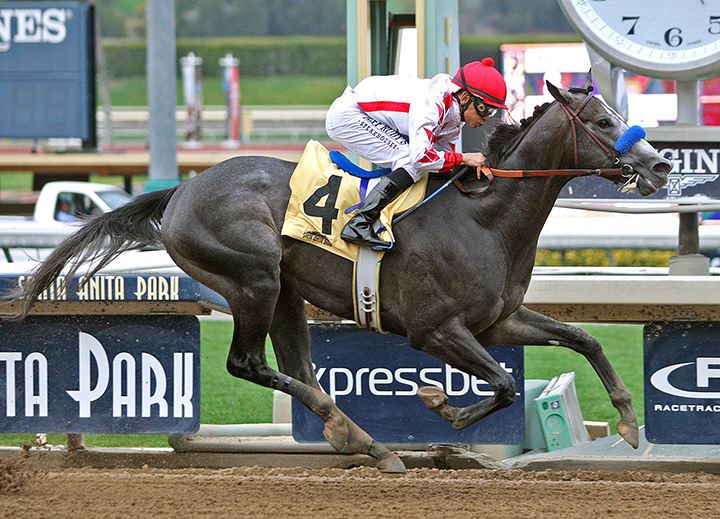
In his one start since the surgery, Roadster won an allowance race here at Santa Anita on March 1, earning a career-best Beyer Speed Figure of 91 while defeating another Santa Anita Derby contender in Nolo Contesto. On Saturday, he lines up against the current favorite for the Kentucky Derby, his Bob Baffert-trained stablemate Game Winner, to see how he measures up against the best of the division.
Last summer, before he ever ran, Roadster was the best-known Kentucky Derby prospect of 2019 courtesy of an impromptu interview Baffert gave TMZ Sports. While exiting a popular Los Angeles-area restaurant less than a month after Justify had won the Triple Crown, Baffert was asked who had caught his eye among his new prospects.
“Roadster,” he replied.
:: Add Santa Anita Clocker Reports to your handicapping arsenal
In his debut one month later, Roadster – sent off at 4-5 – easily defeated maidens at Del Mar, winning by 4 1/4 lengths. He was favored for the Grade 1 Del Mar Futurity on Sept. 3 but struggled home third behind Game Winner.
“He was displacing,” Baffert said this week, referencing Roadster not being able to get his proper air intake owing to an obstruction. Surgery was the only option. “We didn’t have a choice,” Baffert said.
Baffert has had a few other horses undergo the procedure, most notably Midnight Lute, a two-time winner of the Breeders’ Cup Sprint.
Roadster was sent to Kentucky to the Rood & Riddle Equine Hospital, where Dr. Rolf Embertson performed the surgery, commonly known as a tieback.
“You’ve got to have the right surgeon,” said Baffert, who praised Embertson for his skill.
Embertson, who has been at Rood & Riddle since 1986, said a tieback surgery is done as a last resort. He estimates he does 70 to 75 per year on Thoroughbred racehorses, and said it’s “not something you take lightly.”
:: DERBY WATCH: Top 20 Kentucky Derby contenders with comments from Jay Privman and Mike Watchmaker
Embertson, in a telephone interview from Kentucky, agreed to speak to the generalities of the surgery but not about any specific horse on whom he has operated. He said the surgery usually takes only 40 to 45 minutes. He said that 95 percent of the time the issue is with the left arytenoid cartilage, which becomes paralyzed or has stopped functioning owing to a damaged nerve that impacts a muscle responsible for movement of that cartilage. The condition is often called a “lazy flapper” if there is still some movement, but often the cartilage is completely paralyzed, Embertson said.
The cartilage “has to lift up and out of the airway for a horse to get enough air,” Embertson said.
When it’s not functioning– when there is not proper abduction of the cartilage – “it restricts a significant amount of airflow,” he said.
In a race, a horse could be fine for the first five furlongs, but with an improperly functioning arytenoid, the muscle gets fatigued, and the arytenoid collapses, restricting airflow, Embertson said.
“You see the horse back up in the stretch, others easily go by him,” he said. If a horse has his airway impacted, “that’s the reason,” Embertson said.
The surgery “allows them to breathe while doing strenuous activity,” Embertson said. But it’s a bit of a high-wire act. The pathway to the impacted muscle is through the neck, “skin on skin,” as Embertson said. An endoscope is used concurrently during the surgery to see exactly where the surgeon needs to move the impacted arytenoid so that there is airflow but also protection of the airway so that foreign objects – like straw – don’t go down the wrong pipe.
“You put sutures in along the same path as the muscle to move the arytenoid up and out of the airway. You have to fix it in a certain place because it’s not moving anymore,” Embertson said. He said it can’t be pulled fully out of the airway because “then you couldn’t protect the airway.”
“It would be like you having food go down the wrong pipe,” he said. “You’re trying to get it well abducted but not fully abducted. And it’s not the same for every horse.
“They do not all go well,” Embertson said.
When they do, “we can’t make them normal, but we can get horses close to the ability they had before they had the problem.”
