
Yonkers: French imports begin series action on Sunday
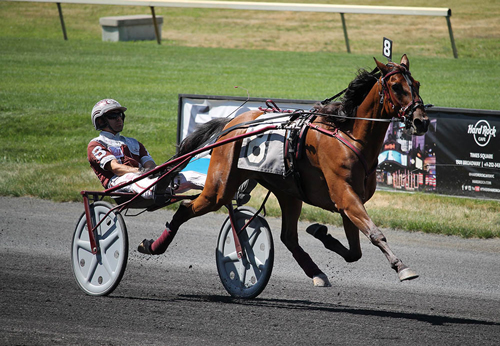
The ongoing partnership between Yonkers Raceway and the French harness racing consortium will take another step forward during Sunday's matinee program at the Westchester, New York, oval when the French-American Trotting Club Series kicks off with a pair of $35,000 divisions going 1 1/4 miles. As part of the usual Sunday agreement, these races will be simulcast to France.
The horses competing in this series were part of an innovative collaboration between the Standardbred Owners Association of New York and LeTrot. Ron Burke, Ray Schnittker, and Mike Lachance went to France back in May to select horses made available by LeTrot for owners here in the United States that had paid fees to participate. After selection and a quarantine period, the horses were dispersed via public lottery to their new connections.
"Everyday it was two hours on the train and an hour and a half on the plane to every corner of France," Lachance recalled about the journey around France to examine and select the horses. "It was a lot of work in a short amount of time."
Some of the horses in the races on Sunday have already made pari-mutuel appearances, while others are coming in off just qualifiers, leading to an intriguing puzzle for handicappers and race-watchers in the first round.
In the first split, pole starter Bioness has beaten non-winners of $3,000 last five and non-winners of $9,500 in last five in 1:55 4/5 at Pocono, while his next-door neighbor Ubanji downed non-winners of $7,000 last five at Harrah's Philadelphia. Alpha D'Urzy (post seven) has also won at Saratoga Harness, beating non-winners of $2,500 last five, non-winners of $3,000 last five and non-winners of $7,500 in last four. Horses that haven't won, like Barry Black (post three) or Uhlan Noir (post four), were competitive against solid horses like former stakes competitor Fashion Creditor at Yonkers and the good mare Misslarose at the Meadowlands.
The second division looks even more wide open, with several horses coming in off just qualifiers and only Akhenation (post three) having visited the winner's circle at Saratoga Harness. Of those qualifying efforts, Ursis Des Caillons, a strong second behind Hambletonian participant Fourth Dimension, and Very Very Fast (2:29 4/5 for 1-1/4 miles), appear to be the standouts.
Lachance noted that figuring out the level of the horses in the United States is something that will come with time, but that there were certain characteristics the group were looking for.
"It's very hard to say the class of the horse until they race," explained Lachance. "The only thing we tried to do, we talked about it the three of us together, and we said we're going to try to get something that's not too hyper, not too hot. The French horses, they have a tendency to get hot, real hot, and hyper. If there was one that was too hot, we would scratch that one right away. We tried to get something that could get around the turns. We sent them around the turns in the training, but training is not a race. Most of them, they were older horses, but when a horse has won a couple hundred thousand in France, he's got to be a little something. He's got to have a little back-class, but it's not like we were buying horses for $100,000. These were all $10,000, $15,000, or $20,000 horses. The most we paid for the horse is $20,000, so there's not one that cost more or one that cost less, they all cost the same.
"There are 22 horses that came down. I'm sure that there's going to be a few that are not good at all, that they don't adapt to the kind of racing. If there's five, six, seven, eight that comes out of it, that's still a good average. Believe me, it's not easy to go France and try to buy horses. Their real good horses, they don't want to sell, they want to keep them."
With owners, trainers, race secretaries, and really everybody involved in the business looking to fill the box and to keep field sizes up, the idea of a new market for possible entrants to come from is intriguing, but Lachance took a wait-and-see approach to France possibly becoming an outlet for trotters like New Zealand and Australia have become for pacers.
"Obviously maybe if something comes out of it, maybe there could be another time," Lachance said about a repeat French excursion. "I would like to wait and see what's going to happen with that first bunch. In France, the only time they get rid of their horses is if they're getting close to 9-years-old, because they can't race anymore at nine or ten. Other than that, they don't want to sell their horses. To go to France to buy a very expensive horse, not too many people have had luck doing that before. It wasn't done that often, but there are not too many people that I can remember in my lifetime that had a lot of luck doing that.
"Something like what we did, if they ever come up with some decent horses, yeah I would possibly be able to do it again, that's for sure, but they're not going to sell their 3- and their 4-year-olds that look like they're promising, or if they sell, they're going to sell it to you for $150,000 or $200,000. Is it worth it to do that? I don't know. I would be skeptical before I would do it."
While more horses coming from France to compete in the future may be up in the air, the ones that are here will be racing in this series throughout the month of August, with a $120,000 final on September 2.