

Watchmaker: Here's hoping for Catholic Boy-Analyze It Round 3
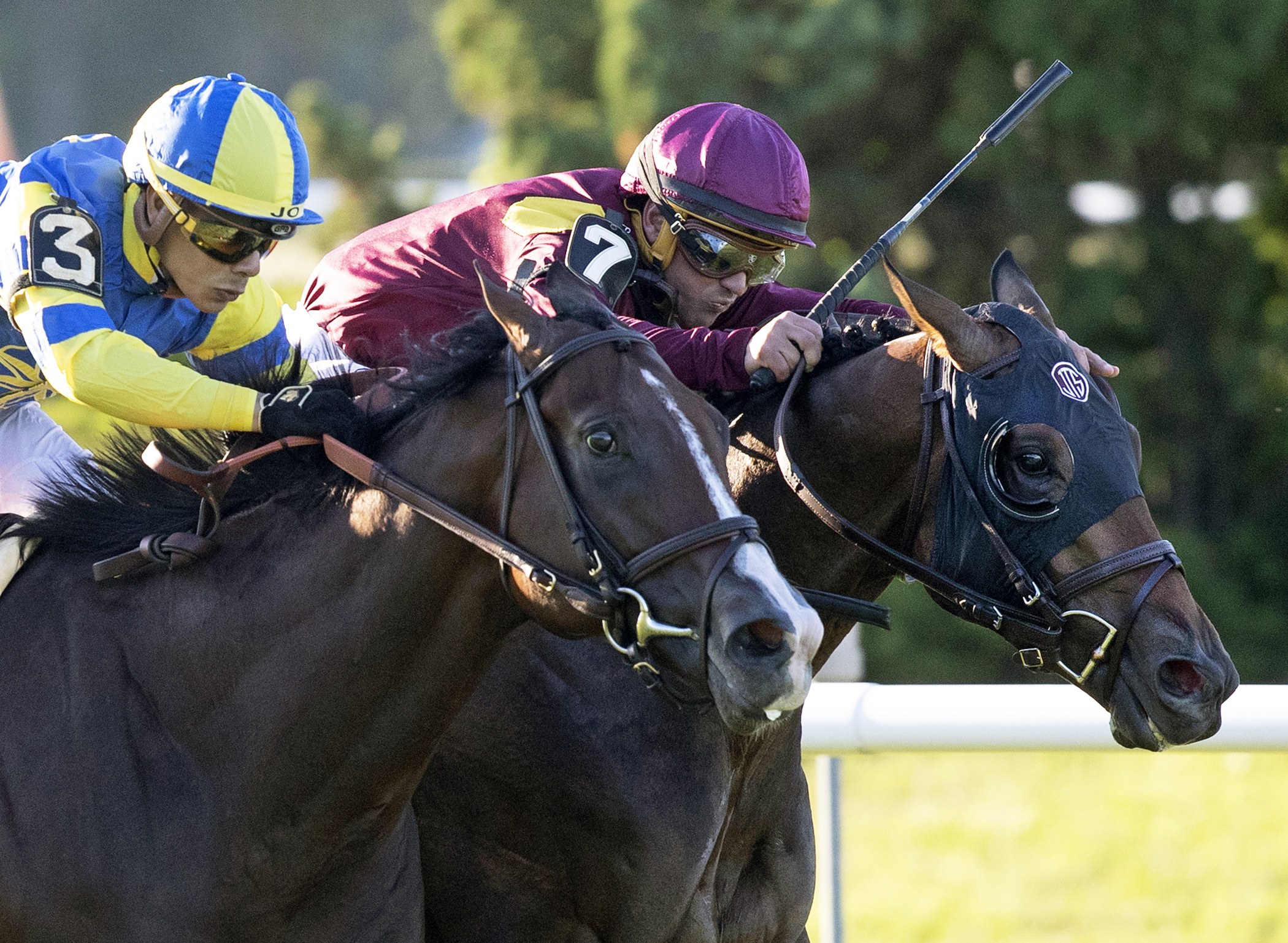
Our game can always benefit from a good rivalry, and we have a potential one budding between Catholic Boy and Analyze It, who threw it down again for a second straight time over the last five weeks in Saturday’s Grade 1 Belmont Derby, the centerpiece of the blockbuster Stars and Stripes card at Belmont Park.
The Belmont Derby was very much a replay of last month’s Pennine Ridge, when Catholic Boy took control of the early pace, Analyze It went by him in the stretch like he was toast, and Catholic Boy courageously came back on to get the money. The only differences this time were Catholic Boy didn’t have to be taken up and angled out because he wasn’t put in tight on the rail like he was in the Pennine Ridge, and his winning margin was a head instead of a neck.
There is no dispute that Catholic Boy and Analyze It are both high-quality colts. Let’s not forget that Catholic Boy also is a major stakes winner on dirt, having dominated the Remsen last fall. And while Analyze It isn’t exactly the unbeatable freak he looked like winning his first three career starts, he’s a fighter, and he proved while narrowly missing going 1 1/4 miles on Saturday that he isn’t quite as distance challenged as it seemed he might be when he couldn’t close the deal in the Pennine Ridge.
However, there is cause for at least some reservation here. If the Belmont Park timer is to be believed – an unfortunate qualifier to employ in the year 2018, but one that certainly applies to more tracks than Belmont – it is then a matter of fact that the final time of the Belmont Derby of 1:59.28 was meaningfully slower than the 1:58.71 fillies of unproven quality went in the Grade 1 Belmont Oaks.
Now, the reason why the final time of the Belmont Derby was slower than the Belmont Oaks was the Belmont Derby’s interior fractions were much slower. The Belmont Derby went 49.20 seconds to the half, 1:13.38 to the three-quarters, and 1:36.75 to the mile as compared to the Belmont Oaks’s corresponding fractions of 48.26, 1:11.97, and 1:35.42. The colts in the Belmont Derby tried late to catch up time-wise, and they did a pretty good job of it, but the time gap in the middle stages of these races was just too large to overcome.
Of course, it must also be noted that the Belmont Derby’s slow interior fractions were a big reason why Catholic Boy and Analyze It went around the track one-two.
In any case, for the Catholic Boy-Analyze It rivalry to truly develop, they have to meet again in upcoming races. And who wouldn’t want to see what might happen if next time Analyze It didn’t just concede the early lead to Catholic Boy and actually took the track from him? The problem is, there are divergent stakes opportunities for these two, such as next month’s Secretariat at Arlington and the Saratoga 3-year-old turf stakes program. But it would be cool if we could keep these two together for a while longer.
Notes:
* Athena, whose European past performance lines were only moderate at best, walloped her field in the Belmont Oaks. It’s pretty clear our 3-year-old turf fillies are, as a group, somewhat limited.
* The Belmont Derby and Oaks might have been the featured events Saturday at Belmont, but, for many, Diversify stole the show with a most impressive score in the Suburban.
It wasn’t about who Diversify beat in the Suburban, because he didn’t beat a lot. It was entirely about how he won. He shot right to the lead, opened up through middle fractions of 46.18, 1:09.65, and 1:34.00, which were very strong for a 1 1/4-mile race even on a Belmont main track that played a bit fast, and he continued to draw away to score by a commanding 6 1/2 lengths. Moreover, Diversify did this racing on or near the inside on a day when all the previous main-track races strongly suggested the inside was not the place to be.
In a sense, it was almost a shame Diversify used this effort on the Suburban, because it was Breeders’ Cup Classic-worthy. Then again, Diversify loves Belmont Park – he won the Grade 1 Jockey Club Gold Cup over the track last fall and now boasts six wins and two seconds from eight career starts over the surface – and for him to run like that in a Breeders’ Cup would probably require a Breeders’ Cup at Belmont, which is a joke, right?
* Firenze Fire also turned in a “wow” performance on the Stars and Stripes program in the Dwyer Stakes. As UAE Derby winner Mendelssohn threw in the towel to finish a badly beaten third, Firenze Fire, in by far the best performance of his career, exploded past his field in upper stretch and ran off to score by nine lengths in a fast 1:33.74 for the mile.
These were not the only notable aspects to the Dwyer. When the Dwyer field began loading into the gate, Firenze Fire’s odds were 6-1. After the start of the race, Firenze Fire’s odds were 5-1. Then, before the first quarter-mile had been completed, Firenze Fire’s odds went from 5-1 to 5-2. He paid $7.50.
Look, I realize out-of-market bets can be posted late, I grasp the power of computer betting, and I realize people only talk about winners whose odds drop after the start of the race and rarely mention the winners whose odds go up after the start of a race. But this particular instance was incredible.
Considering it was a Saturday afternoon at Belmont Park on a card that generated a huge handle, it took a stunning amount of late money to knock Firenze Fire’s odds down to that extent. And then to see him go on and win the way he did, well, without suggesting in any way that anything untoward took place, it’s just not a good look. At all.