

Watchmaker: Dream matchup between American Pharoah and Beholder?
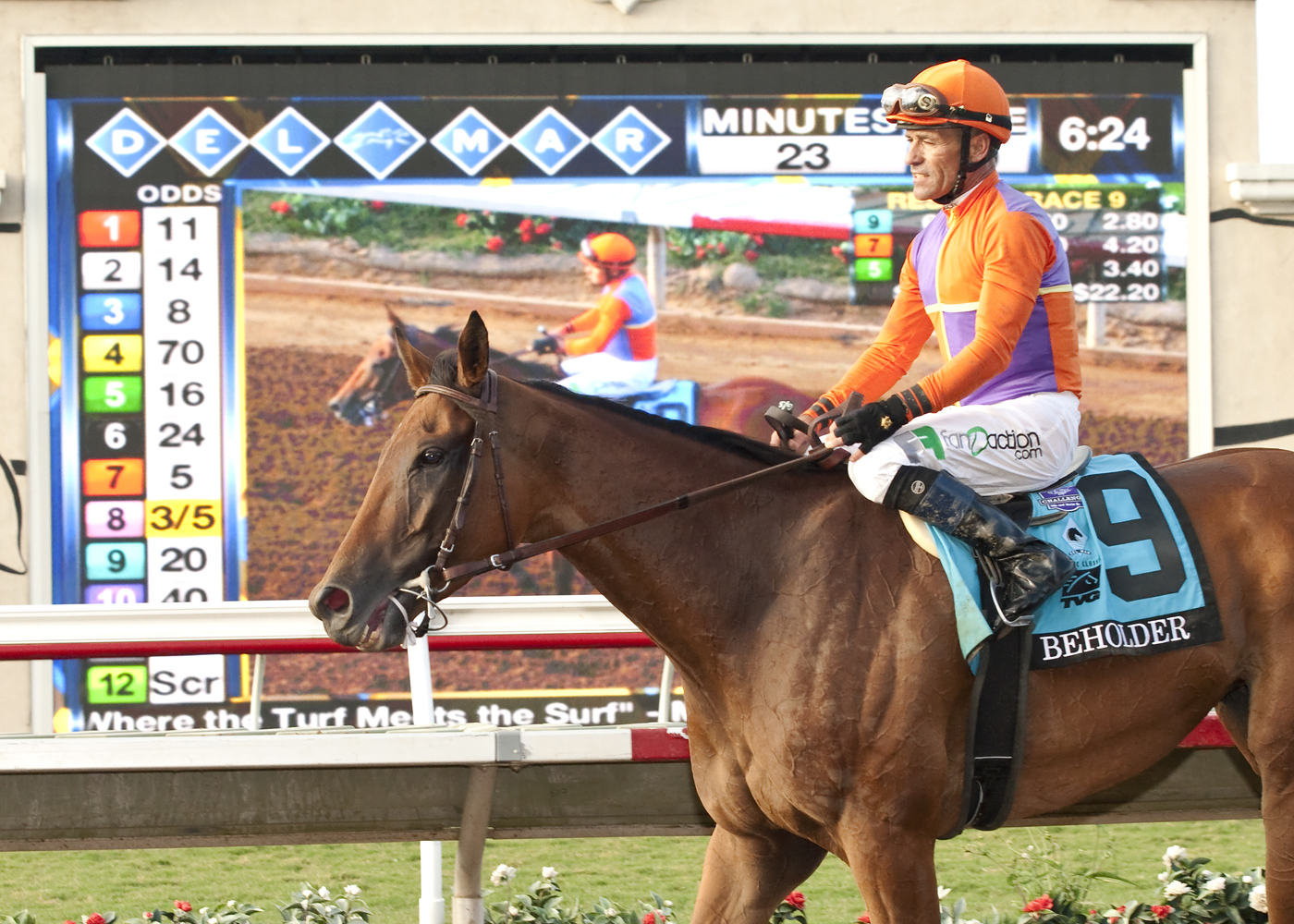
It shows how deeply Triple Crown winner American Pharoah has worked his way into our collective racing consciousness that after Honor Code’s thrilling decision over Liam’s Map in the Whitney a few weeks ago and Beholder’s sensational score over males in Saturday’s Pacific Classic, the most popular topic of discussion from the general racing public was how American Pharoah might have fared against those horses in those races.
And count me among the surprised at how many folks concluded that American Pharoah wouldn’t have fared all that well. It seems like half of the people who land this way note that American Pharoah really hasn’t earned a blockbuster speed figure yet, which is true. But outside of his Kentucky Derby, American Pharoah has barely been asked to run all year. Moreover, as a relatively lightly raced 3-year-old, he certainly still has a license to take a big step forward figure-wise.
The other half of this group appears to base its skepticism on the historical belief that a good older horse will beat a good 3-year-old, even in the fall of the year. I suppose there is some merit to this. But these folks lose me when they invoke two of the most often-used examples to support their argument – Seattle Slew’s victory at 4 over the 3-year-old and fellow Triple Crown winner Affirmed in the 1978 Marlboro Cup and Affirmed’s victory at 4 over the 3-year-old Spectacular Bid, the greatest horse ever to be denied a sweep of the Triple Crown, in the 1979 Jockey Club Gold Cup. And they lose me because they either overlook, or just don’t know, how powerfully pace impacted the outcome of those races.
Seattle Slew won the ’78 Marlboro Cup in front-running fashion by three lengths, completing the 1 1/8 miles in a scorching 1:45 4/5. But that race was absolutely over after only the first quarter-mile. Seattle Slew, loose on an uncontested lead, got off with a first quarter in a syrupy-slow 24 seconds flat. I remember vividly how in his first ride on Seattle Slew, Angel Cordero Jr. was credited with completely undressing every other jockey in that Marlboro Cup. Seriously, what horse – 3-year-old, or older, or with wings – would have been capable of competing with the 4-year-old Seattle Slew after giving him a head start like that?
The ’79 Jockey Cup Gold Cup was Affirmed’s turn to be on the good side of a slow pace. On a fast track, the early fractions in that Gold Cup were 25 flat, 49 flat, and 1:13 1/5, which, even though the Gold Cup was run at 1 ½ miles back then, were glacier-like. Affirmed had an enormous tactical advantage being on that pace and ahead of Spectacular Bid, and, of course, Spectacular Bid could not overcome that disadvantage. As we all know, when you gave a bulldog like Affirmed any edge at all, you were giving him the combination to the safe. But I always thought that all things considered, the fact that Spectacular Bid cut Affirmed’s margin to as close as three-quarters of a length at the wire showed just how tremendous he was.
Not surprisingly, many were dreaming of a potential matchup between Beholder and American Pharoah (and others!) in the Breeders’ Cup Classic after Beholder destroyed her field in the Pacific Classic. But while that would be great, let’s not get ahead of ourselves, if for no other reason than Beholder has a reputation for not being the greatest shipper. So, we’ll have to see how the Breeders’ Cup at Keeneland thing works out for her.
In the meantime, let’s savor what Beholder did Saturday. She was making her first start against males and her first at a distance as far as 1 1/4 miles, and yet she could have easily scored by a double-digit margin but settled on an official 8 1/4 lengths because she was barely being asked. All of this should satisfy even the harshest critic who might be inclined to note that while Beholder beat males, she beat a suspect group of them, including a few who are not true Grade 1 material (Red Vine, Hoppertunity, Hard Aces), and one who is but just looks gone (Bayern).
There is still plenty of season left, but it will take some monumental work in a hurry to deny Beholder another divisional Eclipse Award this year, which would be her third. On the other hand, the very last word might have a big say in the 3-year-old filly division, which remains as clear as mud after Saturday’s Alabama.
It was Embellish the Lace’s name that came up on the turn sheet in the Alabama. Embellish the Lace stopped like she took a lead pipe to the head last time in the Mother Goose in her only other stakes attempt, but she went all the way in the Alabama. I’m a Chatterbox ran okay to be second considering she had no pace to rally into. But running well in defeat doesn’t cut it when it comes to championships, even in this murky division.
I mean, who is your choice for divisional leader? Lovely Maria won the Kentucky Oaks and Ashland but was terrible in the Delaware Oaks and Alabama. Curalina won the Acorn and CCA Oaks on disqualification and had a golden opportunity to make a compelling case for a divisional title Saturday but finished an empty third. I’m a Chatterbox hasn’t even won a Grade 1 race. And Include Betty’s Mother Goose really looks now like a win owed entirely to a favorable pace setup, an issue Embellish the Lace must address going forward.
I’ve said it before, but it bears repeating. Lady Eli might have been a turf specialist, and she might have cruelly been rendered inactive because of a bout with laminitis, but she was the one true special member of her crop. She’s still by far the best 3-year-old filly anyone has seen this year.