

Watchmaker: Assessing the link between BC Juvenile, Kentucky Derby
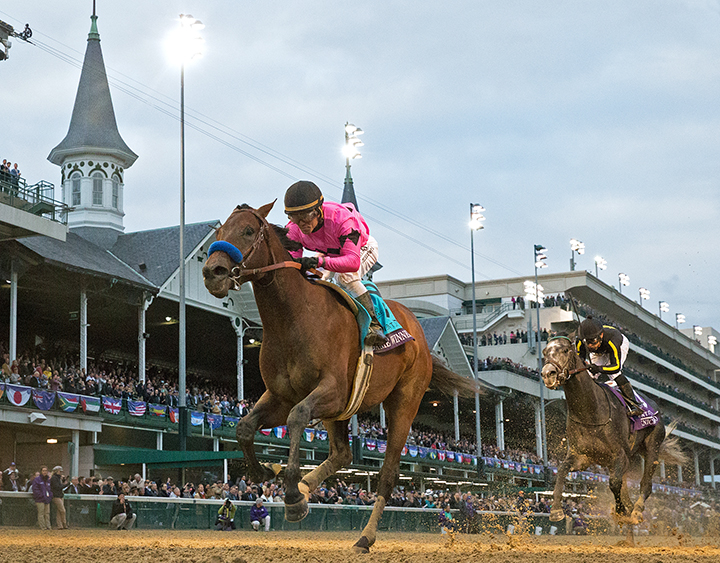
If future-book wagering on the Kentucky Derby in Las Vegas weren’t virtually extinct, you could be certain that the current favorite for the 2019 Derby would be Game Winner.
As well he should be. And yes, that would be the case even after the sensational debut Saturday at Del Mar by Bob Baffert barnmate Coliseum, who delivered a performance that sparked enormous buzz in the American racing community.
Game Winner, of course, won his debut at Del Mar, then won the Grade 1 Del Mar Futurity, followed by a dominating score in the Grade 1 American Pharoah in his first start around two turns, which he clearly relishes, and then wrapped up the 2-year-old male Eclipse Award with his victory in the Breeders’ Cup Juvenile.
To put it another way, Game Winner is the most accomplished member of his generation, and it isn’t even close. So, any set of future odds on the 2019 Kentucky Derby, whether hypothetical or practical, must begin with him. If they don’t, then they aren’t worth your time.
But in a year when we saw a horse in Justify become the first in 136 years to win the Kentucky Derby without having raced at 2, one can be forgiven for thinking that the disconnect between 2-year-old form and success in the Derby is as severe as ever. Is that really true, or was Justify an aberration? I mean an aberration only in terms of breaking a 136-year run, because there was certainly nothing whatsoever fluky about Justify’s Triple Crown sweep.
Game Winner is only the latest Breeders’ Cup Juvenile winner to be (or would be, depending on whether you can find a place to get down early on the Derby if you are so inclined) to be anointed future-book Kentucky Derby favorite. That’s almost an annual given this time of year. But should we be even propagating this particular Juvenile-Derby link? In today’s game, what does the Juvenile even mean when it comes to the Derby?
For answers, I looked at the last 15 runnings of the Kentucky Derby, and specifically the first three finishers, to see how many of them had competed in the Juvenile the previous fall. I thought that was as good a way as any to get a feel for what sort of connection exists between the Juvenile and the Derby. And perhaps most importantly, I hoped to get a handle on how much we should be looking at the Juvenile as a legitimate source of strong Derby contenders, if at all.
Here is what I came up with:
• Of the 45 horses who finished one-two-three in the last 15 Derbies, nine (or 20 percent) previously ran in the Juvenile.
• Three of the last 15 Derby winners (also 20 percent) competed in the Juvenile the previous fall. They were Street Sense, the 2007 Derby winner who also won the 2006 Juvenile; Mine That Bird, the 2009 Derby upsetter who finished 12th and last in the 2008 Juvenile; and Nyquist, the 2016 Derby winner who also won the 2015 Juvenile.
• That means two of the last 15 Derby winners, or 13 percent, also won the Juvenile.
• Two of the last 15 Derbies saw two horses who previously ran in the Juvenile hit the board. Pioneerof the Nile, who finished fifth in the Juvenile, finished second to Mine That Bird in the 2009 Derby. Exaggerator, who finished fourth in the Juvenile, finished second to Nyquist in the 2016 Derby.
• That means seven of the last 15 Kentucky Derbies (47 percent) had horses finish third or better after previously competing in the Breeders’ Cup Juvenile.
As is the case with almost anything in statistics, your conclusion will depend on how you choose to look at the numbers. But I don’t think these numbers are flattering to the Juvenile.
Far more often than not, the Breeders’ Cup Juvenile winner is considered the best of his generation at the conclusion of his 2-year-old year. Indeed, of the 15 runnings of the Juvenile that apply to this Kentucky Derby discussion – the Juveniles from 2003 through 2017 – 11 were won by horses who went on to be voted 2-year-old male champion. Eleven out of 15 translates to a princely strike rate of 73 percent, and that success rate will increase because, as noted, Game Winner is a cinch to be voted divisional champion.
By extension, it is reasonable to conclude that many, if not most, of the other horses who compete in the Juvenile were also pretty good horses considered to also be among the best of their generation, at least at that time.
That said, let’s revisit some of the bullet points above and flip them on their heads:
• Of the 45 horses who ran one-two-three in the last 15 Derbies, 36, or 80 percent, never ran in the Juvenile.
• Twelve of the last 15 Derby winners, or 80 percent, did not run in the Juvenile.
• None of the one-two-three finishers in eight of the last 15 Derbies, or 53 percent, ran in the Juvenile.
Right here, let me stress that I am not implying the Breeders’ Cup Juvenile is some sort of negative key race when it comes to the Kentucky Derby. And let me also state that I am in no way impugning Game Winner, who strikes me as a colt who will love every step of the Derby’s 1 1/4-mile distance.
I am, however, questioning the wisdom of automatically starting every early Derby discussion with the Juvenile winner. And I am also reminding myself, if no one else, that when thoughts turn to the Derby, while you can and should take a look at the Juvenile, it’s more fruitful to look seriously elsewhere.
:: Want to get the latest news with your past performances? Try DRF’s new digital PPs
