

Thoroughbred Owners of California discuss wisdom of four-day weeks for Santa Anita, Del Mar
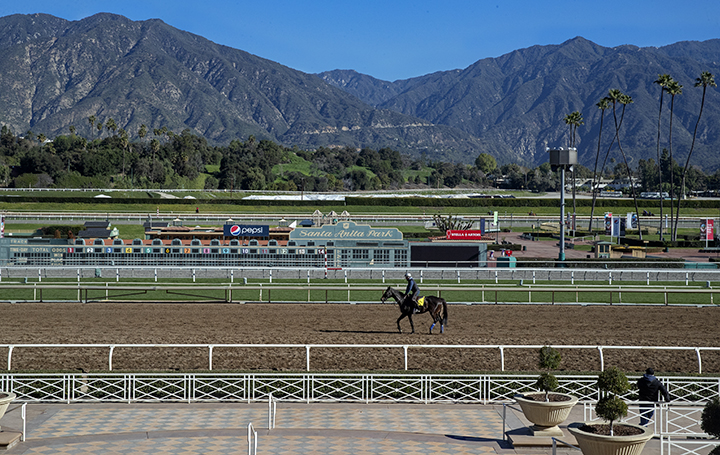
DEL MAR, Calif. - Del Mar and Santa Anita intend to run four days a week during their fall meetings even though the population of Thoroughbreds in Southern California has declined by approximately 24 percent in the last year, racing and track officials said at Saturday’s annual meeting of the Thoroughbred Owners of California.
Executives with the TOC and Del Mar discussed a wide range of topics at the morning meeting, including the series of 30 equine deaths that occurred during racing and training at Santa Anita earlier this year, and expectations for racing in coming months at those tracks.
TOC president and chief executive officer Greg Avioli said his organization’s board of directors met with Santa Anita officials on Friday and that the track plans to run four days on most weeks at the autumn meeting, which begins on Sept. 27 and will include the Breeders’ Cup races on Nov. 1-2.
A similar schedule is planned for the winter-spring meeting, which begins on Dec. 26.
“They’ve stated they want to run four days a week in December,” Avioli said. “We have 2,700 horses, down 650 from a year ago. It’s hard to run four days with 2,700 horses.”
Avioli said Santa Anita officials are considering using the hillside turf course for sprints at the winter-spring meeting. The track announced earlier this week that the hillside turf course will not be used for sprints at the autumn meeting.
Santa Anita largely had a three-day racing schedule during its spring meeting, which ran from mid-April to June 23, cancelling races on nine Thursdays.
Del Mar is running five days a week, but has reduced the number of races on some days. Track president John Rubinstein said at the TOC meeting on Saturday that a four-day schedule is planned for most of the track’s autumn meeting, which begins on Nov. 8. The track had a similar schedule on most weeks at the 2018 autumn meeting.
A large portion of Saturday’s discussion reflected on events earlier this year at Santa Anita. The track lost 14 days of racing in March while the main track underwent a renovation and inspection following a series of equine fatalities in late February and early March.
Saturday, TOC officials were critical of Santa Anita’s maintenance of the main track during a winter with higher-than-normal rainfall.
“We have been working – to be direct – to keep horse racing alive this year,” Avioli said in his introductory comments. “Thirty horses perished for 30 different reasons.
“We all know the track was sealed too many times and unsealed too many times.
“The reality is that we’ve had to change. We’ve been wed to the way we do things. The public has had concerns about horses dying. Our job is to make racing as safe as possible.”
When racing resumed in late March, Santa Anita enacted a series of protocols designed to improve safety, including a reduction in some medications and greater oversight of horses allowed to race and train.
During March when there was no racing, several stables shipped horses to Kentucky which reduced the number of race-ready horses available to compete and contributed to the springtime reduction in racing days.
In June, even tougher restrictions were put in place when Gov. Gavin Newsom called for greater veterinary oversight for racing after several equine deaths in May and June. A five-person panel of stewards and veterinarians was formed to review the racing, medication and training records of horses entered to race. The panel has had the right to reject entries since mid-June.
Some of those rules could be enacted in other jurisdictions, TOC chairman Nick Alexander said.
“We inherited a situation that was really dire,” Alexander said. “The public wanted us to shut down. The governor wanted us to shut down.
“We survived and we’re in a position where the rest of the nation is coming around to the fact California’s rules are pretty good. We continue to fight for a safe racetrack, safe conditions and safe protocols to keep sound horses going to the track.
“What we’re doing is working with the greatest animals in the world. I hope we still retain enthusiasm for owning horses, buying horses and racing horses.
“We’re not going away and I think we’ve made huge strides since the winter.”
Rubinstein, the only track executive at Saturday’s meeting, said greater oversight is part of the sport’s future.
“If racing is to survive and be sustainable, it is with these reforms,” he said. “I don’t think this is a California-only rule.”