

Tech innovations at sales continue
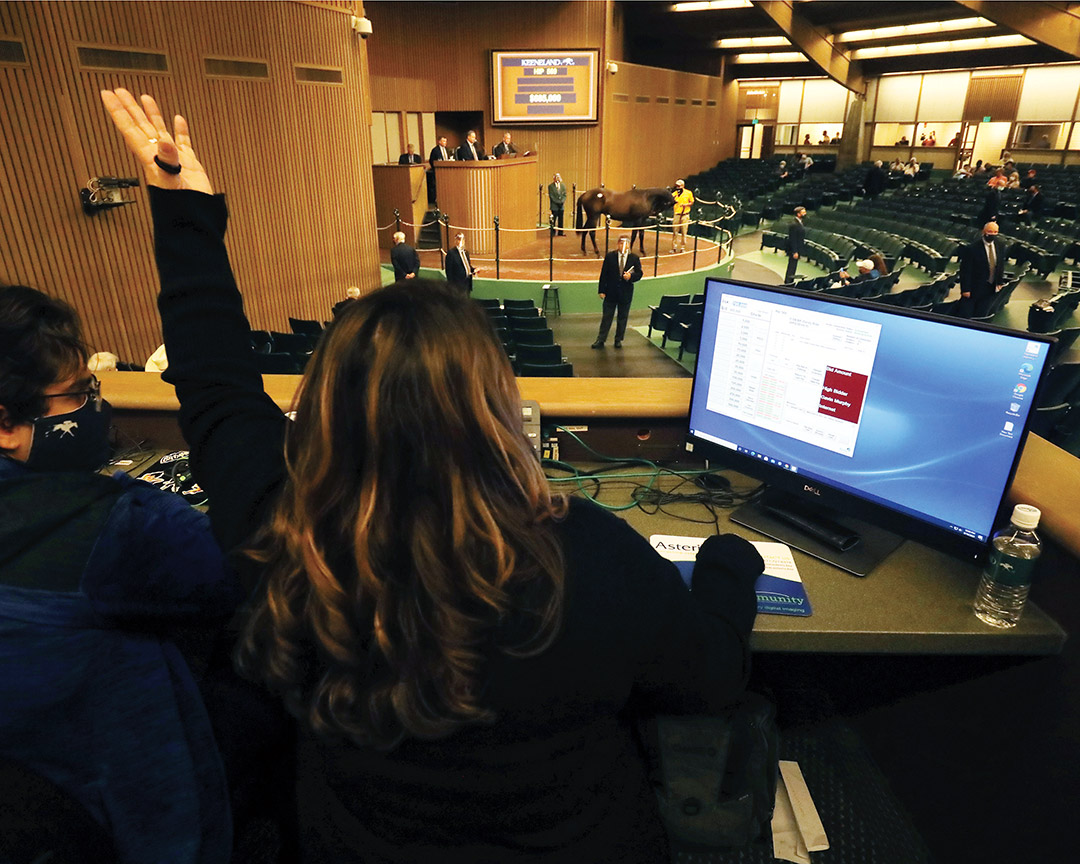
Some virtues were born out of necessity in the pandemic-challenged Thoroughbred sales marketplace in 2020. With limits on travel and attendance for buyers – particularly international buyers – in play, consignors and sales companies worked to fill in the gaps by providing a virtual picture of yearlings to potential buyers via expanded photography, walking videos, and more.
“It forced us to really hone our skills on walking videos and providing information to buyers digitally so they could participate wherever they were in the world,” said Allaire Ryan, director of sales at Lane’s End. “Including veterinarians – the repositories were opened up to have complete digital access from wherever you were. And the online bidding options as well – I think those are all advancements that proved very helpful to us last year. Even though the market was down, it probably would have been down even more had we not kind of had the foresight to say, ‘Okay, we need to make these sales accessible to people somehow.’ I think all those kind of modifications are here to stay, and a good thing to have as something to fall back on.”

Even though sales companies expect to see increased in-person attendance this fall, the expanded online- and phone-bidding options introduced by all three major auction houses – Keene-land, Fasig-Tipton, and the Ocala Breeders’ Sales Co. – last year will also play a role. At last year’s Keeneland September sale, 126 horses were sold via the online platform for grosses of more than $12.1 million, a significant contribution to the tally. The horses sold via the online platform included $825,000 and $750,000 colts to Yuji Hasegawa of Japan, who had a representative on the grounds but did his own bidding remotely. At the Keeneland November breeding stock sale, participation increased, with 279 horses sold for more than $16.2 million. Those were led by Grade 1 winner Ollie’s Candy for $1.65 million to K I Farm of Japan. Officials have noted that mares, as a proven commodity with racing and/or production records that can be quantified, may lend themselves more favorably to online inspection than young horses with only a physical inspection and pedigree page on which to rely.
Tony Lacy, Keeneland’s vice president of sales operations, noted updates to Keeneland’s online catalogs this year to showcase some of these innovations, which be believes will continue to expand.
“Last year, coming from the consignor side, we were sort of focused on Books 1 and 2 to get videos,” he said. “It was a very steep learning curve as far as how these would work, and how we would do them, and how they would be received. It became very apparent, very quickly, that, ‘Wow, we need to do this for all of it.’ As we moved into Book 3, it was like, ‘Well, we can’t stop now.’ We were doing videos of horses in Book 6 – and it became a more streamlined process.
“And now,” he continued, “as you look at the Keeneland website, you’ll find it far more interactive when it comes to the catalog and the visuals. So it’s becoming more a part of the research that people do, and the information people are able to interact with. Those innovations are going to keep evolving as we move forward.”