
Santa Anita stewards dismiss complaint seeking disqualification of Justify
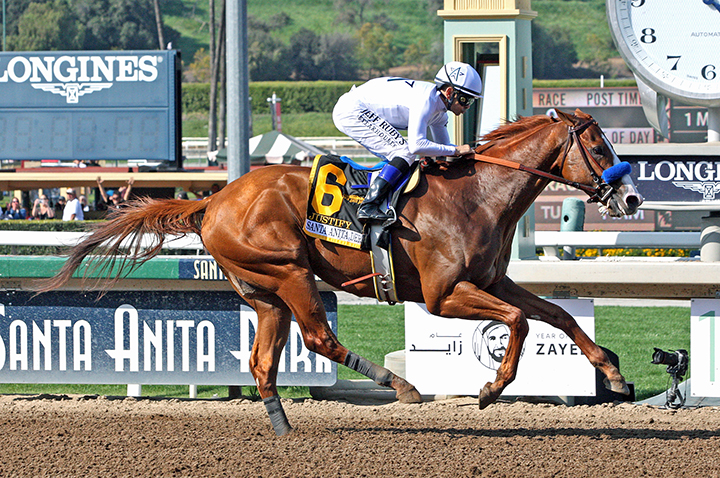
A panel of stewards at Santa Anita in Southern California has dismissed a complaint seeking the disqualification of Justify from the 2018 Santa Anita Derby due to the finding of scopolamine in the horse’s post-race sample, citing the state regulatory agency’s power to consider mitigating circumstances.
The decision by the stewards echoes a decision made in 2018 by officials at the California Horse Racing Board, who declined to file a formal complaint in the case after an investigation determined that the positive test was likely due to environmental contamination and had no bearing on the horse’s performance in the Grade 1 race, which he won by six lengths at odds of 90 cents on the dollar.
The CHRB filed a formal complaint in the case this year after Mick Ruis, the owner-trainer of the runner-up in the race, Bolt d’Oro, reached a settlement with the board on a lawsuit he had filed seeking Justify’s disqualification. The settlement required the board to conduct a hearing in the case.
The order by the stewards lays out a complicated timeline regarding the formal classification of scopolamine at the time of the positive and the CHRB’s delayed intention to downgrade the significance of a positive finding for the drug.
At the time of the Derby, scopolamine was listed as a Class 3 drug – which requires a disqualification under the CHRB’s rules – but the order also details the CHRB’s intention at the time to downgrade the drug to a Class 4, consistent with the recommendation of national regulatory bodies. A positive finding for a Class 4 drug does not require an automatic disqualification.
The order concludes by brushing aside the complications of the classification of scopolamine to assert that the CHRB had the authority to dismiss the case under language allowing for “mitigating circumstances” to determine the board’s course of action.
“Even if this panel were to disagree with the CHRB’s decision to dismiss these matters or the way the CHRB handled the situation, it cannot be argued that the CHRB lacked the authority to do so,” the order stated. “The law specifically allows such actions to take place and the CHRB followed the law.”
The order also affected a positive finding for scopolamine in Hoppertunity, who won the Grade 3 Tokyo City Cup at Santa Anita the same day as the Santa Anita Derby. Both Justify and Hoppertunity were trained by Bob Baffert, the Hall of Fame trainer.
The case received national attention last year when The New York Times published an article asserting that the positive finding was deliberately suppressed by CHRB officials. The article strongly suggested that the CRHB dismissed the finding out of deference to Baffert and the horse, who went on to win the Triple Crown and retire undefeated in six starts.
In a statement provided by his attorney, Baffert said that he was “happy with the decision, most importantly for Justify.”
“He is a great horse and deserves his undefeated record,” Baffert said.
Baffert also referenced the fact that he has had multiple positives for regulated medications this year and has pledged to pay more attention to his barn’s operation.
“As I have said before, 2020 has been a difficult year so I’m happy to put this matter behind me,” Baffert said. “While I’m grateful for the decision, and believe me it was the correct one, it does not alter my commitment to an improved 2021.”
Scopolamine is a problematic substance in horse racing because it is found in jimsomweed, a common contaminant in hay. The substance has psychoactive properties and is among a category of drugs that are prohibited in racing due to its potential to impact a horse’s performance even if there is little reason to administer the substance to a performance animal.
The CHRB formally adopted a rule stipulating that scopolamine should be treated as a Class 4 substance as of Jan. 1, 2019. In late May of this year, Santa Anita stewards issued warnings to four trainers whose horses tested positive for the substance, writing that “contamination was the cause for these positives and warnings were the appropriate penalty.”