

Santa Anita agreement reached, racing resumes Friday
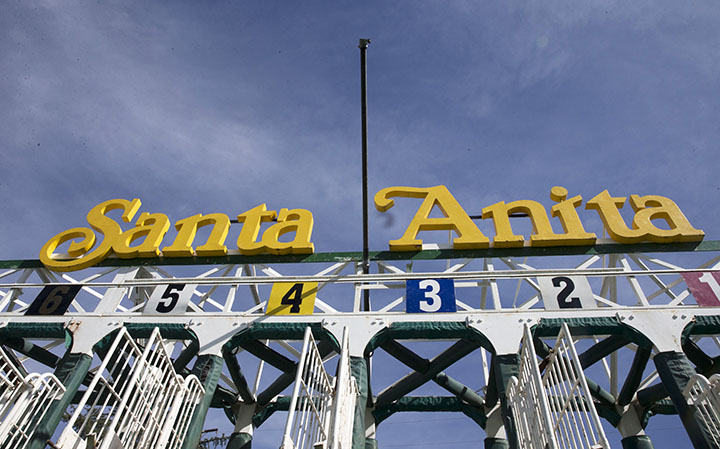
Santa Anita is scheduled to resume racing Friday and a planned introduction of the elimination of Lasix will begin with next year’s crop of 2-year-olds under a deal hammered out by Santa Anita and the Thoroughbred Owners of California on Saturday, according to a source with knowledge of the agreement.
Terms of the deal include the immediate reduction of race-day administration of Lasix from a maximum of 10 CCs to 5.
The agreement was forged 48 hours after Belinda Stronach, the chairman and president of The Stronach Group – which owns Santa Anita – put out an open letter in which she said Lasix would be eliminated at both Santa Anita and another Stronach-owned California track, Golden Gate Fields.
The open letter caught many – ranging from the TOC to trainers to management at other California tracks – off guard, as it came one day after many stakeholders, in a private meeting, had agreed to working toward some of those goals.
Santa Anita has been closed for racing for nearly two weeks after a rash of equine fatalities and a reexamination of the racing surface. As of Saturday morning, the future of racing at the historic track, let alone an opening date, remained uncertain.
“We don’t have a date now, everything’s tentative,” Tim Ritvo, the chief operating officer for The Stronach Group, said Saturday morning.
But behind the scenes, the deal was worked out and agreed on.
TOC and the California Thoroughbred Trainers support the use of Lasix, a diuretic that helps prevent horses from hemorrhaging. Stronach is against race-day Lasix. Belinda Stronach's unilateral declaration on Thursday came hours after the filly Princess Lili B became the 22nd equine fatality at Santa Anita since Dec. 26.
California Horse Racing Board regulations state that an immediate ban on a permissible medication such as Lasix cannot go into effect without TOC consent. The TOC was not willing to accept Stronach's scenario as of midday Saturday. The compromise for the Lasix ban to begin with next year’s 2-year-olds, and to reduce the current permitted dose of Lasix, was forged during negotiations.
TOC president and chief executive officer Greg Avioli was optimistic Saturday morning that a resolution would be reached. “I think this is going to get resolved one of two ways, between now and the first of the week,” Avioli said.
Avioli at that time said a compromise could include a “reasonable phase-out” of Lasix use, which ended up agreed on.
“If The Stronach Group maintains the position of must-be-immediate (Lasix ban), I do not think you will get the support of the TOC or CTT,” Avioli said Saturday morning. “And at that point, it will be an issue for the CHRB to address.”
If TSG and TOC had been unable to reach an agreement, the CHRB could have stepped in. The no-Lasix directive appeared to go against CHRB rule 1581, which states changes in permissible medications such as Lasix must be agreed to by the horsemen’s organization.
If the racing board got involved, it could have sided with TSG and immediately disallowed Lasix at Santa Anita. In that case, racing would continue at Santa Anita, probably with small fields, which Ritvo said the track was prepared to do. Or, the CHRB could have sided with TOC, and the possibility existed that race dates allocated to Santa Anita could be reallocated to other Southern California tracks.
The no-Lasix directive from Stronach, and reluctance by horsemen to support an immediate ban, stalled apparent progress by racing officials to reduce the number of breakdowns.
Santa Anita instituted numerous safety protocols, and as the wet weather has receded the racing surface is now deemed safe. Most agree the use of Lasix is unrelated to the breakdowns, although the timing of the no-Lasix announcement – the afternoon following the 22nd fatal breakdown – suggested that Stronach might believe there is a correlation.
“Everyone has advised her that that’s not the case,” Ritvo said. “Lasix has not contributed to breakdowns. Lasix does not mask pain. I think we all know that. In her mind, she is doing something that’s really good for the horse.”
Avioli said TOC negotiations with TSG were cordial, but acknowledged that the Lasix issue was a lightning rod and most TOC members support the use of Lasix.
In the uncertain environment Saturday morning, horsemen were weighing options. Trainer Jeff Mullins has plans to ship “as many as possible” to Keeneland in the next 10 days. Trainer John Sadler worked two horses that he originally planned to run in Santa Anita stakes.
Sadler-trained Gift Box, an early favorite for the rescheduled Santa Anita Handicap on April 6, worked five furlongs. His turf horse Catapult, aiming for the Grade 1 Frank E. Kilroe on March 30, worked a half-mile.
Sadler said the Big Cap and Kilroe remain the objectives, “with the caveat that if the races do not happen, then one could go to Oaklawn and the other to Keeneland.”
Gift Box could ship to Oaklawn for the Grade 2 Oaklawn Handicap on April 13, while Catapult could be redirected to the Grade 1 Makers Mark on April 12 at Keeneland.
Now that racing appears set to resume Friday, barring another unforeseen interruption, those horses, and numerous others, will not have to make alternative plans.
-- additional reporting by Jay Privman
