

Pandemic impacting juvenile supply chain
Gulfstream Park held North America’s first 2-year-old races of the season in mid-April, a welcome look to the future in the midst of the coronavirus pandemic. However, the immediate future for this division remains uncertain. The pandemic forced the cancellation of Keeneland’s spring meeting, which traditionally opens the 2-year-old season, as well as the final weeks of Aqueduct’s spring meet, which also cards juvenile action. Belmont Park and Churchill Downs have pushed back their upcoming meets; Churchill was to have contested a rich early-season target in the $150,000 Kentucky Juvenile, part of the now-postponed Kentucky Derby week.
Quinoa Tifah and Gatsby, who won the first juvenile races of the season, are both Florida-bred homebreds for Arindel Farm. While farms will continue to proudly unveil their promising homebreds, a number of outfits would typically still be adding juveniles to their barns via public auction at this time of year. However, with a lack of targets on the immediate horizon for this division, some prominent bloodstock agents say that there isn’t as much urgency from their clientele to acquire young stock at this point in time.
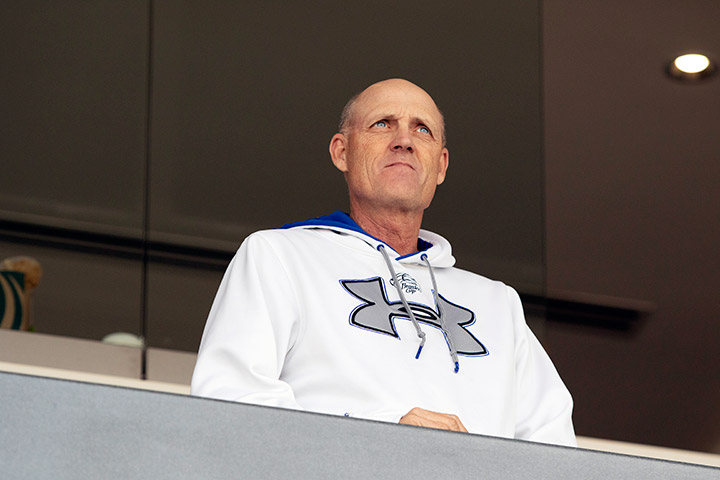
“Most of my owners are kind of chilling. There’s not much going on,” said California-based Dennis O’Neill, who purchased a pair of Kentucky Derby winners at auction as juveniles in I’ll Have Another (2012) and Nyquist (2016). Both were trained by his brother Doug O’Neill for prominent client J. Paul Reddam.
Most Thoroughbred racing in California is at a standstill. Los Alamitos is conducting a Quarter Horse and lower-level Thoroughbred evening meeting, with no 2-year-old races for Thoroughbreds in the current condition book. Thoroughbred meets at Santa Anita and Golden Gate were suspended by county government officials, with the tracks working to create protocols for reopening. Meanwhile, there is no set timetable for a return to racing in two other major jurisdictions, Kentucky and New York, and only limited opportunities in Florida. The next 2-year-old maiden special weight races in the country won’t be contested until May 7 and 8 at Gulfstream; the track also has a pair of maiden-claiming races in the condition book as substitute races earlier in the month.
“Speaking to the various clients that I have, with no real plan of racing ahead, it’s hard to get somebody motivated to go buy something, regardless of how they think it might be priced – even if it’s undervalued,” Kentucky-based bloodstock agent Jacob West said. “Somebody might say, ‘Yeah, I can go buy this horse, but where am I going to run it?’ That’s what’s difficult for everybody – trainers, owners, agents, breeders – with no real plan of what racing is going to look like over the next couple months.”
:: To stay up to date, follow us on: Facebook | Instagram | Twitter
In addition to the lack of urgency in buying created by limited racing opportunities, the pandemic’s economic impact is already creating market restraint. The Ocala Breeders’ Sales Co.’s March sale of 2-year-olds in training, the lone juvenile auction conducted in the U.S. thus far this season, posted understandable declines, with gross receipts dropping 37 percent from 2019, the average price falling 34 percent, and the median down 34 percent. The buyback rate was 40 percent. The sale was topped by a $650,000 American Pharoah filly sold to Japan’s Katsumi Yoshida, and both O’Neill and West landed horses who were among the top 10 prices. O’Neill signed for a $550,000 Constitution colt, and West, as agent for Repole Stable, purchased a $420,000 Frosted colt, leading the multiple purchases made by both bloodstock agents. However, O’Neill – who said he made purchases for Reddam and for William Strauss – said that he found himself shopping for fewer clients.
“I called probably eight or 10 other people, and everyone is very, very scared with everything going on to buy anything,” O’Neill said. “I’ve never seen anything like this. It’s kind of scary.”
Well-regarded juveniles are often targeted for the boutique summer race meetings at Saratoga and Del Mar, both of which card lucrative maiden special weights as well as a robust stakes program for youngsters. Last year’s Breeders’ Cup Juvenile winner and Eclipse Award champion juvenile Storm the Court, a $60,000 OBS April purchase, debuted at Del Mar. Breeders’ Cup Juvenile Turf winner and fellow Eclipse finalist Structor, who fetched a handsome $850,000 at OBS March, won his debut at Saratoga. The third finalist for the award, Godolphin homebred Maxfield, debuted at Churchill Downs in the fall. Meanwhile, all three finalists for the Eclipse 2-year-old filly title – champion British Idiom, Bast, and Sharing – were yearling purchases at public auction and debuted at either Saratoga or Del Mar.
West said that the biggest factor that would prompt clients to begin looking for additional juvenile prospects would be if the New York and California racing authorities could establish dates for the Saratoga and Del Mar meets.
“If we get that before those sales, I think you would definitely see a return back to some sort of normalcy,” West said. “If we get that, I think definitely, you’ll see added confidence and people going in to buy horses. They’re going to have an idea of where they send them out of those sales.”
Both Kentucky Derby winners that Dennis O’Neill scouted out were juvenile auction purchases who competed in stakes company at Del Mar. I’ll Have Another ($35,000 OBS April purchase) finished second in the Grade 2 Best Pal Stakes at Del Mar, and then traveled to Saratoga to run in the Grade 1 Hopeful Stakes. Nyquist ($400,000 Fasig-Tipton Gulfstream purchase), the 2-year-old champion, won the Best Pal and the Grade 1 Del Mar Futurity, among his four stakes wins that season.
“We feel good about Del Mar being in July,” O’Neill said. “The scary part is if they open stuff up too soon, and we spike again, we’ll be in big trouble.”
Even if stables choose to exercise restraint in this year’s 2-year-old market, it doesn’t mean that they won’t have young horses to compete this season. In addition to homebred programs, a number of prominent operations also shop at the upper end of both the yearling and juvenile markets, and thus already have 2-year-olds in their barns. For example, last year’s most expensive juvenile purchased at public auction was the $3.65-million Curlin colt Cezanne, who led the Fasig-Tipton Gulfstream sale when sold to Coolmore interests. Coolmore’s M.V. Magnier went on to purchase a pair of yearlings at the Fasig-Tipton Saratoga selected sale, and then made 10 purchases alone or in partnership at the Keeneland September sale, including four seven-figure colts in various partnerships. Larry Best, who has become a regular high-end buyer at the juvenile auctions in recent years, spent more than $6 million buying yearlings and weanlings to campaign in future years at the Keeneland September and Keeneland November sales. O’Neill and West were both active at Keeneland September, with West’s purchases for prominent clients Robert and Lawana Low led by a $1.2-million Curlin colt.
The Keeneland September topper, of course, was America’s Joy, an $8.2-million American Pharoah filly sold to Mandy Pope’s Whisper Hill Farm. The half-sister to four-time Eclipse Award champion Beholder, Grade 1 winner and leading sire Into Mischief, and globe-trotting Grade 1 winner Mendelssohn is in early training in Florida, but is not expected to race until summer 2020 at the earliest, and Pope has not yet named a racetrack trainer for the filly, the most expensive of her sex ever sold at Keeneland September. Behind the filly, the sale’s next four highest-priced lots were all purchased by Godolphin, led by the $4.1-million Curlin colt Aussie Pride, who is out of New Zealand champion sprinter Bounding. Both Pope, who has amassed a star broodmare band led by champions Groupie Doll, Havre de Grace, and Songbird, and Godolphin are examples of outfits that both cultivate strong homebred programs and buy young stock for their racing stables. On the other side of the coin, Stonestreet Farm, which bred and sold Aussie Pride to Godolphin, splits its homebreds between its racing string and the sales, and also made a pair of purchases at Keeneland September
Meanwhile, the 2-year-old sale calendar, normally bustling in April and May, is scheduled to resume in June with several sales postponed from their original dates. The OBS spring sale, originally scheduled for April, is now scheduled for June 9 to 12, with the company’s traditional June sale pushed back to July 14 to 17. Meanwhile, Fasig-Tipton’s Midlantic sale, normally held in May, is now scheduled for June 29 and 30, and is expected to be a focal point on the calendar. But behind the scenes, some consignors are continuing to try to move stock privately – both to hedge their bets should the sale calendar continue to change as the pandemic evolves, or to reduce overhead on horses who were intended for earlier sales.
“I’ve had people in Ocala reach out to me with horses for sale privately,” said West, who said he plans to continue to scout out young horses in Florida. “That’s happened quite a bit. If something comes along, you can always call somebody.”
O’Neill said he is also getting frequent calls from consignors sending videos and other information to promote their horses privately.
“We’ve done a little bit of [private sales], but not much,” O’Neill said. “The process of the sales is so much safer.”