

Online bidding figures to continue making an impact during November sales
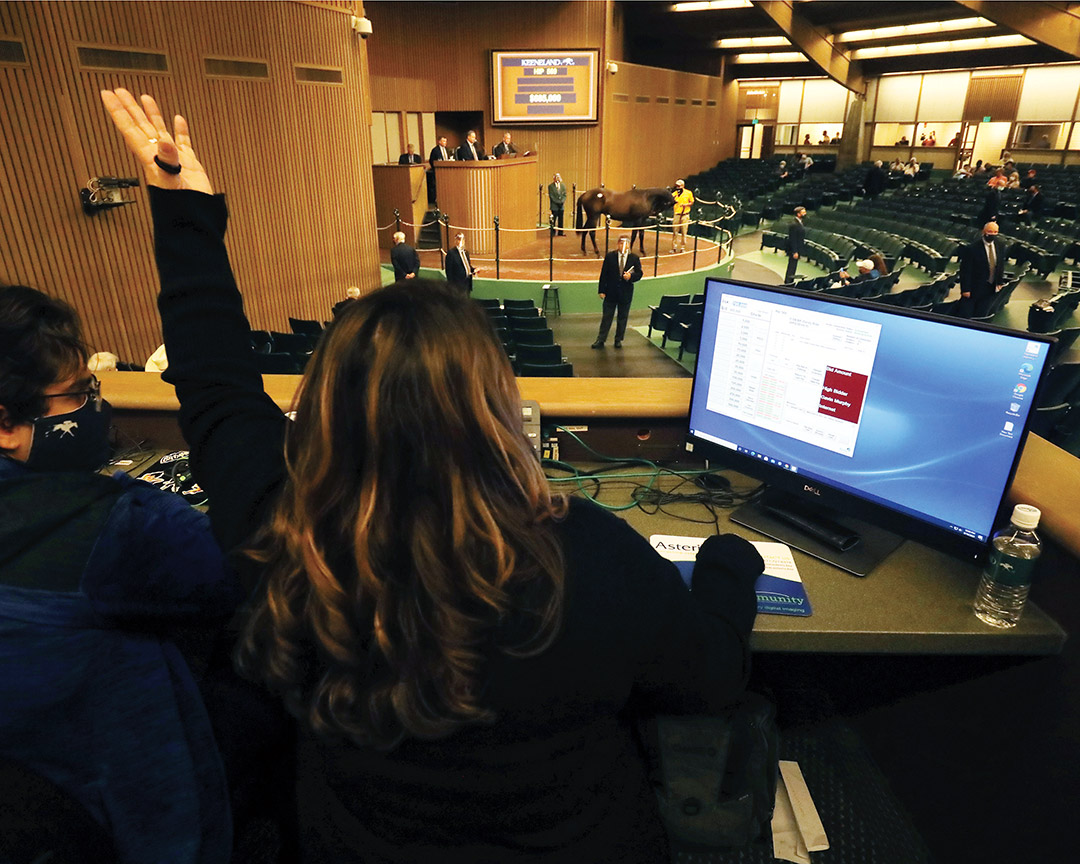
One of the most visible effects of the global coronavirus pandemic on the North American Thoroughbred auction marketplace has been the shift to a largely domestic buying bench. Not only are there travel restrictions and biosecurity protocols in place for international buyers wishing to come to the United States, they may face quarantine mandates or other logistical tangles on the return trip.
North American auction companies have thus worked to provide remote-bidding options throughout this year’s impacted 2-year-old and yearling sale seasons, expanding traditional phone-bidding programs and also integrating newly developed online-bidding platforms into their live auctions. The online outlet played a significant role in the marketplace at the Keeneland September yearling sale, which like the company’s upcoming November breeding stock sale is a multi-session bellwether that typically attracts global buyers at various levels.
There were notable international players missing from the buying bench at the September sale, most notably the Godolphin operation of Dubai ruler Sheikh Mohammed al-Maktoum, which led all buyers at the 2019 sale with 10 purchases for $16 million. Coolmore, another of the major international entities that typically dominates the leaderboard, spent $3,615,000, compared to $7.8 million last year.
While that void in gross sales could not totally be filled, Keeneland’s new online platform stepped up with success, as Keeneland reported 126 horses were sold via the platform for grosses of more than $12.1 million, a significant amount. The horses sold online included pricey $825,000 and $750,000 colts to Yuji Hasegawa of Japan, who had a representative on the grounds but did his own bidding remotely during Book 1. Although Korean interests were not as active during the sale as in a typical year – last year, the Korea Racing Authority bought 15 horses – two yearlings did sell to those interests via online and phone participation.
“The mechanics really worked, the mechanics of the internet bidding,” said Shannon Arvin, Keeneland’s president-elect and interim director of sales. “We spent a lot of time practicing and preparing for that, so it was really great that it worked out as we hoped and expected that it would.”
While Fasig-Tipton did not report statistics on the number of horses sold online at its Kentucky selected yearling showcase in September, company president Boyd Browning Jr. said “a number” of horses changed hands via the online platform.
“There was certainly participation,” Browning said. “It wasn’t like every other horse [sold online] by any stretch of the imagination. . . . But I think when we started this process, my goal was to be able to lay my head down tonight and say we tried everything amongst our own organization, everything that we can.”
The online bidding platform and other remote buying options may see even more activity in November. With so many broodmares and broodmare prospects on offer, including several Eclipse Award champions and Breeders’ Cup candidates, top-flight international interests often look to bolster their programs. At last year’s Keeneland November sale, two of the top three lots were sold to Japanese interests, while Fasig-Tipton November’s second-highest price joined them. In the middle and lower levels of the marketplace, other entities look for mares to support their new stallions. Extremely active in the second week of the Keeneland November auction last year were interests from Korea and Turkey, which has been bullish in the stallion market.