

OBS restarts 2020 juvenile sales marketplace
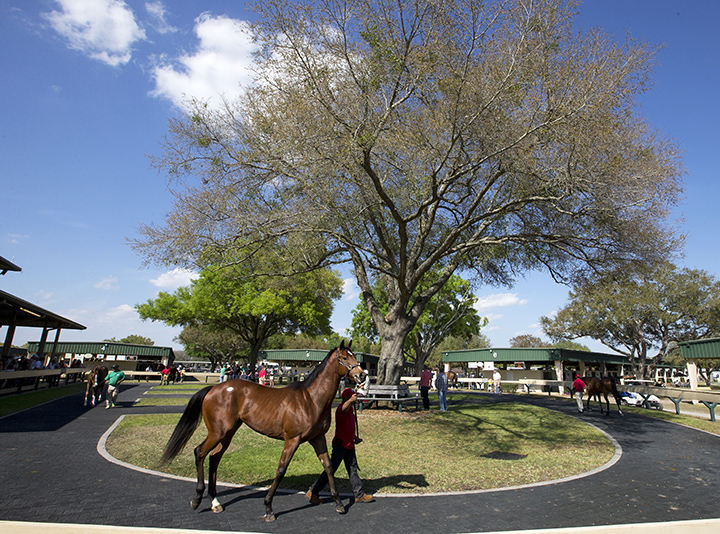
The Ocala Breeders’ Sales Co. annually has the unenviable pole position for the 2-year-old sale season in North America, tasked with establishing market momentum. But in this season like no other, the Florida auction house faces this task not once, but twice, and in daunting economic circumstances.
The juvenile sales season, which has been upended by the global COVID-19 crisis, essentially relaunches with the OBS spring sale of 2-year-olds in training, which begins June 9. OBS began the first take of the season with its March sale, for which the breeze show was already under way as the pandemic escalated, causing cancellations and postponements to begin to pour in around the Thoroughbred racing and bloodstock industry. The market was expected to show restraint due to the evolving pandemic, with the stock market dropping sharply. The two-day sale, which was led by a $650,000 American Pharoah filly, finished with a 37 percent drop in gross receipts compared to 2019, a 34 percent decline in average price, and a 38 percent decline in the median. The buyback rate was 40 percent, compared to 24 percent.
For additional context, the OBS March sale would have been fighting an uphill battle to maintain its strong 2019 figures even before the pandemic; last year’s renewal of the sale was topped by Chestertown, who sold for a sale-record $2 million. Still, buyers showed restraint. Prominent bloodstock agent Dennis O’Neill, who has purchased two Kentucky Derby winners as juveniles, said he only made purchases for Reddam Racing and William Strauss at the March auction, finding himself shopping for far fewer clients than usual.
“I called probably eight or 10 other people, and everyone is very, very scared with everything going on to buy anything,” O’Neill said. “I’ve never seen anything like this. It’s kind of scary.”
The sales calendar was wiped clean for April and May. It now resumes with the OBS spring sale from June 9-12, with an under-tack preview show Sunday to Saturday on the Ocala Training Center’s all-weather Safetrack surface. This sale had originally been scheduled for April 21-24. As a result of its postponement, the OBS June sale, slated for the end of the month, also has been pushed back, to July 14-17.
“We need to balance a sense of social responsibility with providing our consignors the best opportunity to market their horses and give buyers the best place to obtain them,” OBS director of sales Tod Wojciechowski said.
The upcoming OBS spring sale is considered the company’s flagship sale and is something of a bellwether for the national marketplace. The sale typically offers the largest catalog of the season and is seen as a marketplace with a broad spectrum of horses for buyers at all levels. Last year, the sale was led by three seven-figure horses – a $1.3 million Into Mischief colt, a $1.2 million Liam’s Map colt, and a $1 million Quality Road filly.
With limited opportunities in the juvenile sales market this year – counting horses of racing age sales, there will be five total auctions in the marketplace in 2020, compared to eight in 2019 – sellers will be eager to move horses, rather than potentially being stuck with continued overhead until they can negotiate private sales. The Kentucky-based Brilliant Racing partnership expects OBS spring to be a buyers’ market.
“In this depressed market, there is a real opportunity to acquire nice prospects at a bargain price,” the partnership wrote on its social media channels.
However, with the racing calendar for the summer still developing, some bloodstock agents say there wasn’t as much urgency from their clients to acquire young stock in the spring. Well-regarded juveniles are often targeted for the boutique summer race meetings at Saratoga and Del Mar, both of which card lucrative maiden special weights as well as a robust stakes program for the division. Racing in those jurisdictions has resumed, with Santa Anita back in action and Belmont scheduled to open Wednesday. Del Mar announced Thursday that its summer meet would open July 10, in what seems fortuitous timing for the June sales.
Bloodstock agent Jacob West said that a finalized summer calendar is a major factor that could prompt buyer enthusiasm for the juvenile sales.
“If we get that before those sales, I think you would definitely see a return back to some sort of normalcy,” West said prior to Del Mar’s announcement. “If we get that, I think definitely, you’ll see added confidence and people going in to buy horses. They’re going to have an idea of where they send them out of those sales.”
In accordance with local guidelines, OBS is encouraging those visiting the breeze show and sale grounds during the spring sale to wear protective face coverings to stymie the spread of pathogens and will require its employees to wear masks. The sale company, as it did for the March sale, will frequently sanitize surfaces in and around the sale pavilion and will leave open doors that do not need to be locked for security in order to reduce the need for patrons to touch the handles.
Consignors also have begun to navigate the new normal by establishing their own biosecurity protocols around their barns.
Woodford Thoroughbreds, which bred champion Midnight Bisou and sold her at the 2017 OBS spring sale, has 26 horses cataloged for this year’s renewal. Consignment employees will have their temperature checked each morning, will be provided daily with a mask and gloves, and will have equipment assigned to them to reduce touch points. Buyers shopping at the consignment will not fill out a hip card of horses to view, but will instead be met by a Woodford employee who will fill out the card, limiting additional touch points. The consignment also will be managed to ensure social distancing while waiting for and viewing horses.
“The 2-year-old in training sales are a critical piece to the sale cycle of the Thoroughbred industry in the United States,” Woodford director of sales Beth Bayer said. “We have full confidence in the preparation that went into our horses and expect them to perform well. Woodford Thoroughbreds understands in order for the sale to be a success, we must do our part by providing additional hygiene and social-distancing precautions for potential buyers as well as employees.”
For buyers unable or unwilling to physically attend its sales, OBS has expanded its phone-bidding program and also will offer an online bidding platform, in keeping with an international trend, as global auction houses have begun to explore the options. In April in Australia, Inglis conducted its flagship Easter yearling sale solely with online and telephone bidding. The sale recorded solid results as it was keenly watched by the global bloodstock community, with a $1.8 million Snitzel colt becoming the highest-priced horse ever sold in an online auction.
Fasig-Tipton announced that it will have online bidding in place for its Midlantic juvenile auction.
“The addition of online bidding to our live auctions is a service we are pleased to offer,” Fasig-Tipton president Boyd Browning said. “At no other time has this service been more crucial or needed. As we all work to conduct business in the current COVID-19 environment of adjusted social norms, online bidding ensures the best possible marketplace for our buyers and sellers in 2020. Looking beyond 2020, we envision this service being an integral component of all future auctions."
In late May, Keeneland, which cancelled its April sale of 2-year-olds in training sale along with its popular spring race meeting due to the pandemic, announced the launch of its Digital Sales Ring. The company will debut the platform with a digital-only sale of selected horses of all ages on June 23, a sale likely to include some juvenile prospects in the horses of racing age.
Keeneland said in a release that the company had been working on the Digital Sales Ring prior to the spread of the COVID-19 virus, but that its efforts were “expedited” beginning in March when it became clear that the pandemic would have long-lasting impacts. The platform is similar to one used by Magic Millions in Australia earlier this year, Keeneland said, and was developed with Horseco, a Kentucky technology company.
“We received positive and constructive feedback after presenting the platform to a focus group of buyers and consignors in early May,” Bob Elliston, Keeneland's vice president of racing and sales, said. “Their input informed the final product that we are making available to the public.”
Meanwhile, two independent online auction companies are making forays into the U.S. Thoroughbred market and could attract some juveniles, particularly those from regional or statebred programs that could be lost in the shuffle of major physical sales. The online platforms also lessen shipping and employment expenses for consignors, perhaps providing relief to smaller operations that will be hard hit by the economic fallout of the coronavirus crisis. ThoroughbredAuctions.com, which held a series of dispersal sales last year, is conducting a digital spring mixed sale in late May, the company’s biggest foray yet into the Thoroughbred bloodstock market. Meanwhile, BloodstockAuction.com, an independent company that was the first online-only Thoroughbred sale in Australia, has arrived in the U.S. market and is currently taking entries for a June sale.
“Ready or not, the way you sell and buy is changing,” Tim Jennings of ThoroughbredAuctions.com said in a press release. “Sales moved to the internet in the show horse industry following the 2008 recession. The Thoroughbred industry has lagged behind until now.”
--additional reporting by Matt Hegarty