

NYRA witnesses claim Baffert adversely affected business
A number of witnesses called by the New York Racing Association in its hearing to consider a ban of Hall of Fame trainer Bob Baffert implied during testimony on Wednesday that the controversy surrounding the trainer threatened their business prospects, despite, as Baffert’s lawyers pointed out, recent wagering records at the association’s tracks.
The witnesses called by NYRA lawyers on the third day of the hearing included vice presidents of the association’s on-line wagering operation, NYRA Bets, and its marketing department. Both provided testimony on Wednesday asserting that customers of NYRA Bets and its bricks-and-mortar tracks had signaled that Baffert’s continued participation at NYRA’s tracks had the potential to cost the association business.
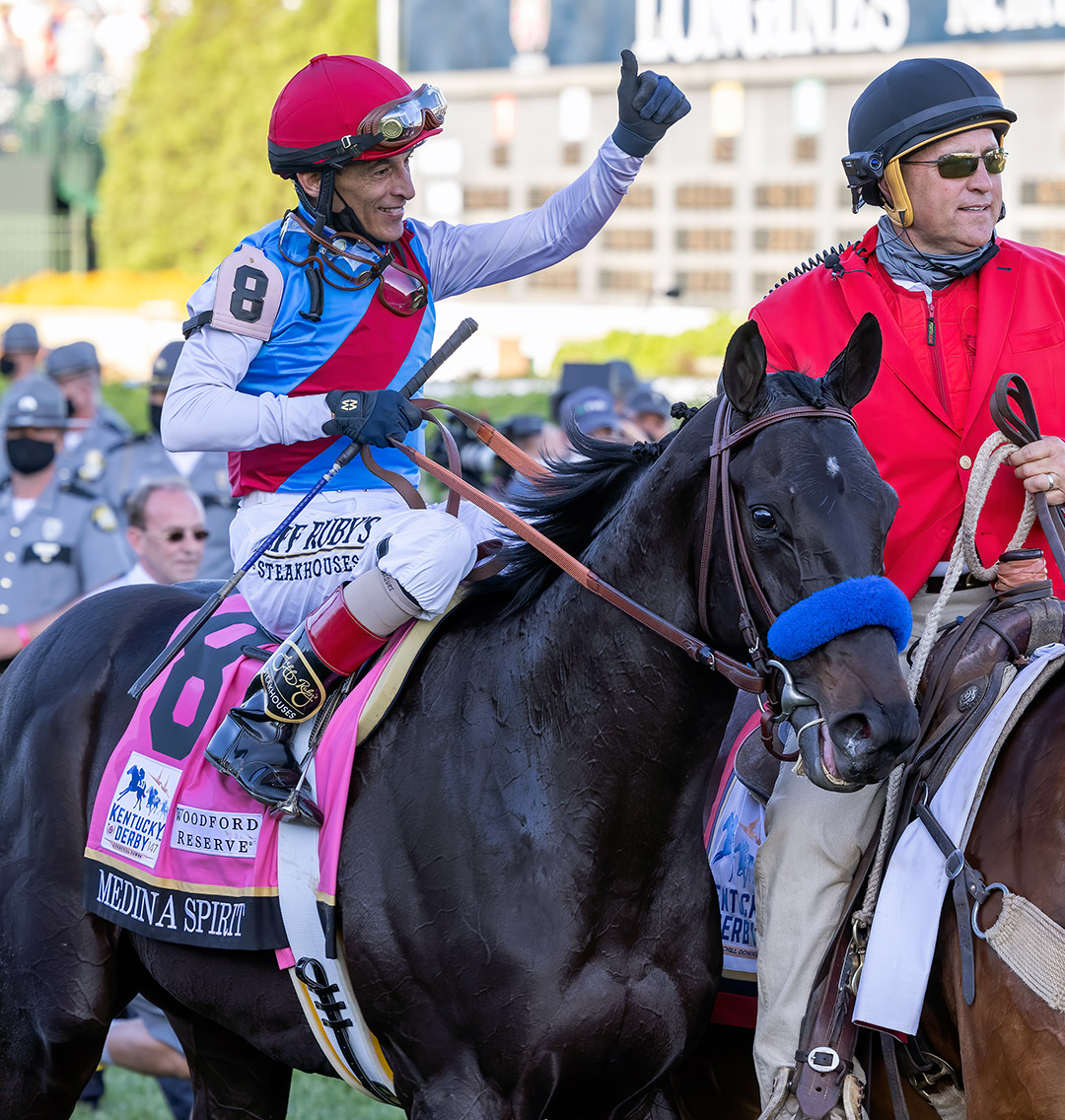
Donald Scott, the vice president of marketing for NYRA and NYRA Bets, said that the association’s marketing metrics had begun signaling widespread discontent with Baffert on May 9, when the trainer acknowledged that his Kentucky Derby winner, Medina Spirit, had tested positive for the regulated corticosteroid betamethasone, an anti-inflammatory, after the race. The feedback intensified the next day, Scott said, after Baffert began appearing on several news programs to discuss the positive.
“It was one of those stories where as it started to spread it really started to worry me, because it had to do with an incident in the racing industry that a lot of people probably thought would never happen, especially in the Kentucky Derby,” Scott said. “It threatened all the brand equity I had been communicating and financially investing in to say [to our customers], ‘We are the leader, you can trust in us.’ ”
The testimony from Scott and Matthew Feig, the general manager of NYRA Bets, was used by NYRA’s attorneys to bolster the association’s case in front of O. Peter Sherwood, a former New York State Supreme Court Justice who was selected by NYRA to act as the hearing officer in the case. NYRA has said that the controversy surrounding Medina Spirit and six medication violations for Baffert horses during a 14-month span from 2019 to 2020 justifies a ban because it represents “conduct detrimental to racing.”
NYRA passed protocols to hold internal hearings for licensees this fall, after a federal judge in New York, Carol Bagley Amon, ruled that a ban of Baffert issued by the association shortly after the Derby violated the trainer’s due-process rights. The judge has sanctioned the right for NYRA to hold the hearing in rulings issued as recently as Friday, but her latest ruling also said that Baffert would have an opportunity for judicial review at the state level based on the conduct of the hearing and any potential ban.
During cross-examinations of the NYRA executives, attorneys for Baffert attempted to undermine the claims that Baffert represented an existential threat to the business of the association, pointing out that wagering at Saratoga Race Course this year set a record – despite the fact that Baffert ran a handful of horses during the meet after the judge had struck down NYRA’s earlier ban.
Earlier in the day, NYRA’s attorneys called two other employees of the association, its director of equine safety, Anthony Patricola, and its director of veterinary practices, Anthony Verderosa, to further solidify the association’s contention that the improper use of regulated therapeutic medications represented a threat to the safety of horses and jockeys. Of the six Baffert violations NYRA has cited during the hearing, all were for regulated medications that have therapeutic uses.
Patricola and Verderosa both said that certain therapeutic medications, like phenylbutazone, betamethoasone, and lidocaine, can interfere with examinations that are used to determine whether horses are sound to race. But both also said under cross-examination that they had never encountered a problem with Baffert’s horses when he raced horses in New York, nor had they seen any of his horses suffer an injury at a New York track.
When cross-examining Verderosa, who is the director of NYRA’s veterinary department, Baffert attorney Clark Brewster asked a series of questions designed to demonstrate that if a trainer did attempt to use therapeutic medications to mask an injury, that medication would turn up in post-race tests.
“If [a] trainer has done something to mask an injury that’s going to fool you, he’s going to be held accountable, is that true?” Brewster asked.
“Yes,” Verderosa said.
After Brewster asked Verderosa if he had ever seen Baffert do something improper with a horse, and Verderosa answered “no,” Brewster asked him whether he would it feel it was “appropriate” to report anything improper to the racing commission.
“I would feel compelled to,” Verderosa said.
NYRA rested its case just prior to the lunch break. After lunch, Baffert’s attorneys called two Hall of Fame jockeys, Mike Smith and John Velazquez, to the stand. Both praised Baffert for his horsemanship and his honesty, and both said that they did not feel “concerned for their safety” when riding his horses, nor did they consider him a “threat to the health, safety, and welfare of horses and jockeys.”
“We ride horses for a living,” Velazquez said. “We have to trust the people we ride for.”
Answering a question from Baffert attorney Craig Robertson about what he would tell young riders about Bob Baffert, Smith said: “That they would be very blessed to get an opportunity to ride for him, that they can learn a lot from him, not just on race-riding but about how to be a horseman.” Smith was the rider of Justify, a Baffert-trained horse who won the Triple Crown in 2018.
Greenberg, treading gingerly during his cross-examination given the amount of respect the two riders have within the racing community, focused in on Velazquez’s rides on Medina Spirit in last year’s Kentucky Derby and on Gamine in the 2020 Kentucky Oaks. Gamine, trained by Baffert, was disqualified from third in the Oaks after testing positive for betamethasone, the same medication that turned up in Medina Spirit.
In that case, Baffert conceded that he had legally treated the horse with betamethasone 18 days prior to the race, outside of the 14-day guideline. He accepted a fine but was not suspended.
Greenberg asked Velazquez what he remembered about the positive, and the jockey said that Baffert had told him that he had treated the horse “in plenty of time but still got the positive.”
“How did you feel?” Greenberg said.
“I was disappointed, absolutely, yeah,” Velazquez said.
The hearing ended on a bizarre and chaotic note when Brewster called Steve Lewandowski, a former state steward, to the stand, in an attempt to get testimony from a state racing official to vouch for Baffert. Lewandowski said that he “never, never, ever had any problems” with Baffert in his years in the stewards’ stand.
On cross, Greenberg challenged Lewandowski’s recollection of his interactions with Baffert, pursuing a line of questions related to the running of the 2018 Belmont Stakes, when there were allegations from an owner of a horse in the race that Justify’s stablemate ran interference for the horse. The questioning was intended to go to the credibility of the witness, and after Lewandowski seemingly contradicted himself on the stand, Greenberg was then allowed to pursue questions relating to Lewandowski’s public support for Rick Dutrow, a trainer who a decade ago was banned for 10 years and fined $50,000 by the New York racing commission for “conduct detrimental to racing.”
Lewandowski then went on an unchecked, animated rant for several minutes from the witness stand, in which he accused Greenberg of calling him a liar.
After the episode ended, Brewster requested a brief re-direct of Lewandowski.
“In all the times when Rick Dutrow was running up violations, did NYRA ever attempt to suspend him?” Brewster asked.
“No,” Lewandowski said.