

NYRA hearing on Baffert concludes first day
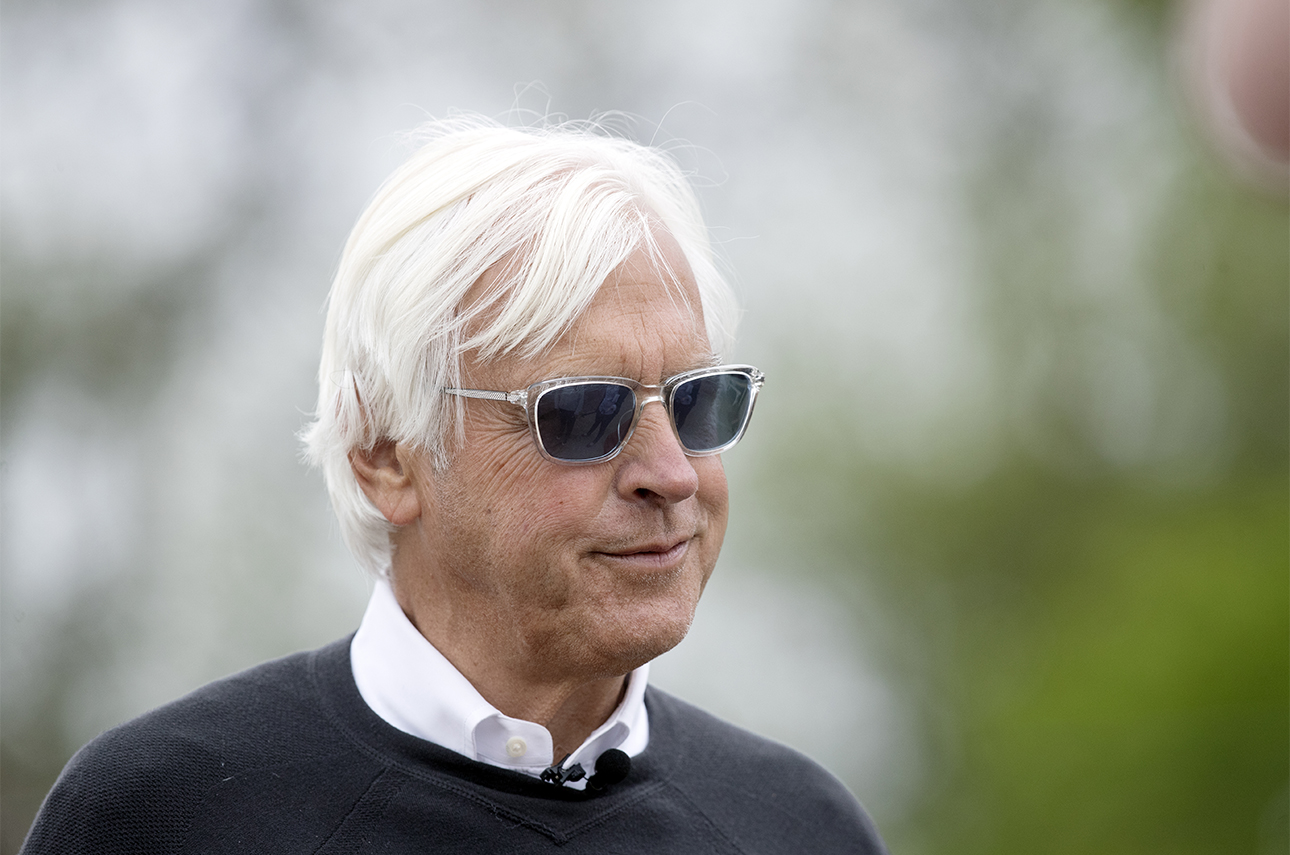
A hearing called by the New York Racing Association to consider a ban of a Hall of Fame trainer Bob Baffert began on Monday with opening statements from attorneys for both sides and testimony from the day's single witness.
Speaking directly to the hearing officer, an attorney for NYRA contended that a spate of positives for regulated medications in horses trained by Baffert during a 16-month period in 2019 to 2020 provided ample justifications for a ban by the association, especially in light of Baffert’s public statements that he did not bear responsibility for the violations. Invoking the concept of “social license,” the attorney, Hank Greenberg, said that it was NYRA’s “responsibility” to ban licensees that have threatened that compact.
“What happens if those institutions [like NYRA] do not use their very best effort, everything in their power, to protect the safety of animals, in this case, horses?” Greenberg said. “What happens is what happened to greyhound racing, which you no longer see. What happens is what happened to circuses, where there were lion tamers. They don’t exist anymore.”
Craig Robertson, an attorney for Baffert, countered in his opening statement that NYRA’s attempt to ban Baffert was “unprecedented,” arguing that NYRA has allowed trainers with violations exceeding Baffert’s to race at its tracks without any ban. Robertson also contended that board members of NYRA who own horses that race at NYRA’s tracks had a “personal vendetta” against Baffert and were attempting to eliminate competition from Baffert-trained horses.
Robertson also pointed out that the violations cited by Greenberg had been adjudicated by the state racing commissions in those states, and that Baffert had not served any suspensions due to the violations.
“Now NYRA comes here and they want to step outside of that regulatory framework, and they want to relitigate the matters that occurred in California, Arkansas, and Kentucky,” Robertson said. “They want to cast all that aside and impose their own suspension. It’s inappropriate and it’s unlawful.”
The hearing into considering the suspension of Baffert is expected to last at least three days and possibly stretch into next week. NYRA put in place protocols to conduct internal hearings considering punishments of licensees after a federal court ruled last year that an earlier ban announced by NYRA violated Baffert’s due-process rights.
NYRA put the first ban in place after Baffert acknowledged that a horse he trained, Medina Spirit, tested positive for a prohibited amount of betamethasone, a regulated corticosteroid, after winning last year’s Kentucky Derby. The case has not yet been adjudicated. Baffert and his attorneys have said that the positive arose from the use of an ointment containing betamethasone to treat a skin condition, rather than through the injection of a joint, the most common use of betamethasone in horses.
Greenberg told the hearing officer, O. Peter Sherwood, a retired New York State Supreme Court justice, that NYRA was following in the lead of Churchill Downs, which issued a two-year ban of Baffert after the positive was confirmed by Kentucky regulators. Churchill Downs is a private company that has broader exclusionary rights than NYRA, which is heavily regulated by the state and has been ruled to be a “state actor” by judges.
But Greenberg said that Baffert’s behavior following his acknowledgment of the Derby positive caused significant damage to the perception of the sport, pointing to interviews that Baffert gave to national media outlets calling into question the integrity of the sport’s regulation. Baffert later acknowledged that Medina Spirit was treated with the ointment.
“Does he accept responsibility for his actions?” Greenberg said. “No. Instead, he trashes everyone he can think of. He trashes regulators, he trashes the media, he attacks everyone and everything, and he says he has no idea how this could happen. … The damage that was done to Thoroughbred racing on those two days was incalculable.”
In his own opening statement, Robertson said that Greenberg was misrepresenting the facts of the cases that had been adjudicated, and asked the judge to consider the case in the light of the records of other trainers who race at NYRA tracks. Robertson also pointed out that Baffert has never been found to violate a New York racing rule in 30 years of running horses at New York tracks.
“There are numerous trainers, numerous, who have medication records far worse than Mr. Baffert’s, and those trainers have been found guilty of violating New York racing rules, and NYRA welcomes them with open arms,” Robertson said. “What they are doing here, again, is truly unprecedented. … I am not asking that you treat Mr. Baffert any better than any trainer, I’m just asking that you don’t treat him any worse.”
Only one witness took the stand on Monday following opening statements. Rick Goodell, a former longtime official at New York’s racing regulatory agency, spent several hours on the stand verifying the authenticity of documents related to the six positive findings cited by Greenberg during his opening statement, as Greenberg attempted to establish a factual basis for the violations underlying NYRA’s case to issue a ban of the trainer.
Greenberg asked Goodell whether he knew of any trainer who had six medication violations in a 14-month period, as Baffert had.
“Not to my knowledge, no,” Goodell answered.
Against multiple objections from Baffert’s legal counsel, Greenberg also used Goodell’s presence on the stand to replay video recordings of Baffert’s appearances on multiple news programs discussing the Medina Spirit case in the days after he acknowledged the betamethasone positive. In all of those recordings, Baffert states multiple times that Medina Spirit was never administered betamethasone by his staff, and he several times placed blame on regulators. He was also critical of Churchill Downs’s decision to ban him.
Greenberg then asked Goodell to estimate the number of days that Baffert would have been suspended, in total, under New York racing rules if he had been charged with the six violations in the same time frame that they occurred in the multiple states. Goodell answered “240 days,” though he said that the number could vary depending on several factors.
On cross examination, however, Baffert’s second attorney, Clark Brewster, attempted to undermine Goodell’s assertion by pointing out that the first two positives in Greenberg’s timeline, for the regulated non-steroidal anti-inflammatory drug phenylbutazone, a painkiller, would not have been called a positive in New York. At that time, in 2019, New York had a higher threshold than the one in place in California, where the violations occurred, Brewster said.
Brewster went on to establish that all the medications cited by Greenberg in Baffert’s history of violations were all allowed to appear in horses on raceday in New York, though under certain concentrations. The line of questioning appeared to signal an intent to establish that Baffert’s violations did not constitute an attempt to administer performance-enhancing drugs associated more clearly with doping violations.
The more subtle lines pursued by Brewster during the cross included a discussion with Goodell over a case seven years ago in New York in which an employee of the trainer Steve Asmussen secretly recorded his New York operation over the period of several months. The employee, who had gotten a job with Asmussen’s barn in order to record the operation for the animal-rights organization PETA, turned those recordings over to the New York regulatory agency where Goodell worked, which then conducted an investigation into the accusations.
Brewster asked Goodell if he remembered the intensity of the accusations lodged against Asmussen over social-media platforms after PETA publicized its own account of the recordings and accused Asmussen of mistreating horses. Goodell answered that he did remember, and Brewster asked him if he remembered what the regulatory agency’s findings were.
“The allegations that [Asmussen] was starting his horses sore or infirm turned out to be false,” Goodell said. “His use of [medications] were consistent with good veterinary care.”
The hearing was recessed for the day just after Brewster began asking Goodell if he was aware that two members of NYRA’s board ran against Baffert-trained horses on the day of the Kentucky Derby last year, or if he was aware that members of the board had raced against Baffert-trained horses “numerous times over the past three or four years.”
Goodell said he did not know the identities of the members of NYRA’s board, at which time Sherwood ordered the recess until Tuesday.