

NYRA, Baffert attorneys clash over significance of trainer's medication violations
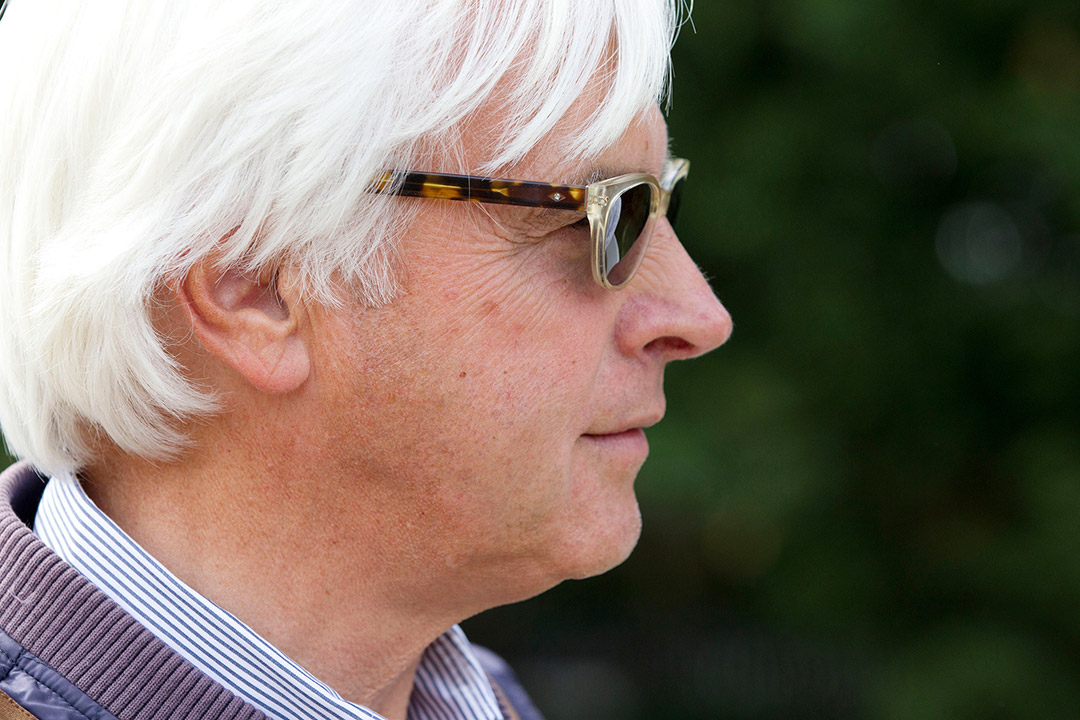
Several new witnesses testified on Tuesday in the hearing called by the New York Racing Association to consider a ban of the Hall of Fame trainer Bob Baffert, as attorneys for both sides clashed over the significance of the trainer’s recent medication positives.
Tuesday was the second day of the hearing, and it opened with continuing testimony from the first day’s only witness, Rick Goodell, a former longtime official at New York racing’s regulatory agencies.
Goodell was peppered with questions from one of Baffert’s attorneys, Clark Brewster, about a comment he had made on the first day of the hearing in which he had contended that Baffert would have received a total of 240 days of suspension if six medication violations he racked up during a 14-month period in 2019 and 2020 were adjudicated by New York’s racing commission. Those cases did not result in any suspension penalties for Baffert in the other jurisdictions.
Brewster took Goodell through the particulars of the cases, and as he did on Monday, he undermined Goodell’s assertion by pointing to New York regulations that could have absolved Baffert of several suspensions, in particular, the New York commission’s own regulation of betamethasone, a corticosteroid found in the post-race sample of Gamine, a horse Baffert trained, in the Kentucky Oaks in 2020. Baffert was fined for the positive and the horse was disqualified, but the trainer did not receive a suspension in the case.
Brewster showed Goodell the rule in place in New York at the same time as the Kentucky Oaks, and it clearly stated that the commission would not treat a betamethasone overage as a positive if the trainer had records showing the drug was administered outside seven days of a race. (The rule has since been modified to 14 days.)
A search of a database maintained by the New York Gaming Commission shows that the state’s racing commission has not called a positive for betamethasone since 1991.
:: Get Daily Racing Form Past Performances – the exclusive home of Beyer Speed Figures
Goodell had also acknowledged on Monday that two positives for the regulated non-steroidal anti-inflammatory medications phenylbutazone that were adjudicated in California in 2019 would not have been treated as violations in New York under the state’s rules at the time.
But the two clashed over the disposition of several other cases, including a decision by the Arkansas Racing Commission to rescind a suspension of Baffert for two lidocaine positives in May of 2020. The suspensions were rescinded on appeal after Baffert’s attorneys had argued before the commission that the positives could have been caused by accidental or environmental contamination.
NYRA put in place protocols to conduct internal hearings considering punishments of licensees after a federal court ruled last year that an earlier attempt by NYRA to ban Baffert violated the trainer’s due process rights. NYRA has contended that Baffert’s recent history of medication positives and the controversy surrounding Medina Spirit, the Baffert-trained horse who won last year’s Kentucky Derby but tested positive for the regulated corticosteroid betamethasone after the race.
The Medina Spirit case has not yet been adjudicated. Baffert and his attorneys have said that the positive arose from the use of an ointment containing betamethasone to treat a skin condition, rather than through the injection of a joint, the most common use of betamethasone in horses.
After Goodell was dismissed Tuesday, the hearing took an unusual turn when NYRA’s attorneys called Dr. Pierre-Louis Toutain, a professor of veterinary pharmacology, to the stand, testifying via video-link from his home near Toulouse in France. NYRA’s lead attorney, Hank Greenberg, questioned Toutain about the efficacies of the medications that had been found in Baffert’s horses, and, over repeated objections from Baffert’s lawyers, entertained speculation about how the medications could be used in nefarious ways to mask pain or lameness in horses. Toutain also contended that the thresholds set by U.S. authorities were set artificially high “in order to protect the institution” of racing, instead of the animals, which he called “a difference in philosophy” between the U.S. and other countries.
Toutain spoke in heavily accented English, and he was told several times to slow down so that the court reporter could produce an accurate transcript of the hearing. In general, however, he answered Greenberg’s questions directly and without much need to ask for clarifications.
On cross, however, the language barrier presented a significant hurdle for Brewster, who had to frequently reword questions at the request of Toutain, who often did not directly answer the question that Brewster asked. In addition, Brewster’s attempt to reference a document listing the screening limits recommended by the International Federation of Horseracing Authorities (IFHA) – a publicly available document that can be found on the internet with one search phrase and two clicks – somehow generated objections and bewilderment from NYRA’s attorneys, despite it being a commonplace, well-known reference in racing jurisdictions worldwide.
That document shows that the IFHA’s recommendations for threshold levels for several of the drugs that had been discussed earlier in Toutain’s testimony are actually set higher than the U.S. levels that were used to adjudicate Baffert’s positives. NYRA’s attorneys objected to the introduction of the document on evidentiary procedural grounds, and it was sustained.
The third witness to take the stand on Tuesday was Dr. Camie Heleski, a lecturer in the University of Kentucky’s Agricultural Equine Programs. Heleski was asked to discuss her findings in the area of horse racing’s “social license,” a term that is increasingly used to describe a given activity’s acceptance in the broader culture. NYRA’s attorneys had claimed in their opening statement on Monday that Baffert’s ability to race at their tracks would have a negative impact on the association’s social license to operate.
NYRA’s attorneys asked Heleski to describe the impact of allegations of doping or medication violations on the social license of Thoroughbred racing, and she answered, generally, that the circulation of those stories “have the potential” to weaken the sport’s acceptance. When asked whether a “single member of an industry” can affect social license, she answered, “Yes.” Heleski also testified that the general public usually fails to differentiate between positives for therapeutic medications and those for clear performance-enhancing drugs.
“Most of the time if there’s a drug or medication noted, they think it’s bad. They put it all under the name of doping,” Heleski said.
:: For the first time ever, our premium past performances are free! Get free Formulator now!
Under cross, another of Baffert’s attorneys, Craig Robertson, attempted to turn the focus on to NYRA, asking Heleski whether a racing company could also weaken the sport’s racing license if they acted in ways contrary to honest principles and transparency. Heleski agreed.
Robertson also asked whether it was “Mr. Baffert’s fault” that the public conflates doping charges with positives for therapeutic medications.
“No, that’s not his fault,” Heleski said.
The last witness to appear was Jeffrey Cannizzo, who described his role as NYRA’s senior director of government affairs. Cannizzo testified that he meets frequently with legislators and state officials to further NYRA’s interests, in a line of questioning intended to show that NYRA’s influence in New York’s political spheres depend on how the company is perceived.
Cannizzo’s appearance touched off yet another argument between Brewster and the hearing officer presiding over the case, O. Peter Sherwood, a retired New York State Supreme Court Justice, over whether Brewster could pursue lines of questioning related to NYRA’s legal right to exclude individuals from its businesses. The clashes indicate that Baffert’s attorneys are dissatisfied with an interpretation of one of the hearing’s stipulations, telegraphing that any result of the hearing dissatisfactory to their client will be appealed in civil court.
Under the protocols adopted by NYRA, the hearing officer is required to issue a report to a review panel appointed by NYRA’s president after the hearing has concluded. The review panel will have the “discretion to adopt, modify, or reject any or all of the hearing officer’s report,” according to the protocols.
The hearing is set to resume on Wednesday morning.