

New medication policies, whip rules in place at 2-year-old sales
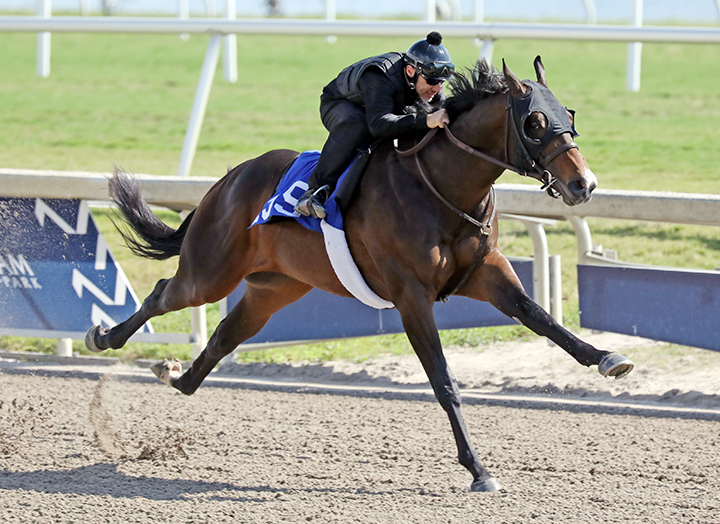
The turning of the calendar means a shifting of focus toward the 2-year-old sale season, with the preparation and training of young horses already well under way for early-season sales in warmer climes. However, a new year doesn’t mean Thoroughbred racing has left behind conversations of the previous year, as the industry continues to discuss equine welfare issues that were brought to the forefront in 2019.
Those discussions have sparked policy changes around the industry. And thus, in advance of the 2020 juvenile sale season, Fasig-Tipton, Keeneland, and the Ocala Breeders’ Sales Co. have jointly announced changes to medication policies and the use of riding crops for under-tack preview shows.
Under revised medication policies, no more than one non-steroidal anti-inflammatory drug may be administered to a horse, with “stacking” of NSAIDS prohibited. Bronchodilators, such as clenbuterol and albuterol, are prohibited. No medication may be administered within 24 hours of a juvenile’s breeze at an under-tack show.
The schedule for administration of permitted medication at Keeneland’s April 2-year-olds in training sale will be governed by the rules of the Kentucky Horse Racing Commission at the time of sale. In December, the KHRC approved a proposal to eliminate the race-day administration of furosemide, known as Lasix, in Kentucky 2-year-old races beginning in 2020, with affected horses allowed to receive the medication up to 24 hours prior to post time. The approved proposal is still going through an official regulatory review. In late February, Keeneland and Churchill Downs jointly reiterated that they plan to follow through with the new regulation.
In addition to race-day medications, the use of the riding crop, in regards to animal welfare and the public perception of horse racing, also has been under discussion at racetracks around the country, with some proposing rules as to where a horse may be struck and how often. All three major sale companies will now prohibit “excessive use” of a riding crop during breeze shows.
Under the new guidelines, a rider may remove their hands from the reins and strike a horse once behind the girth only prior to the starting pole at which the horse begins to breeze. During the breeze, the rider may only use the crop while both hands are holding the reins, and not behind the girth, and the rider is prohibited from striking the horse in any manner beyond the finish line.
In situations where the safety of the horse or rider is in jeopardy, the crop may be used in front of the girth. Spurs are not allowed. Infractions of the policy may result in “substantial fines” to be paid by the consignor, and chronic offenders may be banned from riding on sales grounds.

The revised conditions of sale for all three companies take effect this month, prior to the start of the sales season. OBS hosts three 2-year-old sales, in March, April, and June; Fasig-Tipton hosts a sale in April in Florida, in May in Maryland, and in June at Santa Anita; and Keeneland conducts its sale in April.
“We continue to refine and adapt our policies with the overriding goal of protecting both the human and equine athletes while providing our customers the best opportunity for success at the racetrack,” Fasig-Tipton president Boyd Browning Jr., Keeneland president and chief executive officer Bill Thomason, and OBS president Tom Ventura said in a joint statement announcing the rule modifications.
Noted bloodstock agent Liz Crow, who, with Paul Sharp, pinhooks at 2-year-old sales under Crow-Sharp Pinhook Ventures, swiftly took to social media to applaud the new policies for breeze shows.
“This is what our industry needs – three sales companies coming together for the good of the sport,” Crow said. “Well done. Better for buyers and sellers. Will definitely be a plus for our sale horses, since most don’t see the whip until the breeze show.”
In recent years, there has already been a movement quietly under way to push young horses less at breeze shows, with some consignors opting to open-gallop, rather than breeze, their youngsters. The most prominent of those is consignor Kip Elser of Kirkwood Stables, who, with unnamed clients, began consigning horses to Fasig-Tipton under a banner dubbed “Gulfstream Gallop” in 2018. Over the past two seasons, Elser has offered 14 juveniles under the program, eight of which met their reserve in the sale ring. Standouts of the program have included multiple graded stakes-placed Splashy Kisses, sold for $100,000 in 2018; and Defense Wins, sold for $175,000 last year and later third in the Grade 1 Del Mar Futurity.
This year’s 2-year-old sale changes are the second major policy initiative North America’s three major sales companies have jointly taken in the last calendar year.
Last year, Fasig-Tipton, Keeneland, and OBS announced a joint policy allowing buyers of young horses at their auctions to request purchases be tested for bisphosphonates and to return a horse in the event of a positive test, a move intended to stop off-label use of the drugs. Bisphosphonates are a class of drugs that are approved for use in older horses to treat osteoporosis but also have been rumored to have been abused in young horses headed for the sales ring. This followed the joint action, of a decade prior, to ban the use of anabolic steroids in sales horses.
Meanwhile, in an effort to take a degree of stress off young horses, a growing movement has emerged among consignors and buyers to scale back the number of endoscopic examinations a sale prospect undergoes, in some cases by making high-quality video of exams available for viewing by potential buyers. Keeneland supported that effort by encouraging consignors and veterinarians to utilize the video capabilities of its repository to upload and view endoscopies, which many consignors took advantage of at last year’s bellwether September yearling sale.
“In this day and age, any time we can take one step back and consider both animal welfare and the public perception of animal welfare, that is something we need to do,” said Gray Lyster, president of the Consigners and Commercial Breeders Association.