

King: So far, 3-year-old males have been slow group
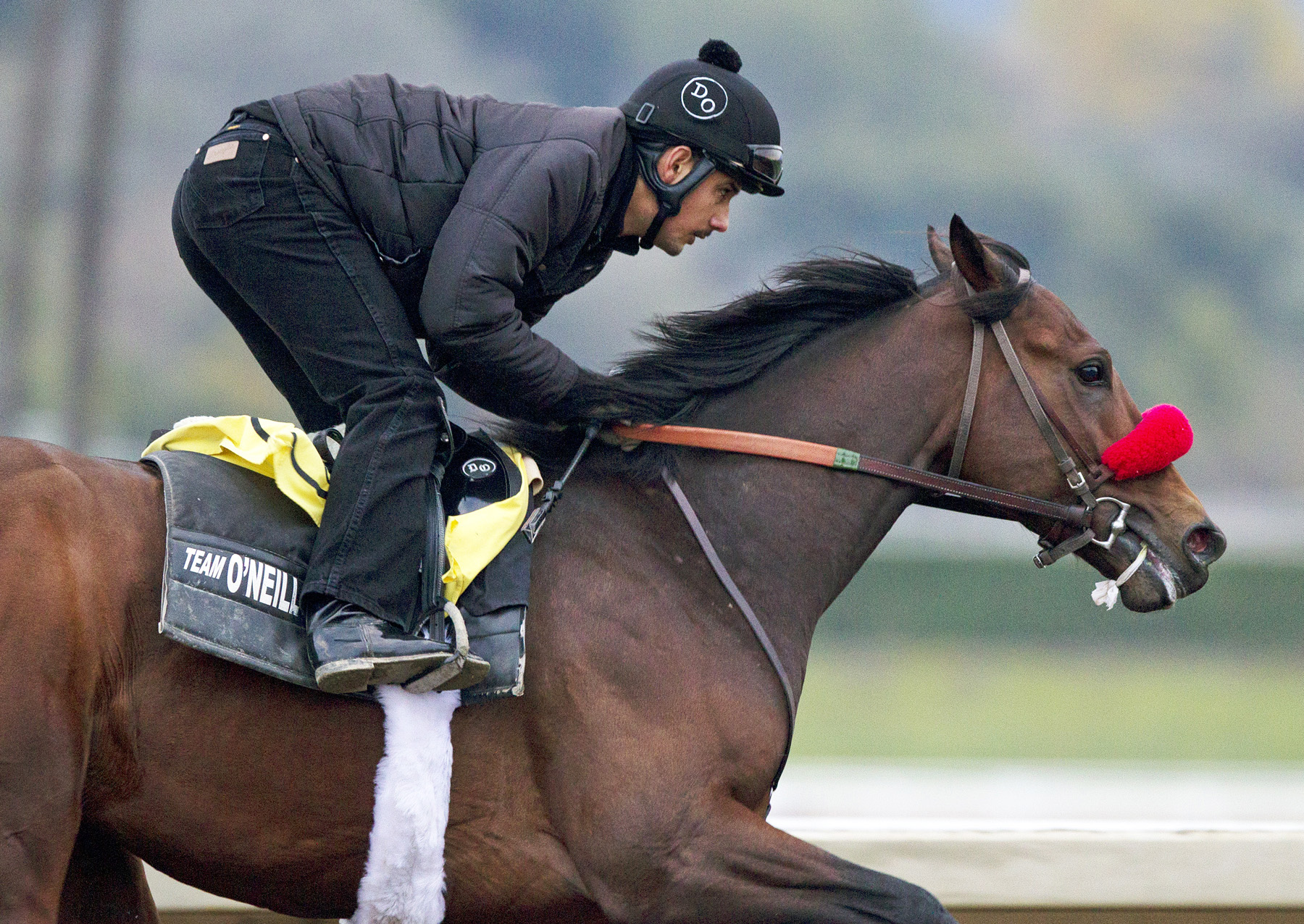
When Nyquist capped an unbeaten 2-year-old season Oct. 31 by winning the Breeders’ Cup Juvenile at Keeneland, the widespread consensus was that he capitalized throughout the year by defeating a slow group. And there was evidence supporting this view: He never posted a Beyer Speed Figure higher than an 89, and his time in the 1 1/16-mile Juvenile was more than a second slower than Songbird needed to win the Juvenile Fillies.
A little more than three months later, Nyquist is breezing in preparation for his first start at 3 – along with many other horses who ran in the Breeders’ Cup Juvenile – but one thing hasn’t changed: The opposition remains slow.
From the day after the Breeders’ Cup through Wednesday, a male who is now 3 has run a 90 Beyer or higher in a dirt route only 10 times. Over the same period through Feb. 3, 2015, there were already 24 occasions when such horses matched or exceeded that 90 Beyer threshold.
Last year’s group was faster at the top, too. Upstart ran a 105 Beyer in winning the 2015 Holy Bull, while Calculator ran a 98 in the 2015 Sham. This winter, the leader in the Beyer clubhouse is Mohaymen, who ran a 95 in taking last fall’s Remsen Stakes at 2 and also in the Holy Bull Stakes last weekend in his first start at 3.
Those numbers make Mohaymen currently faster than Nyquist, but not by an insurmountable margin. With time to grow and develop over the winter, Nyquist could get faster with maturity, which is typical of many 3-year-olds. And the same could be said for others, such as Brody’s Cause, last year’s Breeders’ Futurity winner and the Breeders’ Cup Juvenile’s third-place finisher.
We also have to consider that Nyquist likely would have run faster in the Breeders’ Cup if he had drawn better and been able to tuck in at some stage. Bumped at the start after breaking from post 12, he was hung wide throughout, covering 94 more feet of ground than the pacesetter and eventual sixth-place finisher, Riker, per the racing data company Trakus.
Yet Nyquist somehow prevailed when he seemingly had no chance entering the first turn, sitting in seventh, 3 1/4 lengths off the pace, when he had never before been more than 1 1/2 lengths off the leader.
Putting Nyquist aside for a moment, I have two thoughts regarding the relatively low speed figures from these 3-year-olds with the Kentucky Derby just a few months away.
First, if I owned the champion Songbird and she dominates, as expected, in her 2016 debut against 3-year-old fillies in the Las Virgenes Stakes on Saturday at Santa Anita, I would want to make her a late nominee to the Triple Crown and point toward a late Derby prep to earn the necessary qualifying points for a start in the Kentucky Derby.
That probably isn’t going to happen, based on the stated intentions from the Songbird camp, but she has the necessary talent, and the opportunity is there.
Second, the relative slowness of this group of 3-year-old males could make the division ripe for an up-and-comer, one ready to vault onto the scene with sudden improvement perhaps just in the final month or two before the Derby.
Perhaps a horse like Malibu Sunset, who sparkled in winning a maiden sprint by 10 1/2 lengths on Jan. 31 at Fair Grounds, can prove more of a factor against this crop of 3-year-olds. His relative inexperience might not prove the disadvantage it might have in other years.
Beyond those opinions, Nyquist and the other top performers from the Breeders’ Cup Juvenile seem poised for big seasons at 3 because so few of their counterparts, save perhaps Mohaymen, have really stepped up with fast, flashy efforts at age 3.