
Kentucky judge denies Baffert stay of suspension
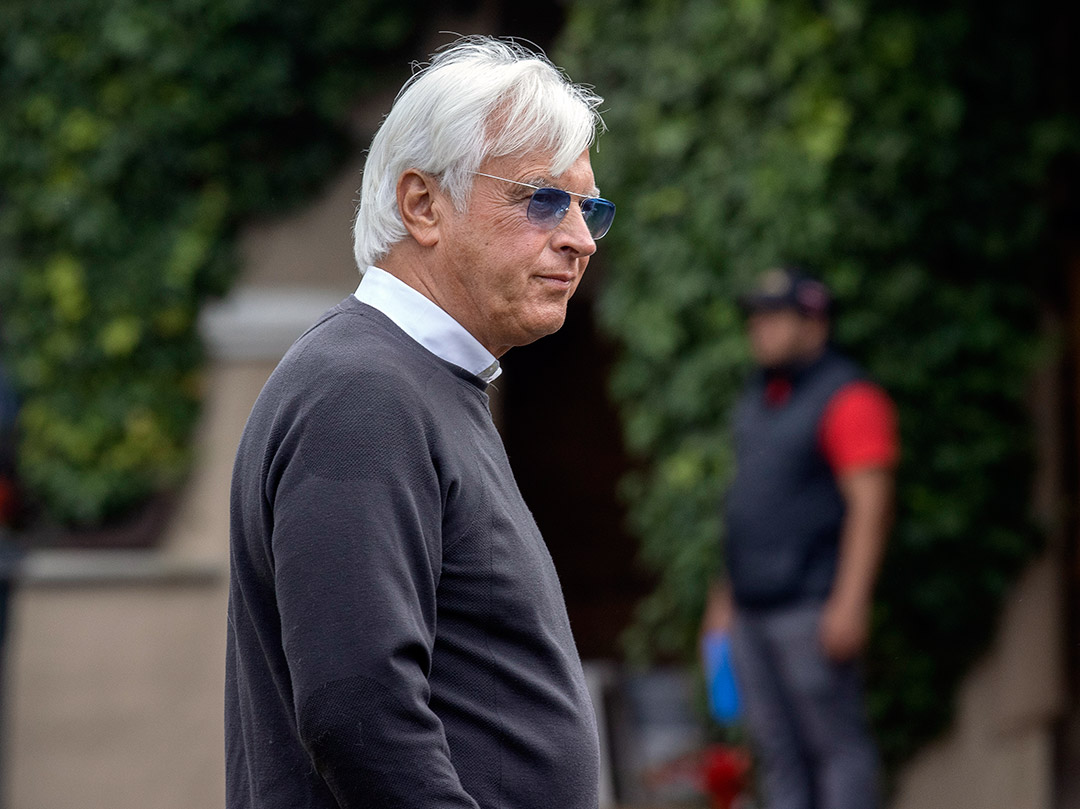
LEXINGTON, Ky. -- A Kentucky circuit court judge on Monday denied the trainer Bob Baffert a stay of a 90-day suspension issued by Kentucky stewards until his appeal of the penalty can be adjudicated by the Kentucky Horse Racing Commission, ruling that the KHRC was within its rights to issue its own denial of a stay.
The ruling by Judge Thomas Wingate of the Franklin County Circuit Court concluded with an order to force the suspension to go into effect on April 4 and said that Baffert and his attorneys “may seek emergency relief with the Kentucky Court of Appeals and take any necessary action to comply with the ramifications of the penalties imposed.”
Although Baffert will almost certainly pursue an appeal, the prospect of beginning the suspension on April 4 would cause a significant blow to Baffert’s operations. According to Baffert’s attorneys, the trainer has 100 horses under his care, and because of a practice known as reciprocity, Baffert would be banned from starting a horse in any U.S. racing jurisdiction while suspended.
Under the rules in place in California, where Baffert is based, he would also be required to transfer his horses to a trainer with whom he has no financial relationship.
Clark Brewster, one of Baffert’s attorneys, released a statement after the ruling was issued saying that Baffert intended to appeal “given the importance of the matter.”
“We are disappointed with the decision,” the statement said.
In his ruling on Monday, Wingate said that Kentucky’s racing laws give the KHRC and its executive director wide latitude in determining whether to issue a stay of a penalty on appeal. The ruling noted that there was a “general consensus” among both parties that stays were routinely granted but that the law clearly states that the KHRC can consider each case on its own merits.
“The statute’s existence and language openly suggest that a request for a stay should be evaluated on a case-by-case basis,” Wingate wrote. “Otherwise, logically, the General Assembly would have written the statute to provide for an automatic stay and would not have prescribed numerous avenues to appeal the denial of a stay.”
The initial order suspending Baffert had a March 8 start date. That date was pushed back indefinitely two weeks ago after Wingate asked the KHRC to delay the suspension until he could conduct a hearing on a request for a temporary injunction and issue a ruling.
Regardless of any decision by the Court of Appeals, Baffert has a hearing scheduled in front of a hearing officer appointed by the KHRC beginning on April 18. The appeal has been allotted four days. It typically takes four to six months for a KHRC appeal to be fully adjudicated.
During a hearing in Wingate’s courtroom on Thursday last week, Baffert’s attorneys argued that enforcing the suspension without first adjudicating the appeal would be a “death sentence” to Baffert’s career and that the trainer had reasonable grounds to get the penalty reversed.
But Wingate pushed back against that assertion, writing in his ruling that “unlike certain athletes whose careers are subject to a small window of eligibility or period of peak performance, Baffert’s career has spanned decades and will continue following this brief suspension.”
“In fact, Baffert has expressed his intent to continue in his chosen profession,” Wingate continued. “The horses under Baffert’s care — the athletes — do possess a finite window of eligibility and peak performance. However, those horses can still race.”
During last week’s hearing, attorneys for the racing commission justified their decision to deny a stay by telling Wingate that Baffert was “the very definition of a repeat offender,” citing the trainer’s history of medication violations, including a positive in the Kentucky Oaks in 2020. Continuing to allow Baffert to delay the start of the suspension would represent a threat to the integrity of Kentucky racing, the attorneys said.
Wingate agreed with the KHRC in his ruling, writing that “the court believes it is imperative to ensure public confidence in the commonwealth’s signature industry.”
The suspension was first issued by Kentucky stewards in February after a horse Baffert trained, Medina Spirit, tested positive for the regulated corticosteroid betamethasone after winning last year’s Kentucky Derby. Baffert’s attorneys have argued that the positive was due to the use of an ointment to treat a skin condition in the horse, and that Kentucky’s rules do not apply to the use of the cream, which they said was applied daily up until the day before the Derby, under a prescription from Baffert’s vet.
Baffert’s attorneys told Wingate that they were confident that courts would overrule the KHRC decision to litigate the positive because of that explanation. But attorneys for the KHRC had told Wingate that their regulations prohibit the presence of betamethasone in a post-race sample regardless of the route of administration.
In his Monday ruling, Wingate agreed in part with this interpretation by citing a case he had presided over four years ago involving the trainer Graham Moton, which was eventually settled by the Court of Appeals. That court overruled Wingate’s own decision throwing the violation out.
“The holding in Motion makes clear that the KHRC is vested with the power to establish its regulations and nonetheless, the actual effect of a banned drug is irrelevant,” Wingate wrote. “Therefore, plaintiffs have failed to demonstrate a substantial likelihood of success.”
Baffert has also been banned by Churchill Downs Inc. from all of its tracks through the 2023 Derby, a decision the company made last year shortly after Baffert acknowledged the Medina Spirit positive one week after the Derby. A month ago, Baffert challenged the ban in court, arguing that his due-process rights had been violated. Last week, Baffert’s attorneys asked the judge in the case for a hearing on a request for a temporary injunction during the week of April 11-15, noting that the attorneys would not be able to appear in court the next week due to the KHRC hearing.