

Kentucky Derby pedigrees tilt more to sprint
LEXINGTON, Ky. – North American sires have become more speed-oriented over the last several decades, and that trend is evident in the sires of the top-three performers in the last 30 Kentucky Derbies. But pedigree analysts differ on how significant the trend toward speedy sires might be on the first Saturday in May.
The sires of the Derby’s top three performers between 1980 and 1989 had a combined average winning distance of 8.2 furlongs, according to Jockey Club statistics. In the 1990s, that average dipped slightly to just under 8.1 furlongs, and in the last decade it has dropped again to 7.9 furlongs.
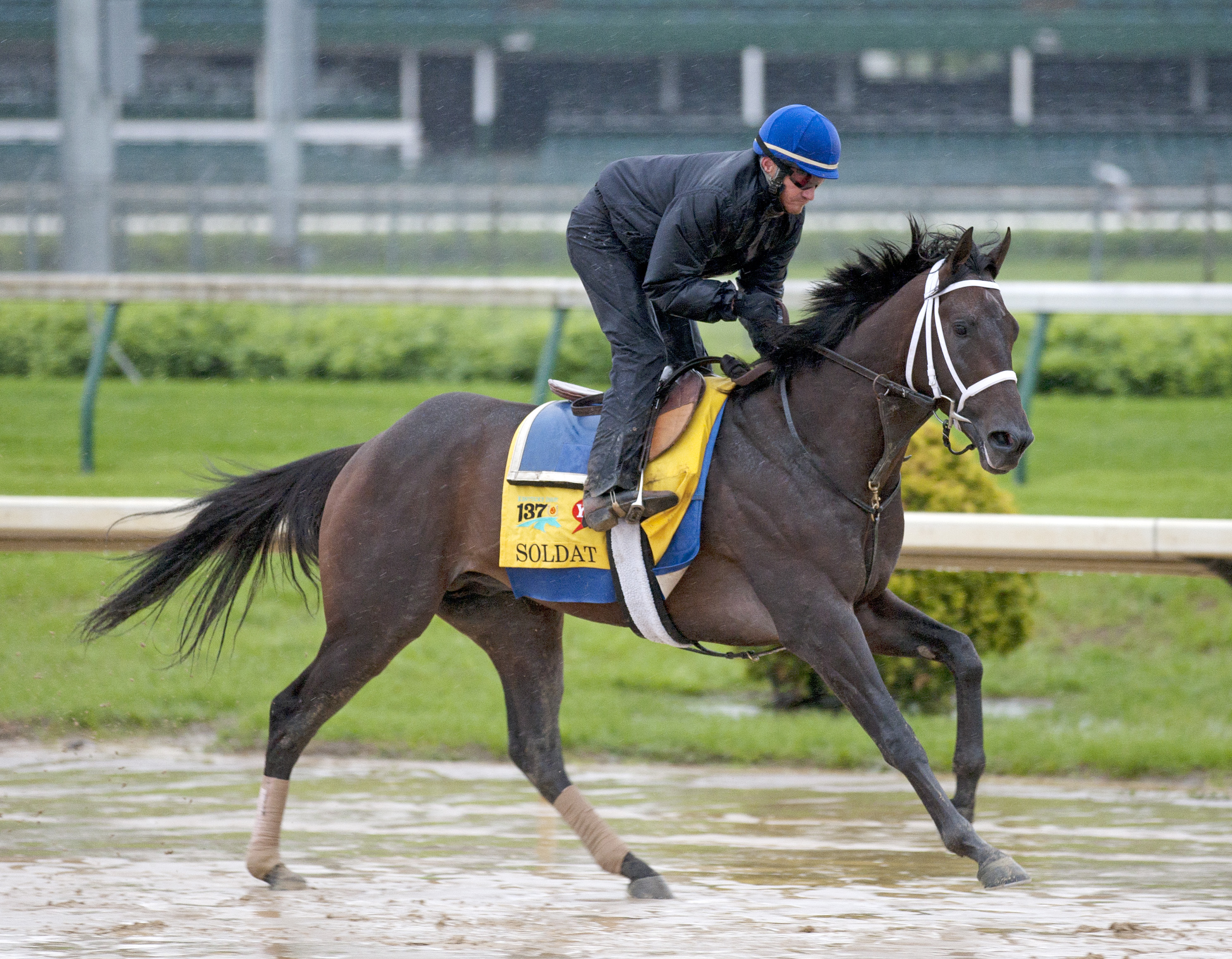
The 2011 Derby field presents a mixed bag of sires. Quite a few fall under the sprinter-miler category, including father and son Indian Charlie (sire of Uncle Mo) and Bwana Charlie (Comma to the Top); Soldat’s sire, War Front; and Shackleford’s sire, Forestry. But there are other sires with more stamina reflected in their average winning distance, including A.P. Indy’s son Bernardini (sire of Stay Thirsty), Mineshaft (Dialed In and Nehro), and Dynaformer (Brilliant Speed). And even among runners with sprinter-miler sires, there are some whose dams have longer average winning distances, such as Animal Kingdom’s dam, Dalicia, by Acatenango, and Midnight Interlude’s dam, Midnight Kiss, by Groom Dancer.
“The North American Thoroughbred has really homogenized into a horse that’s very good from seven furlongs to 1 1/16 miles from the time it’s a mid- to late 2-year-old through to its early 3-year-old season,” said Byron Rogers, co-owner of Pedigree Consultants LLC. “There are horses – like A.P. Indy and Tiznow and, to a lesser extent, Distorted Humor and Dynaformer – who can get you a 10-furlong-plus horse. But, in general terms, the average stallion in North America is being bred into that effectiveness between seven furlongs and 1 1/16 miles.”
KENTUCKY DERBY DAY: Past performances, contender profiles, and video
So where has the trend toward sprinter-miler sires come from? Owners’ desire to get relatively fast action – and, if possible, a quick return on investment – has prompted commercial breeders to produce horses for that market.
“The physical type people are selecting for in the yearling sales isn’t actually a Derby horse,” Rogers added.
Influential trainers like D. Wayne Lukas and Bob Baffert, who got their start in Quarter Horse racing, have played a role in that change by focusing on the more muscular, precocious young horse that is better designed for sprints or middle distances. But they’re still getting to the Churchill Downs winner’s circle on Derby Day.
“What they’re asking them to do is go further than they’re genetically made to do,” Rogers explained. “They’re training them as well as they can, and horses are arriving on the day trained to the minute and are able to get that extra furlong or furlong and a half, even though they’re not supposed to do it, just because of superior training.”
And stallion buyers and breeders tend to select sprint-to-miler sires partly because speed traits are more easily passed on than the physical characteristics that lead to high-quality stamina performance, Rogers believes.
“You use different metabolic systems to stay than you do to sprint,” he said. “Sprinting is not as complex an issue as getting a route of ground, from a metabolism viewpoint. The heritability of the systems you need for staying are not as well mapped-out, and, basically, it’s harder to breed a good stayer. What they’re finding in genetics with sprinters is they don’t have to have great cardio and they don’t have to have a great oxygen transport system. What they do have to have is good biomechanical efficiency and muscle.”
But there is another side to the pedigree equation, and that’s the dam. Stamina-lovers can take comfort in the fact that the North American broodmare population still contains a good supply of stamina, says noted pedigree analyst Les Brinsfield. And Brinsfield points out that a speedy sire matched with a distance-oriented female family traditionally has been a key to Derby success.
“My view is that today’s Derby horses are not speed-oriented, because for the most part they have stamina and classic staying power in their dams,” Brinsfield said. “I’m in the prediction business, and I predict you’ll be seeing classic winners coming out of the daughters of horses like Key to the Mint, Nijinsky, A.P. Indy, Seattle Slew, and Unbridled, even if the sire is some jackrabbit out there right now that doesn’t have runners yet.”
But, Brinsfield warns, you have to be selective in order to maintain that well of stamina in the broodmare population.
“If you keep breeding everything for those jackrabbit 2-year-olds, that will change,” he said, “because over time the profile of the mares will change with that. You can start with a Key to the Mint mare and if you breed over and over to sprinters for four generations, that Key to the Mint influence will evaporate as far as stamina is concerned. Fortunately, we’ve got horses like Seattle Slew and his get – A.P. Indy, principally – and you have horses out of Secretariat mares like Gone West, Storm Cat, and A.P. Indy that lend stamina.”
Using such mares could help breeders cash in on some classic opportunities.
“One of the best races to win is the Kentucky Derby,” Rogers said. “There are many people who want to win that race, but very few people actually build a breeding and racing program around that goal. But the people who do are very successful at it, because they know the playing field now for horses racing between 1 1/8 miles and 1 1/2 miles, there’s no competition. It’s swung so far to the sprinter-miler that there’s a big opportunity for people who know how to breed horses to get 10 furlongs. The market will work its way through, but there’s a good opportunity there.”