

Kentucky Derby: Black Lives Matter protests a somber backdrop to Authentic's victory
LOUISVILLE, KY. – Even though Churchill Downs on Saturday was closed to spectators and all but a select few as a result of the coronavirus pandemic, the calls for racial justice that have gripped Louisville for more than three months were visible before, during, and after the Kentucky Derby.
Derby Day marked the 101st consecutive day of protests in Louisville following the fatal shooting of Breonna Taylor by police as the 26-year-old Black woman slept in her home in March. While the shooting is being investigated by state authorities and the FBI, demonstrations calling for charges against the officers involved have continued.
Demonstrations by several separate groups in support of the Black Lives Matter movement were held Saturday and marched as close to Churchill Downs as possible prior to the running of the race. Counter-protests also were held, including by a heavily-armed group in downtown Louisville saying it was supporting the police.
The demonstrations remained nonviolent throughout the day. The Louisville Metro Police Department said Saturday night it had made three arrests during the day. None took place during the marches to Churchill Downs.
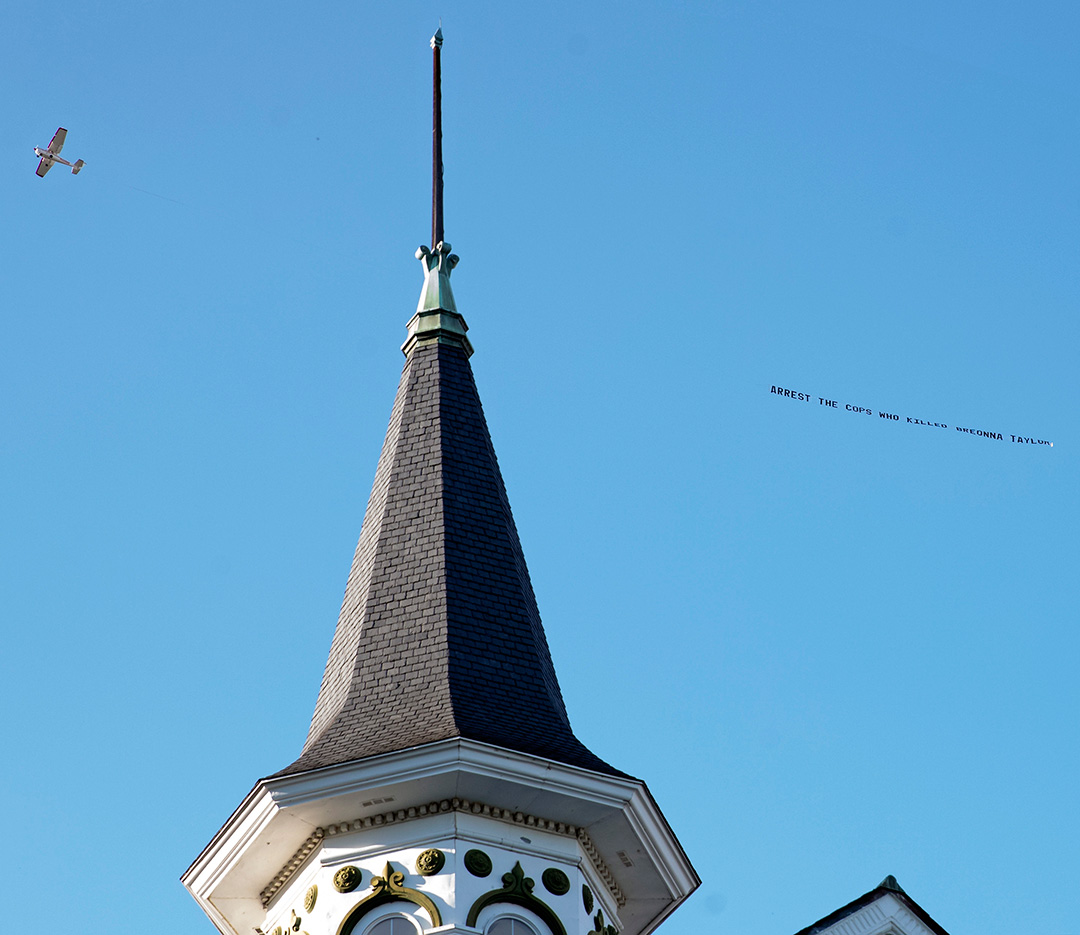
Until Freedom, a national group that has moved its base to Louisville, arranged for a plane pulling a banner to fly over the track directly before and during the Kentucky Derby, reading “Arrest the cops who killed Breonna Taylor.” As the Derby field stepped on the track, announcer Travis Stone read a prepared statement from Churchill Downs regarding “My Old Kentucky Home,” the state song of Kentucky and the traditional Derby anthem.
:: Want to get your Past Performances for free? Click to learn more.
The song, written by Stephen Foster in the 1850s, is written from the perspective of a slave being sold down the river from Kentucky. Churchill’s statement referenced remarks made by Frederick Douglass, a famed abolitionist and former slave, regarding the song, “in which anti-slavery principles take root, grow, and flourish,” Douglass said.
Churchill’s statement concluded: “Please join us in a moment of silence as we pause to recognize the inequities that many in our nation still face, and reflect on renewed hope for a more just country to truly take root, grow, and flourish,”
“My Old Kentucky Home” was then played by track bugler Steve Buttleman.
Two of the owners in the stands were Greg Harbut and Raymond Daniels, who, along with Wayne Scherr co-own Necker Island, who finished ninth. Harbut and Daniels are the first Black owners of a Derby entrant in 13 years.
The history of race relations and the Kentucky Derby was not lost on Harbut, whose great-grandfather Will Harbut was the groom for Man o’ War. His grandfather Tom Harbut co-bred and co-owned a horse who ran in the 1962 Derby, but he could not attend the race as the grandstands were only for whites. Harbut and Daniels had been urged by some to boycott the race as a statement.
“A wise man told me this morning, ‘We cannot give protest versus progress,’ ” Daniels told NBC right before the race. “For us, this is progress. And so, we want to promote both.”
Following Authentic’s Derby victory, jockey John Velazquez and trainer Bob Baffert were asked their thoughts on the protests in Louisville. Velazquez held up a black band reading “Equality For All” that he said “most of the guys” wore during the race.
“We believe that if we have equality for everybody, we won’t be in the mess we are in right now,” said Velazquez, who, along with Kendrick Carmouche, was instrumental in organizing New York riders to take a knee in solidarity with protestors prior to Belmont’s first race on its June 3 opening day, following a moment of silence for those affected by the pandemic.
Baffert noted during the post-race press conference that the elation of the moment was tempered by the struggles of the nation.
“To me, I just feel like America is so stronger when we’re united, and hopefully we get united,” Baffert said. “I want to see the old America back.”