

Keeneland September sale looks for international boost
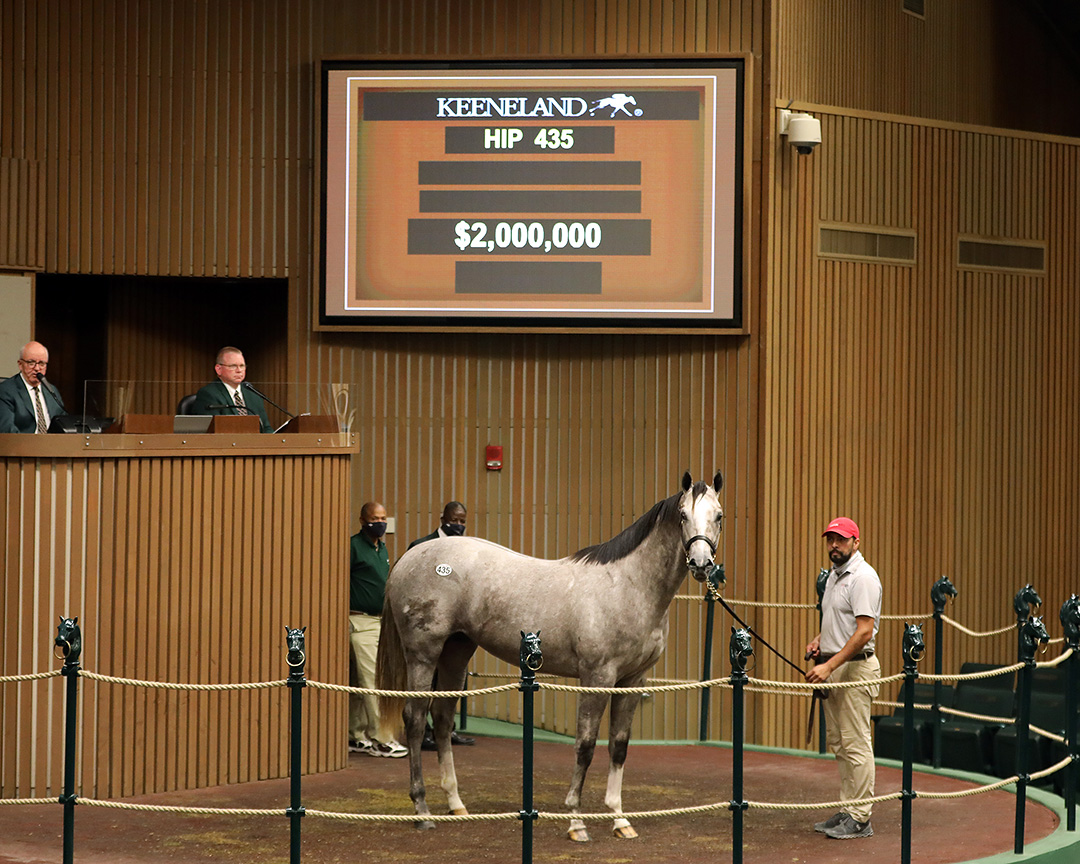
The Keeneland September yearling sale, the biggest dedicated yearling auction in North America, also bills itself as the world’s yearling sale. This year, with a strong start to the North American yearling marketplace, Keeneland hopes to indeed welcome the world back to Lexington.
Hopes are high for this year’s Keeneland September sale, which has 4,034 yearlings in the catalog for its marathon run set for Monday, Sept. 13, through Friday, Sept. 24. The September sale annually acts as a bellwether for the North American marketplace, as it tests metrics at a number of levels and for a number of different types of buyers through its run, and also showcases some of the best of the North American yearling crop to an international marketplace.
Last year, however, yearlings came before a group dominated by domestic buyers, as the coronavirus pandemic hampered travel across the board, but particularly for international buyers.
“While the technology is great and I feel like it’s a huge advancement . . . there is no substitute for a principal of a major group or a syndicate or an owner being on the sales grounds,” said Zach Madden, a partner in consignor Buckland Sales.
Last year’s Keeneland September sale, led by a $2 million Tapit colt, finished with 2,475 yearlings sold for total gross revenues of $248,667,300. The average price was down 25 percent from the 2019 edition of the sale, while the median dipped 18 percent.
The auction marked the first time since 2016 that Keeneland September did not top the $300 million mark in gross sales, and one major factor was reduced participation from international buyers. Notably absent was the international Godolphin operation of Dubai ruler Sheikh Mohammed al-Maktoum, which led all buyers in 2019 by spending $16 million. Coolmore purchased just seven yearlings via agent, none for seven figures, for a total of $3,615,000. The operation was in on 10 purchases, alone or in partnership, for more than $7.8 million in 2019.

Those losses in gross could not totally be filled, although Keeneland, like other major auction houses, expanded phone bidding and created online bidding options for buyers unable to travel.
At last year’s September sale, 126 horses were sold via the online platform for a gross of more than $12.1 million, a significant contribution to the tally. The horses sold via the online platform included $825,000 and $750,000 colts to Yuji Hasegawa of Japan, who had a representative on the grounds but did his own bidding remotely.
“How much international spending was down for North American yearling sales last year, it showed that COVID really did hamper people’s ability to do commerce,” said Mark Taylor, vice president of marketing and sales for his family’s Taylor Made Sales Agency, a perennial leading consignor. “Even though we were somewhat opened up and there were people here, across the board, most of those countries that export out of America, the numbers were down.
“So if we can pick up some of that, if we could get a nice chunk of that back as things get going, I think that’s really going to be a key component to the market.”
This year, with the drive to vaccinate more people continuing in the face of the Delta variant, and with travel restrictions and requirements between various jurisdictions continuing to evolve as the pandemic does, Keeneland officials will continue to work until the last moment to have as many buyers on hand as possible when horses step into the ring.
“We made huge efforts last year, the team here, to get as many people here as possible” said Tony Lacy, Keeneland’s new vice president of sales. “There were some visa waivers, a number of people got visa waivers. We’re in the process of working on those again this year. It’s not a straight line – there’s a lot to jump through when you’re dealing at government levels. But it is relentless. We’re working through all the channels.”
Lacy is part of new leadership for Keeneland’s sales operations as the company navigates this crucial point in its history. Keeneland announced in April that Lacy would join the company, simultaneously announcing that director of sales operations Geoffrey Russell is retiring from his full-time position after 25 years with Keeneland. Russell will remain in a consulting role through 2021.
Lacy, along with Kerry Cauthen, helped establish Four Star Sales in 2001. They eventually developed the company into a leading North American consignor with a diverse client portfolio. Since 2008, Lacy has been the North American representative for the French Thoroughbred sales company Arqana.
In June, Keeneland announced that prominent bloodstock consultant Cormac Breathnach, most recently director of stallion nominations at Airdrie Stud, would be its new director of sales operations. Breathnach, who also worked as the stallion seasons and matings consultant at Adena Springs, founded Galway Bloodstock, a consultancy that has provided a range of services, including auction representation, racehorse management, and matings analysis.
As Lacy and Breathnach bring their respective experiences in the commercial Thoroughbred arena to their new roles at Keeneland, Lacy said one aspect they want to focus on is the customer experience for both buyers and sellers, and creating a vibrant, exciting marketplace.
“As we come in here with fresh eyes, fresh perspective, I think what we’re trying to encourage is creating more of an atmosphere and to build up the sale,” Lacy said. “Everybody comes in here with optimism, they’re excited, they’re ready to rock, they’re ready to buy horses, to look at what’s on offer, for hopefully the next Derby winner.”
Some of the first changes enacted have been continued shifts to the schedule for the September yearling sale, which often evolves every few years in response to market trends and input from buyers and consignors. In an effort to position a larger number of horses before the deepest audience of buyers possible, the highest-market books, Books 1 and 2, will each run over two-session periods prior to a dark day on Friday, Sept. 17, when no sale will be held. Book 1 will include the new RNA Reoffer segment at its conclusion.
Additionally, Keeneland September will run as five books over 11 sessions, one fewer of each than last year. The hope is that a three-day Book 5, as opposed to separating out smaller sessions for Books 5 and 6, will create a more vibrant lower marketplace.
“The back end of the sale, combining the final two sessions – there’ll be more people in town and more bidding through the very last hip,” Breathnach said. “We’re excited to see what kind of changes that can bring about to Book 5.”
The bidding activity in the middle and lower markets will play a large role in the final results of the sale. While the top of the marketplace remained strong in 2020, many of those buyers hold independent wealth and can make purchasing decisions independent of other shifts in the marketplace. As the 2020 sale progressed into other levels, there were more notable declines that caused the overall figures to drop. This year, Breathnach expressed optimism for a stronger middle market.
“With the catalog for this year, I’m fairly optimistic about the strength of the middle market,” he said. “The quality’s there throughout the sale. The market is very vibrant at the top end. So we’re very confident that we’ll have a good beginning, and then, hopefully, a good middle.”
There also is hope for that crucial strong middle marketplace because of the strong 2-year-old sales results earlier this year. Buyers at the upper end of the marketplace are typically end users who intend to race horses themselves, and perhaps to make a stallion or a broodmare prospect whose residual value factors into the seven-figure price tag.
As the market progresses, there is more room for yearling-to-juvenile pinhookers to enter the fray, hoping to buy at a value and sell for a profit. The 2-year-old marketplace was decimated by the pandemic in 2020, leading to reduced participation from that segment of buyers at the yearling sales. Off a rebound in 2021, they can now look to restock.
“The pinhookers that participate in Books 3, 4, 5 at the sale, for them to have a good spring really means a lot to yearling consignors that are looking to have a good fall,” said Allaire Ryan, Lane’s End’s director of sales. “I hope it carries through.”
With the juvenile sales rebounding, and with improved figures at the three Fasig-Tipton sales that opened the season over the summer in Kentucky and New York, optimism is high for the momentum to continue into September.
“The Thoroughbred business has proved itself to be remarkably resilient in these trying times,” said Charlie O’Connor, director of sales for Coolmore’s Ashford Stud. “Hopefully, that will continue throughout the sales season this year.”