

Keeneland September sale gross fails to top $300 million for first time since 2016
LEXINGTON, Ky. – The Keeneland September yearling sale is considered a bellwether for the North American Thoroughbred market, as it tests the marketplace at a number of levels over a nearly two-week run. With the coronavirus pandemic touching every aspect of the business, the community braced for this year's sale and the long-term forecast it would provide as the market tends to react with restraint to turbulence in the world at large. The sale, which experienced a shift to a largely domestic marketplace this year, finished with declines that were not unexpected, but some bright spots.
The Keeneland September sale finished with 2,475 yearlings sold over 12 sessions, arranged in six books, for total gross revenues of $248,667,300. The 2019 sale finished with 2,974 sold in six books over 13 sessions for a gross of $372,348,400. Not only is the year-to-year gross not directly comparable because of the additional session in 2019, another factor must be considered, as last year's sale was led by an outlier at the top of the market – an $8.2 million American Pharoah filly out of Broodmare of the Year Leslie's Lady was the fourth-highest price all time at Keeneland September. The filly helped the 2019 sale finish with its fifth-highest gross all-time in its 77-year history; its second-highest average all-time; and a median tied for sixth-best. Those historically noteworthy figures meant that this year's renewal may have posted year-to-year declines even without the outside factor of the pandemic.
"Last year was one of the strongest September sales we've ever had," said Geoffrey Russell, Keeneland’s director of sales operations. "Even without COVID, I think it would be hard for us to replicate that – but with COVID, and travel restrictions for certain people, and changes of plans for certain people, it had a strong effect on certain parts of the market."
This was the first time since 2016 that Keeneland September did not top the $300 million mark in gross sales. The sale grossed $327,999,100 in 2008, when the results of that month's financial crash began to truly make themselves felt in the second week of the sale. The sale dropped below the $300 million mark for the next several years as the Thoroughbred market struggled and then recovered. The 2017 edition of Keeneland September grossed $307,845,400, followed by $377,130,400 in 2018, and $372,348,400 last year.

Although bidding was competitive, with buyers willing to stretch past seven figures on key horses, restraint at the top of the market, or an invisible ceiling, was apparent. A total of 15 horses sold for seven figures, all in Books 1 and 2, compared to 22 in 2019. Working down through additional price thresholds, an additional 21 horses sold for prices of more $750,000, compared to 35 in 2019; and another 40 horses went for prices between $500,000 and $749,000, compared to 85. The sale finished with another 657 horses sold for six-figure prices up to $499,000, compared to 880 in 2019.
"We haven't seen a horse bust loose like last year," bloodstock agent Jacob West said. "We have not seen that here. Obviously, maybe there's a certain cap everybody's going to, a certain level everyone feels comfortable at. . . . I think at the end of the day, the easiest way to summarize this market is fair. The right horses are bringing the right money."
Partly as a result of that restraint, the cumulative average price dipped downward 25 percent, to $100,472 from $125,210. The year-to-year median ticked downward 17 percent, to $39,000 from $47,000.
A market that already trended toward selectivity and polarization became increasingly selective this season in the face of the global crisis, leading to a 25 percent cumulative buyback rate, compared to 21 percent last year. Keeneland has begun factoring private sales into its final figures, with the 2019 buyback rate incorporating 124 horses changing hands as private transactions after failing to meet their reserves in their trip through the ring. The 2020 results currently include 129 horses sold as private transactions, and more could still be added from the final sessions of the auction.
After the greatest selectivity, with a 40 percent buyback rate, was seen in Book 1, which kicked off the sale on Sept. 13-14, the figures gradually improved deeper into the sale. By the time the sale hit its midway point, wrapping up Book 3 on the evening of Sept. 19, the cumulative buyback rate had improved to 34 percent. Several individual sessions finished with an outstanding buyback rate under 20 percent in the final week of the sale to push it to its final mark.
Russell noted that the changing buyback rate is influenced by the state of the sellers as well as selective buyers. At this upper end of the marketplace, sellers may be more willing and able take the risk of retaining and racing horses themselves rather than parting with them for less than their perceived value. In the middle and lower markets, sellers may adjust their reserves in line with the market to tip the scales in favor of a sale.
"That dynamic falls into the commercial foal crop," Russell said. "These are commercial breeders that have to sell their crop. They might be getting a reduced price, but they need to sell their crop to make a living."
As expected, the buying bench was dominated by domestic interests, owing to travel restrictions caused by the coronavirus pandemic. The leading buyer by gross was the partnership of SF Bloodstock, Starlight Racing, and Madaket Stables, which purchased 28 horses for a total of $11,250,000. The partnership worked through bloodstock agent Donato Lanni, who purchased more than a dozen horses for various other entities.
Rounding out the top 10 buyers by gross were Repole Stables and St Elias Stable, with West as agent; bloodstock agent Mike Ryan; Shadwell Farm, which stated that its top purchase was intended for its U.S. hub; bloodstock agent Liz Crow of BSW Bloodstock; Mayberry Farm; Courtlandt Farm; Larry Best's OXO Equine; the WinStar Farm moniker of Maverick Racing; and Winchell Thoroughbreds. Ryan bought horses intended to race in both the United States and Europe, while Crow's purchases included some for undisclosed clients.
Notably absent from the buying bench was the international Godolphin operation of Dubai ruler Sheikh Mohammed al-Maktoum, who himself traveled to Lexington in 2018 and 2019 for the sales. Godolphin led all buyers at last year's sale with 10 purchases for $16 million. Coolmore, another of the major international entities that typically dominates the leaderboard, purchased just seven yearlings via agent, none for seven figures, for a total of $3,615,000. The operation was in on 10 purchases, alone or in partnership, for more than $7.8 million last year.
While that void in gross could not totally be filled, it did remove some competition with nearly unopposable bankrolls for domestic buyers, several of whom rose to the occasion. Although there were some common threads in partnerships, the 15 seven-figure yearlings of the sale were purchased by 14 different buyers. Best purchased two seven-figure yearlings, while Gainesway was involved in partnership on two others.
"I think it gave off an opportunity to show off the diversified buying bench, which was great to see," said Keeneland president-elect Shannon Bishop Arvin, the company's interim head of sales. "We were really encouraged by the broad numbers of buyers that were participating at multiple levels, including the top level."
Keeneland endeavored to create opportunities for buyers unable or unwilling to travel via various remote-bidding outlets. The company expanded its traditional phone-bidding program and also integrated its online auction platform unveiled earlier this year into the live auction. The latter saw solid activity as Keeneland reported that 126 horses were sold via the platform for grosses of more than $12.1 million. The horses sold via the online platform included $825,000 and $750,000 colts to Yuji Hasegawa of Japan, who had a representative on the grounds but did his own bidding remotely during Book 1. Although Korean interests were not as active during the sale as in a typical year – last year, the Korea Racing Authority bought 15 horses – two yearlings did sell to those interests via online and phone participation.
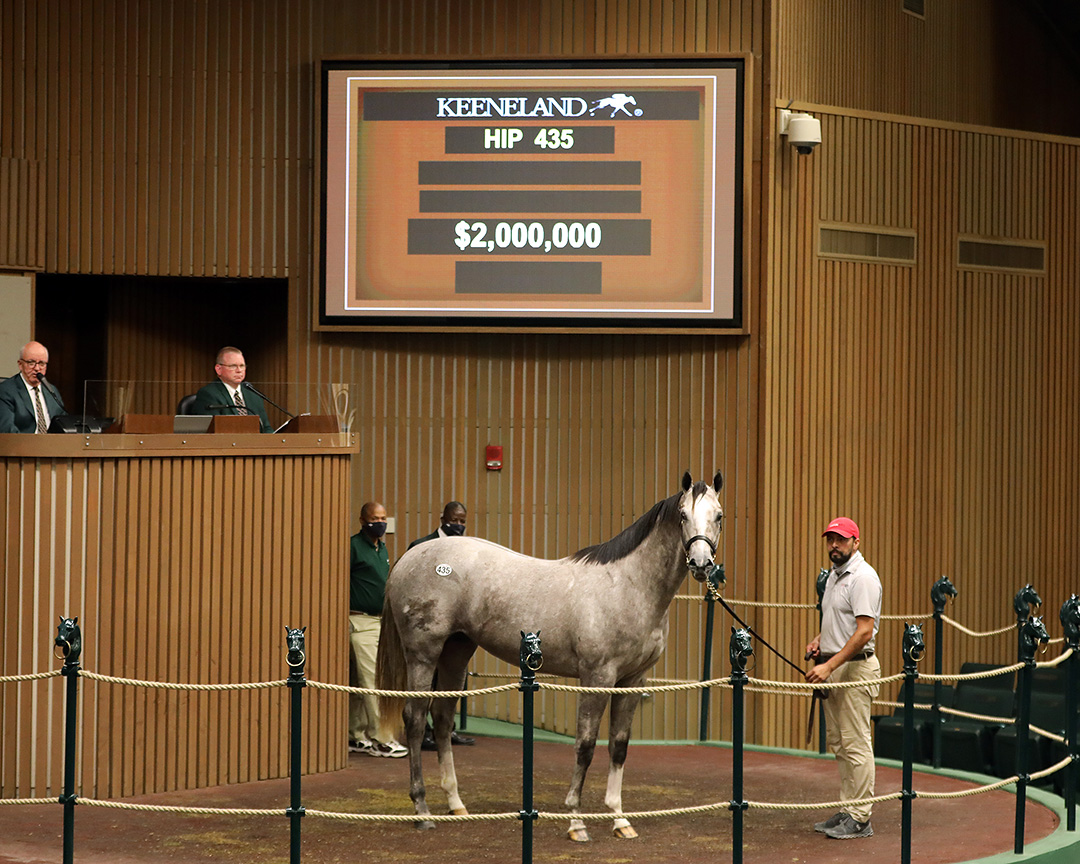
The sale leader was a colt by Tapit sold for $2 million in the Book 1 finale on Sept. 14, with the well-acquainted team of Eclipse Thoroughbred Partners, Robert LaPenta, Gainesway, and Winchell Thoroughbreds joining forces. Eclipse, LaPenta, and Gainesway were among the partners in Tapwrit, one of the three Belmont Stakes winners sired by perennial leading sire Tapit. The stallion stands at Gainesway, and Winchell Thoroughbreds, which campaigned him, maintains an interest in him.
Following the sale, Eclipse president Aron Wellman said that Barbara Banke of Stonestreet Farm, which bred the colt and consigned him via Eaton Sales, had joined the partnership to retain a piece of the action. Banke typically sells the colts out of her mares, but has been known to buy back in afterward, as was the case with Stonestreet-bred champion Good Magic, himself a seven-figure yearling.
Forming multi-pronged partnerships to buy colts at the upper end of the market has been a common practice at public auction in recent years, as buyers look to spread the risk and reward on potential stallion prospects as well as to give themselves additional buying power.
The Tapit colt is the second foal out of the Unbridled's Song mare Tara's Tango, a Stonestreet homebred who won the Grade 1 Santa Margarita Stakes and two other graded stakes races in California. The mare is a half-sister to Grade 1 winner Visionaire as well as Grade 3 winners Madison's Luna and Scarlet Strike. Madison's Luna is by Tapit, making him bred on the same cross as this colt.
"The family speaks for itself, Tapit speaks for himself," Wellman said. "He was just a phenomenal physical. He was a man among boys, in our eyes, in the sale. We waited two days to pull the trigger on him. We couldn't find any chinks in his armor – physically, mentally, or pedigree-wise. He handled it all."
Selling the sale-topper kicked off a noteworthy hat trick for Stonestreet, which bred and sold the top-priced horses of Books 1, 2, and 3. The three colts were handled by three different consignors under the banner of “Stonestreet Bred and Raised.”
“I hope it gives buyers more confidence,” Banke said. “We raise racehorses; we don’t ‘hot house’ them. We do all the right things and try to raise a racehorse that is sturdy and has great breeding.”
The nation's reigning leading sire, Into Mischief, a newly-minted classic sire with Authentic's Kentucky Derby victory earlier in the month, had an outstanding sale with five seven-figure yearlings overall. He had the most expensive filly of the sale as Best, a longtime supporter of the stallion, went to $1.9 million for one.
Best's high-ticket filly, bred by Albaugh Family Stables, was consigned by Taylor Made Sales, as agent. She is out of the stakes-winning Medaglia d'Oro mare Taylor S, whose first foal to race is a winner. Taylor S, out of Grade 3 winner Miss Macy Sue, is a half-sister to Breeders' Cup Dirt Mile winner Liam's Map, a top five freshman sire of 2019; and to Grade 3 winner Not This Time, among the current leaders of the 2020 freshman sire class.
Tapit and Medaglia d'Oro's bloodlines were seen in the top two prices of the sale, and they were joined for the third-highest price of the sale, a $1.6 million Medaglia d'Oro filly out of the Tapit mare Orchard Beach. She sold to the Shadwell operation of Sheikh Hamdan bin Rashid Al Maktoum, which has studs in both England and Kentucky.
Rick Nichols, vice president and general manager for Shadwell in Kentucky, said after signing the ticket that the Ontario-bred will likely remain in the United States as her sire has been more successful here than in Europe.
"Sheikh Hamdan told me this morning to try to concentrate on getting some really nice fillies," Nichols said. “We send all of our good fillies to England, and he keeps promising to send them back [but he doesn’t]. Our broodmare band is starting to get a little old, and we need to rejuvenate it a little bit."
The filly was bred and consigned by Anderson Farms, which also bred Orchard Beach, whose first foal is Group 3 winner Sergei Prokofiev. Orchard Beach is a half-sister to Grade 3 winner Necessary Evil and from the extended family of Grade 1 winner Over All.
All three of the top-priced yearlings, as expected, came out of Book 1, and only one seven-figure horse sold in Book 2, a $1 million Into Mischief colt. Still, there was solid competition on horses and some noteworthy prices for the level well into the second week of the sale. A $500,000 Karakontie colt was an outlier at the top of the market in Book 5, and the aforementioned buyback rate continued to improve.
Another group of buyers looking for a return on investment and active in the second week of the sale were pinhookers, who faced the challenge of forecasting the 2021 2-year-old sales market, when pandemic restrictions will likely still be seen in some format.
"It's a really good croup of yearlings, there's some really exciting young stallions," said Mark Maronde, Keeneland's director of sales development. Pinhookers “have no choice – they have to play. Try to find good physicals by commercially viable stallions that look to have bright futures. They probably weren't so comfortable in Books 1 and 2 as they have been in years past just because of how tough it was on the 2-year-old sales this year."
Led by his five seven-figure lots, Spendthrift Farm's Into Mischief topped all stallions by gross sales with his 57 yearlings sold totaling $25,401,000. It was his first Keeneland September leading sire pennant after finishing second by less than $2 million to American Pharoah, who, of course, had the $8.2 million sale-topper, in 2019.
“What’s left to say about Into Mischief, right?" Spendthrift general manager Ned Toffey said. "He’s done all the talking."
The gross sales for Into Mischief, who was propelled to his first leading general sire title last year by dual Eclipse Award champion Covfefe and is currently leading the 2020 standings, easily outpaced Coolmore's Uncle Mo, with $11,376,000 from 39 sold.
By average sales, Medaglia d'Oro, who stands for Sheikh Mohammed's operation, edged out Into Mischief. He finished at an average of $599,722 from his 18 yearlings sold, including four for seven figures. Into Mischief checked in at $445,632.
Among first-crop stallions, Horse of the Year Gun Runner edged his racetrack rival, the late champion Arrogate, by both gross and average sales. Gun Runner, who stands at Three Chimneys Farm, was represented by 32 yearlings sold for $8,120,000, resulting in an average of $253,750. Arrogate, who stood at Juddmonte in Kentucky until his death earlier this year, had 30 yearlings sold for $7,237,000, an average of $241,233.
For the seventh year in a row, Taylor Made Sales, which consigned horses through all six books, led all consignors by gross, selling 251 yearlings for a total of $29,643,200. Clearsky Farm led consignors by average, at $396,429 for seven sold.
For hip-by-hip results for all sessions of Keeneland September, click here.