

Jerardi: Pharoah’s performance far better than Beyer Figure indicates
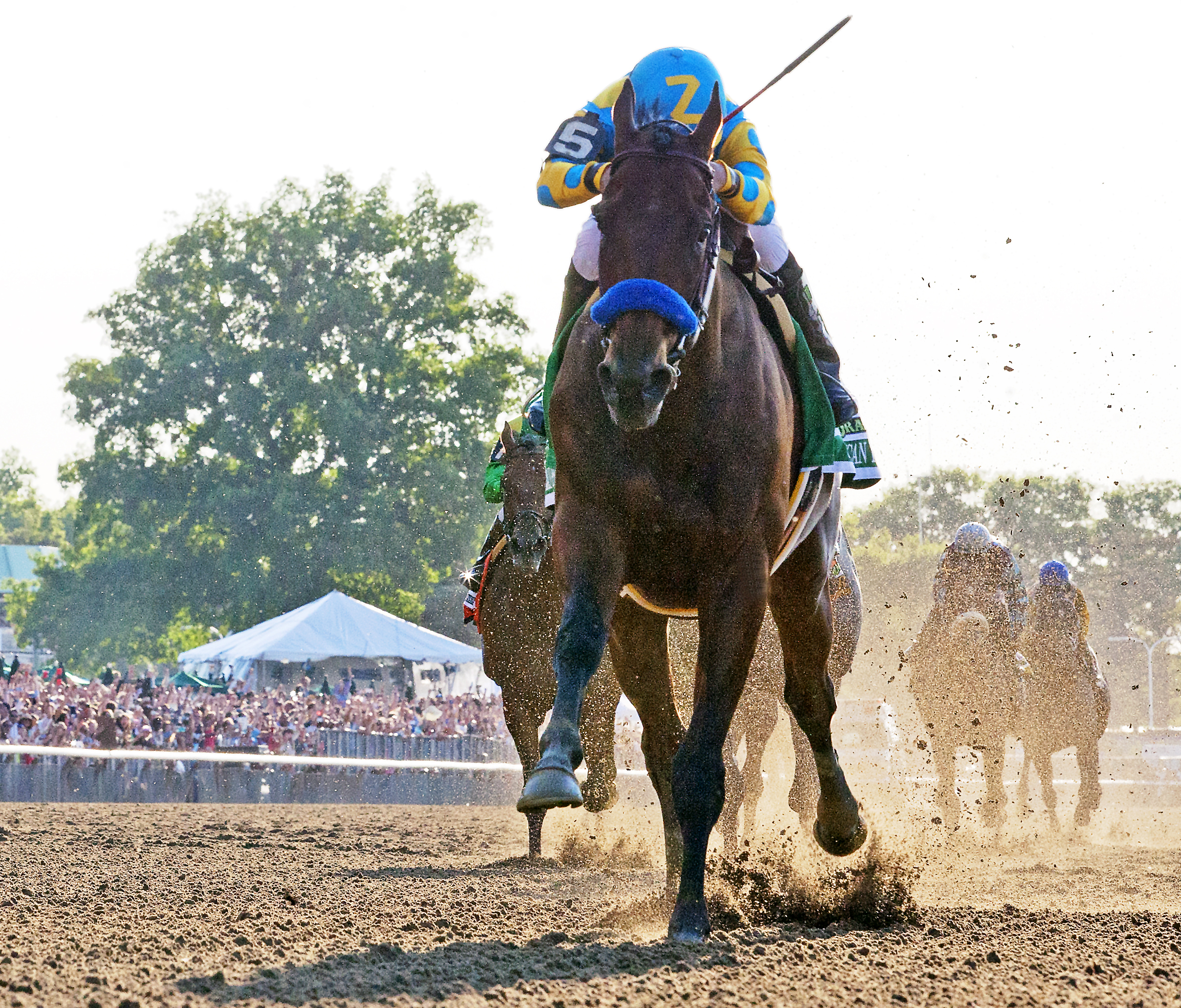
What we all saw, heard, and felt a few minutes before 7 p.m. last Saturday was powerful, uplifting, and cathartic. It was a shared moment that anyone who was watching on television, and especially those at Belmont Park, will never forget.
Nothing can ever change that memory, not silly comparisons to Secretariat, not unnecessary historical perspective, not even a Beyer Speed Figure of 105.
The moment was enough, the absolute explosion in the grandstand, the American Pharoah curtain call wonderfully done by Victor Espinoza, the good feelings that linger still.
My task here, however, is to get past the moment and explain that there was no attempt to denigrate American Pharoah by assigning the Belmont Stakes a 105 Beyer. These numbers are not performance-based. They are arithmetically based, a comparison of all of the times on a day’s card to determine the speed of the surface the horses ran on. With some clear exceptions (the 2015 Preakness being the most obvious recent example), this is much more science than art.
There were nine dirt races Saturday at Belmont Park, including a rarity, two staged at 1 1/2 miles. There was more than enough data to get valid comparisons.
The Beyers are based on final times. The very best comparison was race 6, the Brooklyn, and race 11, the Belmont, each at 1 1/2 miles. Coach Inge won the Brooklyn in 2:27.17. American Pharoah ran the Belmont distance in 2:26.65, faster by 0.52 seconds, not much at all.
In the Beyer system, times are converted to numbers. The difference between the expected numbers and the actual numbers are compiled for the day to get a track variant. That variant is then subtracted from the raw figure on our parallel time charts that equate performances at different distances.
The last five dirt races on Saturday’s card were as clear cut as possible. The surface was exceptionally fast, 27 Beyer points, or exactly four seconds, at 1 1/2 miles. The raw figure for the Belmont Stakes was 132. The raw figure for the Brooklyn was 129. Subtract 27 points, and you get 105 for the Belmont and 102 for the Brooklyn.
Coach Inge had gotten a career-best 104 Beyer when he won an allowance race in the mud at Aqueduct by 12 1/2 lengths April 22. It’s hard to imagine he could have run a better figure at 1 1/2 miles when he won the Brooklyn by a neck. V. E. Day also got a 102 in the Brooklyn, equaling his career best, when he won the 2014 Travers.
Keeping the minus-27 variant in mind, Acorn winner Curalina got a 92 Beyer, 12 points better than her career best. Met Mile winner Honor Code got a 112, a six-point career top after a dream pace-meltdown setup and an incredible final quarter-mile in less than 23 seconds.
I admit to being biased here. I have been making figures since Andrew Beyer’s seminal book “Picking Winners” described the methodology and explained the seemingly unexplainable to me 40 years ago. Time, by itself, means nothing. Time in comparison to other times run on the same card means everything. Once you understand that basic principle, you have a breakthrough moment in understanding the game.
I love the figures, but I also understand how much early pace affects final times and outcomes. I don’t know that Honor Code is a 112 Beyer horse, but he was in the Met Mile because the pace was hot and contested, setting the stage for a really fast final time. When Honor Code runs next, he should be evaluated in the context of how that figure was earned.
I warned last week that if the Belmont Stakes were run like I thought it was going to be run, with American Pharoah loose on an easy lead, it was going to be very difficult for the almost-certain winner to run a big number. The pace on that extremely fast surface was even slower than I expected – 24.06 seconds, 48.83, and 1:13.41. This isn’t a perfect comparison, but on a zeroed-out surface, one neither fast nor slow, the six-furlong split would have been around 1:15.
The coolest thing about the wonderful performance was that American Pharoah ran the second six furlongs in 1:13.24, 0.17 seconds faster than the first six furlongs. This amazing colt, the first Triple Crown winner in 37 years, was running as fast at the end of the race as he was at the beginning. But he could not run that final quarter much faster than the 24.32 he did run it in, so the final time, affected by the pace, could not have been much quicker.
I think if American Pharoah had run the first six furlongs in, say, 1:10.41 and spread the field out, he might have won by 15 lengths as the chasers faded into horse-racing oblivion. The final time would have been much faster, but that simply was not necessary.
Espinoza had the horse with the early speed to control the race. Bob Baffert and his team had brilliantly taught American Pharoah to ration that speed and give it on command. We all saw the result, but do yourselves a favor. Watch the replay again, and keep watching past the finish line. That will tell you more than I can or even the figures can.