

Inquiry sign up on stewards' decision-making policy
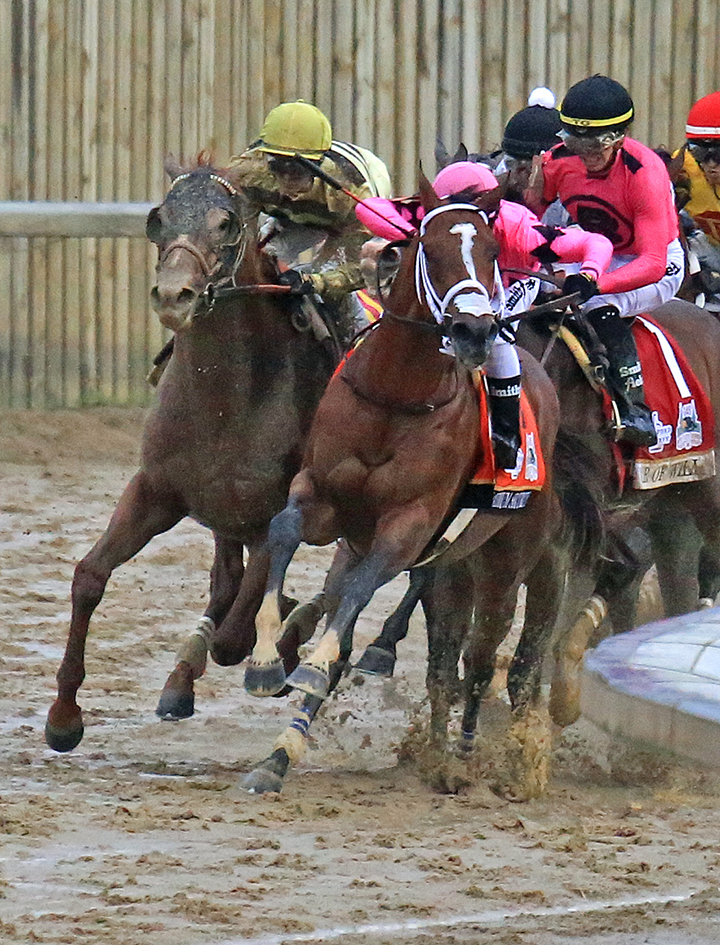
SARATOGA SPRINGS, N.Y. -- With the disqualification of Maximum Security from first place in this year’s Kentucky Derby still fresh in the industry’s mind, issues surrounding the criteria currently used by North American stewards for disqualifications was the subject of two presentations on Tuesday afternoon at the Saratoga Institute on Equine, Racing, and Gaming Law conference, with both officials arguing urgently for change, if from different angles.
Bennett Liebman, the widely respected racing-law expert who is currently a Government Lawyer in Residence at Albany Law School, the administrator of the conference, began an exhaustive presentation during the lunch break detailing the worldwide history of rules governing racing interference and the grounds for disqualification. But he ended with a similarly exhaustive examination of racing’s current patchwork of rules that cover the same grounds, with particular emphasis on a dizzying array of minor variations in the language throughout U.S. racing rulebooks.
Liebman argued that these variations, while allowing for consistency within a racing jurisdiction or at a particular track, are “maddening” and “make no sense” at a time when the sport is disseminated across state lines and into foreign jurisdictions. He called on the sport’s various regulatory bodies to finally settle on a uniform rule defining the grounds for disqualification in less uncertain terms, as well as clearer language to replace squishy terms like “jostling,” “pocketing,” and “finish of the race.”
“Does that mean the first three finishers in a race?” Liebman asked. “Does it mean the first four finishers in a race in the event of a superfecta? Does it mean the purse money that is lost by a horse that finishes sixth rather than seventh?”
Liebman’s presentation finished with brief comments on a current movement by some racing constituents to push for the worldwide adoption of so-called Category 1 rules on disqualifications, which are currently in place in most major racing jurisdictions outside of North America (the other exception is Turkey).
“I don’t know if Category 1 is better, but I do know that we should at least iron out our own language to get consistency here,” Liebman said, before ending his presentation with its title, “Avoiding Maximum Obscurity.”
Under Category 1, which has been adopted in the last decade by France and Japan but has been used far longer in the United Kingdom and Hong Kong, stewards are not supposed to issue a disqualification unless the horse that was the cause of the incident, in the opinion of the stewards, would have finished behind the horse or horses that were impeded if the incident had never occurred. Supporters of the rules frequently state that the adoption of the rules would lead to more “consistency” in stewards’ decisions, citing the fact that in jurisdictions that have adopted the rules, stewards issue far fewer disqualifications than when they were using Category 2 rules.
In a seemingly subtle but profound difference, Category 2 rules generally require stewards to determine whether a horse impeded the progress of another horse. If so, the rules are usually interpreted to require the stewards to place the horse behind the impacted horse in the official order of finish. Even so, there is also a significant amount of wiggle room in the rules giving stewards the leeway to determine whether the incident had a meaningful impact on the race, which is generally where all the debate arises.
Patrick Cummings, the executive director of the Thoroughbred Idea Foundation, a privately funded think tank that has become an outspoken advocate of the adoption of the Category 1 rules in North America, followed Liebman’s presentation with a forceful critique of the decision by Churchill’s stewards to disqualify Maximum Security, largely relying on a set of bullet points laid out in filings by attorneys for the horse’s owner in their challenge of the decision in civil court. But he also claimed in his presentation that the alleged “deficiencies” in the presentation raised “serious questions about the preparedness and professionalism of stewards adjudicating the sport in North America.”
While Cummings did not linger on those claims, he did agree with Liebman on the point that racing’s current rules on interference are “arcane and unsuited to modern audiences,” and used that point to again press his argument that U.S. jurisdictions should adopt the Category 1 rules. As well as leading to fewer disqualifications, he said that the adoption of the rules would increase the North American sport’s popularity overseas, considering that those overseas bettors understand the implications of Category 1 rules better.
“The rules [in North America] have simply not modernized to really engage a global audience,” Cummings said.
Change might be coming. On Thursday in Saratoga Springs, the Association of Racing Commissioners International will hold a meeting of its Model Rules Committee, and interference rules are on the agenda. Then, on Friday in the same hotel, an international committee working to align racing rules across all worldwide racing jurisdictions will open their meeting with a discussion of the relative merits of both categories of rules. Finally, on Sunday, Kim Kelly, the chief stipendiary steward of the Hong Kong Jockey Club, will discuss the topic as a featured speaker at The Jockey Club Round Table Conference on Matters Pertaining to Racing, also in Saratoga Springs.