

With hopes for better days ahead, Hawthorne becomes home for Chicago racing
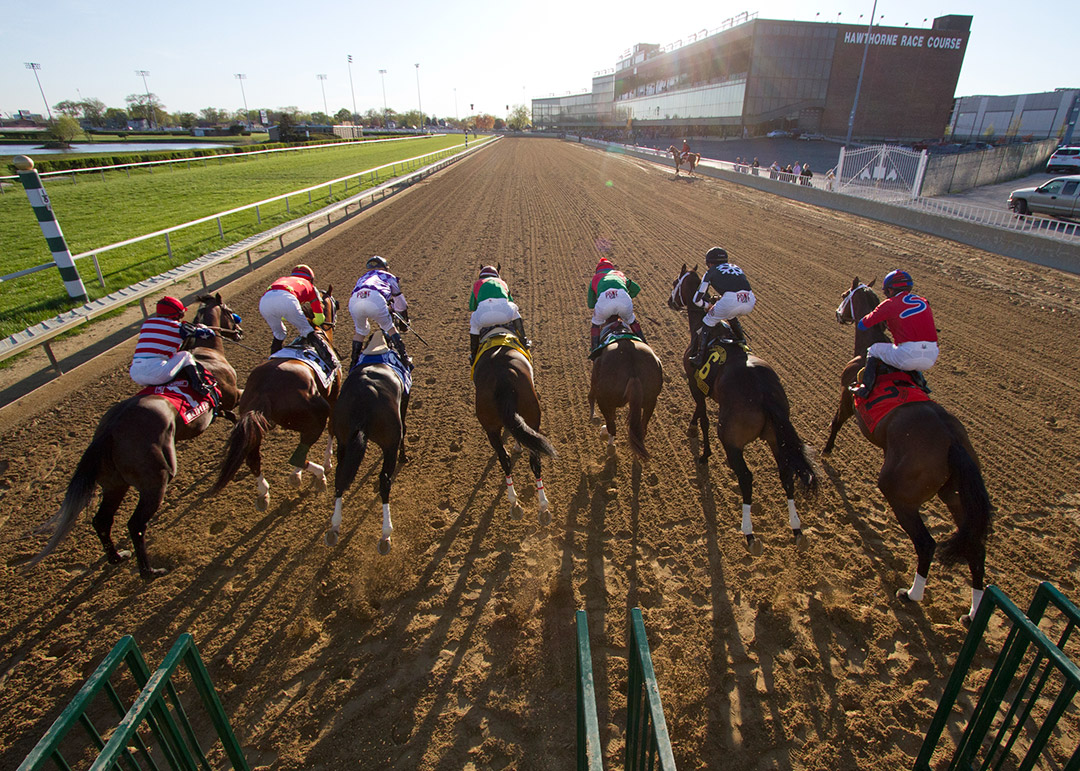
And then there was one.
Hawthorne Racecourse, apparently the Chicago area’s lone surviving racetrack, commences a 34-day fall meet Friday.
The track doubles as a construction zone, with Hawthorne preparing what it hopes will be a casino opening during the first quarter of 2023. Average daily purses this meeting are expected to be paid at a modest $120,000 to $125,000 level. And Hawthorne, which sits in a heavily industrialized corridor at the border of the villages of Cicero and Stickney, never has been confused with a bucolic racing mecca.
Yet this is all Chicago racing has right now.
Arlington’s 2021 meet ended Sept. 25. Arlington didn’t even apply for 2022 racing dates, and barring the unforeseen won’t open again. The Chicago Bears have entered into a purchase agreement with Churchill Downs Inc., Arlington’s parent company, to acquire the Arlington property. Washington Park, Balmoral Park, and Sportsman’s Park on the Thoroughbred side, and the Standardbred track Maywood Park – all those are gone, too. Hawthorne, which just concluded a harness racing meet, is the only Chicago track left for either breed. The Thoroughbred and Standardbred people must awkwardly share the venue during the 2022 racing season, and casino construction halted months ago, leaving horsemen in these parts on edge.
But John Walsh, Hawthorne’s assistant general manager, said financing for the casino project’s completion is close to being in place. Approval for the resumption of work, Walsh said, is likely to be given by the Illinois Gaming Board by the end of 2022, and Hawthorne expects to be able to open its casino 14 months after the work resumes. Moreover, with Arlington gone and Hawthorne receiving all the revenue from Chicago-area simulcast wagers, Thoroughbred purses, Walsh said, should increase by 50 percent in 2022.
“It’s temporarily painful but we think this is a turning point in Illinois racing,” Walsh said. “The future is going to be much brighter.”
Entries for Friday’s first card were solid, with 88 horses passing through the box.
“It’s a good start, anyway, especially since between my two biggest trainers I got one entry,” racing secretary Allen Plever said.
The two outfits are those of Larry Rivelli, who has more than 70 horses stabled at Hawthorne, and Hugh Robertson, who has 60-something. Plever said he gave out 1,300 stalls to trainers that applied, but that Hawthorne typically fills about 80 percent of the assigned stalls.
“We should have 900 to 1,000, which is sufficient to get us through the fall meet,” Plever said. “It’s standard we lose outfits in six weeks or so” when stables move south to winter quarters.
Hawthorne was able to host turf racing into December last season, a boon to entries, but that luxury obviously is weather-dependent. The track’s lone open stakes race is the $100,000 Hawthorne Derby on Oct. 16, a grass route for 3-year-olds. Hawthorne also will host a series of stakes races for the starkly shrunken Illinois-bred population.
The racing week runs just three days, Friday through Sunday (post time 3:10 p.m. Central), as the circuit switches from Arlington’s synthetic surface to Hawthorne’s dirt oval, which features one of the longest homestretches in North America.
The dwindling number of Illinois racing people hope they’re in the homestretch of a very painful period.
“I think it’s important for these horsemen to get some good news pretty soon,” Plever said. “It’s only a matter of time until they start to bleed out of here.”