

History challenge answers: Memories of Havre de Grace racetrack live on
Read the questions HERE.
1. Throughout the 19th century, horse racing was the most popular sport in America, and as it became more organized in the years following the Civil War, tracks sprang up everywhere, from New York to Florida to California.
In many states with racetracks, gambling on horses was technically not even legal; in others, laws were vague. But with the sport flourishing, politicians and authorities seemed content to leave well enough alone. By the end of the 19th century, more than 300 tracks were operating in the United States and 40 in Canada.
Gradually, organizations began to force the hands of politicians, and states began outlawing racing. New Jersey was first in 1894. When California lost the battle in 1909 and New York finally succumbed in 1911, major racing was left only in Maryland, Kentucky, and Canada.
Rushing to fill the void on the Eastern seaboard, Maryland quickly built three new racetracks from 1911 to 1914 – Laurel, Havre de Grace, and Bowie. And once-bankrupt Pimlico became the American leader in purse distribution, a position it held into the 1920s.
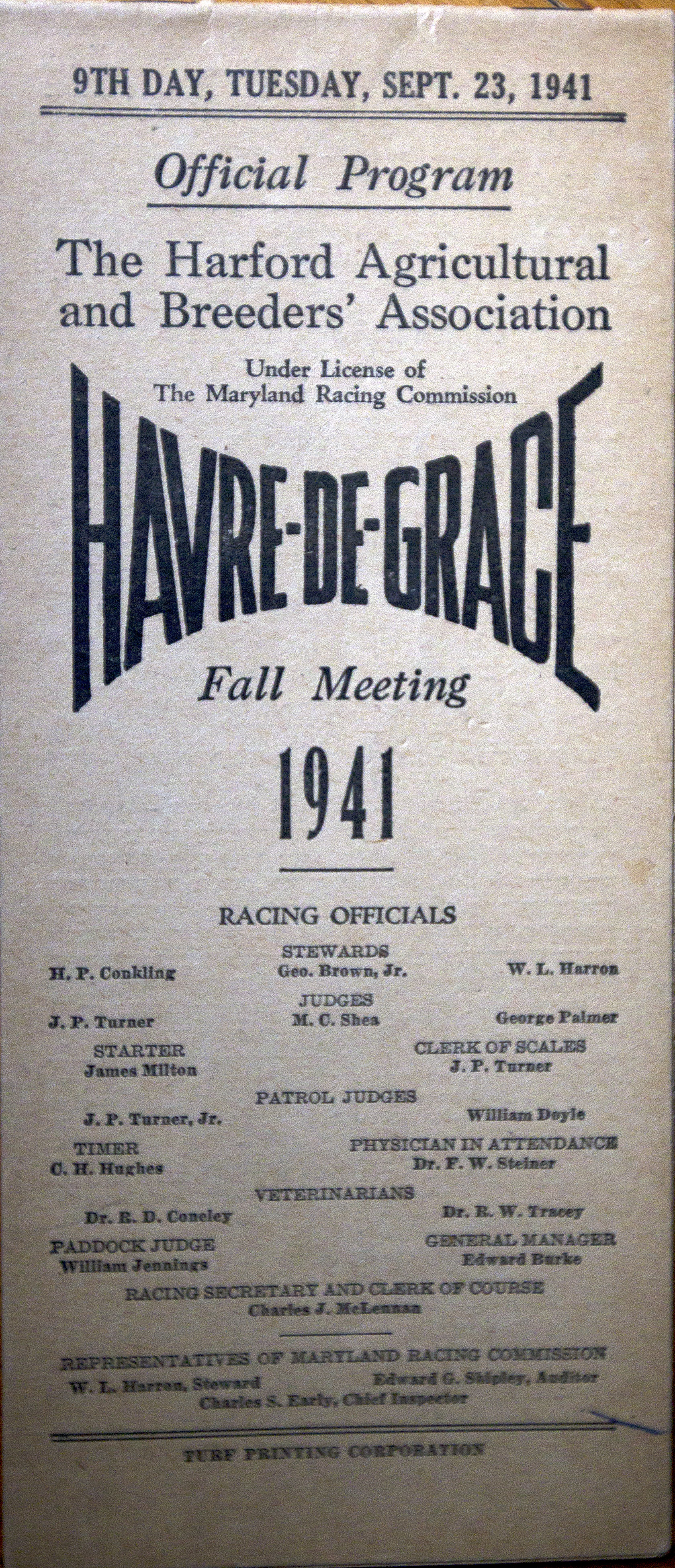
2. Havre de Grace’s general manager from its opening until 1943 was Edward Burke, a tall, burly gentleman with a thick, white mustache.
Burke was a fan of racing as a young boy and began selling his daily tip sheets to bettors. His reputation spread, and when he grew of age, he became a bookie at New York tracks, which would not have parimutuel betting until 1940. Burke was widely respected and admired for his ability to set fair and accurate odds.
He moved into track management, first at Jamaica racetrack in 1903. Burke died on New Year’s Eve 1946 at age 84, and the Edward Burke Handicap was inaugurated at Havre de Grace in 1947 and run until the track’s closing in 1950.
3. Havre de Grace was built on fertile soil that had for decades been plowed and harrowed for farming. For years, the racetrack remained essentially the same – very loose and cuppy – and trainers with long-striding horses like Man o’ War often were disappointed when their stars could not get hold of the track.
Man o’ War’s trainer, Louis Feustel, was not happy when he arrived at Havre de Grace for the Sept. 18, 1920, Potomac Handicap. For one, the track was even more damp and loose than usual. For another, Man o’ War had been assigned the highest impost of his career – 138 pounds. Feustel wanted to scratch.
Owner Sam Riddle did not want to disappoint the record throng that had shown up for the race, for which the track was forced to open the infield for the first time. He would later say that he also wanted to see how much adversity his champion could really overcome.
Man o’ War carried the terrific impost over the poor conditions in style, defeating Kentucky Derby winner Paul Jones in track-record time.
4. Triple Crown champion War Admiral won the first start of his career April 25, 1936, at Havre de Grace, winning a 2-year-old maiden special weight by a nose.
He started three more times at the Maryland track – winning each one. Before taking down the Kentucky Derby, War Admiral captured the Chesapeake Stakes at Havre de Grace, a race Citation would win 11 years later.
Sir Barton was the only other Triple Crown winner to race at Havre de Grace. He made eight starts at the track – all after he won the Kentucky Derby, Preakness, and Belmont stakes.
In 1919, Sir Barton won the inaugural running of the Potomac Handicap, beating his arch rival and stablemate, juvenile co-champion Billy Kelly.
5. When Calumet Farm’s 1945 foal crop were yearlings, future Hall of Fame trainer Jimmy Jones ranked Coaltown at the top of the list, with Citation second.
“It was nearly as right as a man can be and still be wrong,” prominent racing journalist Joe Palmer later wrote.
“No horse since Man o’ War has set or equaled more world records,” Palmer added, referring to Coaltown’s 4-year-old season.
Coaltown was 12-3-0 in 15 starts in 1949, including a walkover in the April 23 Edward Burke Handicap at Havre de Grace. (Six months earlier, Citation had walked over in the Pimlico Special.)