

Harness: A weighty photo finish issue
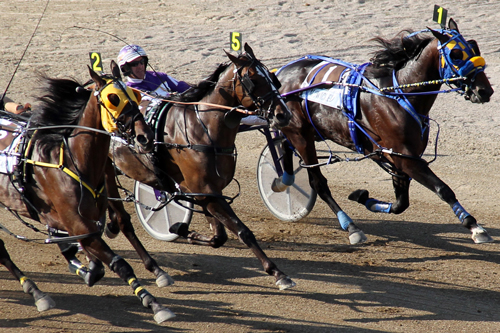
If it is correct to suggest that harness racing belongs in the entertainment business, it's fair to ask how good a job it has done in keeping people's interest and getting viewers excited.
As a veteran of this sport that ventures back into the early 70's, I've seen many things change over time. Much change has been for the better as the sport went from the singular trainer-driver combination to a separation of the talents. This, in my mind, has led to races where driver talent is universally at a high level no matter what track you're watching.
As races have changed and gone faster one image appears further and further in the rearview mirror and seems to have mostly disappeared in today's product: The "close finish" - a compelling factor allowing the sport its popularity in the 60's-80's - has become a distant memory as races have gone faster and heavy favorites, along with speed, have dominated the racing scene.
The first round of the NFL playoffs (January 14-16), where nearly every game came down to the final drive, was a fitting example of the kind of action that keeps viewers interested as the outcome is uncertain until the very end of a three to three-and-a-half hour contest. We may be able to fit 10 races within the same time frame, but one wonders how often we create a suspenseful ending to any of those contests where viewers still have a reason to watch.
The challenge for this sport is quite clear - to survive. Either we become more interesting and give people more reason to pay attention to us, or we continue to play just to ourselves and hope we can bring the next generation of like-minded individuals along to maintain a pulse.
The idea of going back in time would seem futile as the dynamics of harness racing and the allocation of purse money has changed radically over time. Yet in my mind there's still hope for something different on the horizon that asks those in power to take a gamble, if you will, and modify the races to attempt to make them more compelling.
The idea is far from original, but perhaps there has never been a better time to try to implement a system that attempts to balance out the horses within a race, and in the process achieve results where the final eighth of a mile finds viewers at the edge of their seats, still uncertain of the ending. Perhaps 2023 would be a good time to think about adding physical weight to the sulky as a means of handicapping the races to more effectively attempt to balance out the horses behind the starting gate. While harness driver weights are not standardized as they are among thoroughbred jockeys, there's no reason to believe that weight couldn't be added to sulkies to slow some horses down ever so slightly.
Before going further let's just try to understand that the issue here is trying to make the races more interesting and more exciting and not handicap trainers, drivers or owners so that they will lose money in the end. It's a hard concept to grasp because it's natural for each party to get the most out of their investment without restriction. Unfortunately, I believe we're in the current state because no individual or czar has ever been given the authority to monitor the product from all sides and do what was believed to be in the "best interests of the sport." The experiment of slot-funded harness racing has been a success from one aspect of the sport, but unfortunately it has made it all too easy to look away from the actual product and only think of the best ways for owners, trainers and drivers to profit. In the 70's-80's there was no alternate universe to provide purses from and racetrack owners had to be 100 percent focused on the product as the sole source of the purse fund and track profits. Revenue was a product of on-track attendance and wagering on the sport.
► Sign up for our FREE DRF Harness Digest Newsletter
The revival of harness racing has been all too one-sided, and for bettors to get back in the game, the thought here is adding a factor to handicapping that makes it a bit more challenging, and at the same time causes a change to the results that no longer guarantees the 1-5 shot unlimited access to the winner's circle 20 minutes before the race goes off.
The concept is to allow racing secretaries to add weight to the sulky of horses as a means of handicapping them versus others within the race. While post positions may have accomplished this feat on some occasions, the use of them as a handicap has had a troubling impact over time. In the 70's-80's at Yonkers and Roosevelt Raceways, giving post seven or eight to a horse in a handicap race made the event more interesting because even without leaving the gate said horse could still win under those conditions. In today's sport, assigning post eight on a half-mile track more often induces a horse not to leave and bettors to simply ignore them in the wagering. Surprisingly, despite the incredible differences in the effectiveness of such handicapping over the last 50 years, the sport continues to do the exact same thing.
In Thoroughbred racing, just a few extra pounds added to the saddle was thought to make a major difference in performance. It's impossible without experimentation to know just how much additional weight would need to be applied to shave a fifth or two seconds from a horse's best effort. That said, it is something that is worth the experiment. Primarily because it would give not only racing secretaries an added tool to make races more competitive but could be an additional factor bettors use towards handicapping a race.
Added weight could also be an effective tool towards the sport getting a better mix of front-end versus off-the-pace winners. Any move in that direction would not only help the look of the product but would also likely achieve more interest from gamblers of both persuasions.
No plan such as this could possibly work without the total support of horsemen, and perhaps a way to get them on board would not be to handicap them in the reverse. I would suggest that any horses "weighted down" in advance of the race to make them appear more competitive should be rewarded with a larger share of the purse should they accept the added weight and go on to win. In this way both horsemen and bettors are incentivized, and maybe in the end wagering on the sport trends upward.
We can only hope.