
Harness: Time for the tide to switch to an elite racing meet?
There’s nothing like March Madness.
The adrenalin rush of watching five hours of end-to-end action on a Sunday afternoon is what sports and competition are about. That college athletes can lay it all on the line is borne out when the final whistle sounds and the winners are screaming and the losers are brought to emotional tears.
That Sunday afternoon followed a Saturday night at Yonkers Raceway where the first three races saw literally nothing happen during half of what we attempt to call a horse race for prize money. The game of follow-the-leader may have been compelling when I was a 5-year-old, and even that’s a stretch, but to witness it for three races on a Saturday night in succession is too painful for someone that loves harness racing more than basketball.
It is crushing what we have become and even more depressing that hardly anyone seems of the mindset to change it.
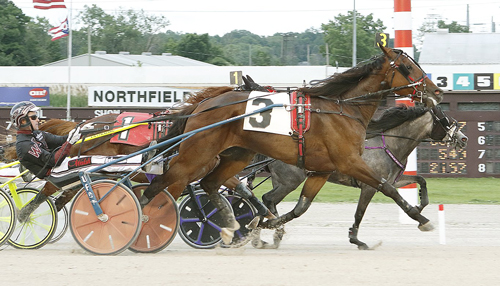
Trainer Ron Burke, in a passing comment, took note of the position horses from his stable were in this past Saturday and what was not likely to work in their favor. “If they go 30 seconds in the second quarter we’re not going have much of a shot. I can’t figure out why they are on the move past the quarter at Northfield Park (half-mile track) but wait until the third turn (past the half) to move at Yonkers,” Burke said, stating what has been the obvious to many loyal and ex-Yonkers watchers.
One could argue that there are ways to correct the imagery on the screen and I have been among those. Yet, nearly 15 months after a Director of Racing was appointed at Yonkers, literally nothing has changed with the exception of post time manipulation and the removal of the passing lane.
Perhaps the most painful aspect of what is being scheduled at Yonkers these days is that horsemen are essentially taking advantage of a system that has been set up by the track and the horsemen, and hasn’t been motivated to change by time or lack of success. It’s one of the hidden factors of a business that is guaranteed to continue even if profits fall or are non-existent.
Motivation for change requires a need and clearly by the actions in the race office or that of the horseman’s organization, keeping the status quo is far more financially beneficial than making alterations to improve the product.
The grim reality is our inaction is not a basis for future success. At Yonkers I was behind President Joe Faraldo and the Standardbred Owners Association of New York when it put a hard stance on maintaining a yearlong schedule when slots were first introduced in 2007. He was right to be wary of efforts to shut down harness racing in favor of slot revenue and an insistence on maintaining racing dates was the core principle.
Fast-forward some 12 years and as in many businesses the climate is quite different and the future challenges are immense. At Yonkers the number of racing days has become a handicap to competitiveness. It has given many horsemen the option of racing a horse easy when it draws outside and save the best for the following week or weeks. Time doesn’t run out on this strategy and due to a condition system that rewards lack of effort, there is much profit to be had in the process.
There have been so few changes to the condition sheet, but when the non-winners of a race class was expanded to eight a few years ago it opened the door further to lack of effort and short-priced favorites. Those classes were great for owners and suddenly a new market developed where horsemen searched Down Under for horses that could milk these classes.
Again, few horsemen will argue when the money is so good and the prospect for earning is year-round. But just how comfortable can a future look with expenses continuing to grow for putting on the show and the horsemen doing little to pick up the increasing tab?
The bottom line has to count at some point in time and while we have taken from the dollars given by State legislatures, we have produced fewer dollars from our core business.
Which brings up the question, why do we need 234 racing days a year at Yonkers Raceway?
Each racing day causes an expense to the host track. Couldn’t the racing side of the equation be more profitable (or less costly) to the track owner if it didn’t have to host as many days of racing?
The horse population has already brought upon shorter racing cards (10 races) and fields with as few as six horses. This in effect compounds the competitiveness problem even further.
Yonkers has reduced its racing calendar by four days from 2018’s 238 to 2019’s 234. It’s the kind of sweeping decision that will hardly be noticed by the horsemen and that is essentially our biggest problem.
The only true option left at Yonkers is for a drastic date reduction to be implemented that would change the system and put a jolt of energy into a meet or meets that horsemen throughout North America can look forward to.
An elite meet if you will, with significantly higher purses but fewer guarantees of racing four times a month. An elite meet where the nightly program wouldn’t always have the same names training and driving in each race.
We’ve reached a point in time that those in power that have held grittily to the status quo, must respect those who share the property along with the cost of doing business. Horsemen and our horses do not need 12 months of racing. Hall of Famer David Miller proved that by taking the winter off and returning perfectly fit and ready to compete, perhaps even excited to be racing.
This sport needs to think of the economics of racing and not just the benefits of favorable legislation. It’s time for bold change because as a sport and a business we must compete on and off the track.