
Harness: Thoughts on the passing lane
Whether you are an owner, trainer, driver or bettor, when the field is coming around the final turn and your horse is sitting in the pocket just behind the leader, only one thought is on your mind -- will my horse find room in the stretch?
Those few seconds of insecurity on tracks without a passing lane, from the moment the horses enter the stretch until (hopefully) a glimpse of daylight appears for your horse to charge to victory, can seem to last an eternity. The horse seems to be loaded with pace or trot and is just waiting for their moment to shine. Will it happen?
The majority of the time, a seam appears. It doesn't seem logical that the driver on the lead would want to open up a hole to his or her left and allow the horse behind easy passage to victory, but it happens over and over again. There are a couple of variables at play here. First, horses have a tendency to drift out at the end of the mile when they are tiring and many drivers will tell you that fighting with a horse to keep them from drifting is counterproductive because it hurts momentum. Secondly, racing can be a bit too friendly at times. At most tracks the same drivers compete against each other every day and no one wants to be the person who is playing cutthroat in an overnight race, especially if their horse is tiring and wouldn't win anyway. Ruthless driving leads to enemies and that results in a much more difficult road to the winner's circle on a daily basis.
So, the most of the time there is no such thing as getting "locked in the pocket" during a race, but it does happen. When? If a horse doesn't drift in the stretch and can go a straight line at full speed, there is a chance that the driver will keep the inside path closed. If there is a non-regular to the track in the pocket or an "unfriendly" who may have recently hurt that drivers' chance of winning a previous race, there is a chance of getting trapped in the pocket. If it is a stakes race and letting someone up the inside could cost the connections thousands or hundreds of thousands, there is certainly a chance that a passing lane won't miraculously develop from thin air.
What's most frustrating is the inconsistency. Why should one situation allow the horse sitting behind the leader to find room and another one end with the horse trapped without racing room?
Of course the "passing lane," a path to the inside of the track which provides an outlet for the horse in second (or third) to have an uninterrupted road to race, is available at some tracks. The recent trend has been to remove passing lanes to promote more movement during races. The theory is that drivers are more likely to make moves during the race if they can't sit along the pylons and simply wait for clearance. There is some logic here, though it never really played out on the track. The passing lane does encourage drivers to be more patient, especially on smaller tracks where saving ground through the turns is important, but at a track like Yonkers, for instance, removing the lane didn't do much to change those tendencies because spending too much time in the two-path was quite detrimental to victory.
By now you are probably wondering, where are we going with this passing lane discussion?
Wait for it . . .
Too often we live in a black and white world. There should be a passing lane as previously outlined at other tracks or there shouldn't be one. There should be a passing lane on smaller tracks but not on larger tracks because that is what has always been done. It seems in harness racing, as with the rest of the world, sentences tend to start with The Mandalorian saying "This is the way," basically etching in stone the status quo as the only possible path.
Hoosier Park bucked the "This is the way" trend when it added a 660-foot passing lane to its seven-eighths track in 2016. Whether it did anything to improve the racing product is debatable, but it never hurts to try something new or something old in a new environment.
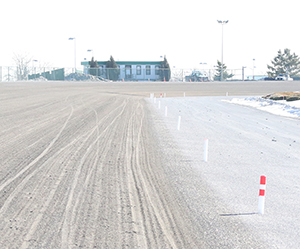
Hoosier Park aside, a passing lane starts at the beginning of the stretch and lasts until the end of the stretch. The length of the passing lane is typically between 400 and 660 feet, which is longer than a football field and in most cases further than the distance to centerfield at a baseball stadium. Depending on the length of the passing lane and the quality of the horses, the opportunity to move to the inside path and gain ground lasts between 10 and 14 seconds. Think about that amount of time in your head . . . . one Mississippi . . . two Mississippi . . . three Mississippi. It really is a long period of time and therein lies the problem with the passing lane.
If the idea behind the passing lane is to provide a "strong" horse sitting just behind the leader with a clear path in the stretch, why are we providing them with so much time to succeed? Of course some horses are slower to hit their top gear than others, but isn't five to six seconds more than enough time for the "pocket-sitter" to win up the inside?
The passing lane falls into the category of good idea, wrong execution. A shorter passing lane is the perfect answer to providing a more consistent experience. Horses sitting the pocket would have a clear opportunity to win, but at the same time the reduced distance would remove the advantage of saving ground third or fourth on the rail as a viable game plan, since there wouldn't be enough time for those horses to take advantage of the inside path.
The idea of a 200-300 foot passing lane would even work at a larger track like The Meadowlands. Nothing is worse than watching 10 straight races where the leader drifts off the cones to allow the pocket horse room and then in race 11 when you need the pocket horse they got locked in and never find room. It's not about being a disgruntled bettor who is mad that they lost. Again, it's about consistency. If an inside path is going to materialize most of the time, it should be there all of the time.
In the overall scheme of things, changing the passing lane as above is not going to transform harness racing into the national pastime of any country. It's simply a baby step that could provide players with a better overall experience and give participants from all aspects of the sport one less reason to be disenchanted.