

Harness: Replacing the Gural Rule
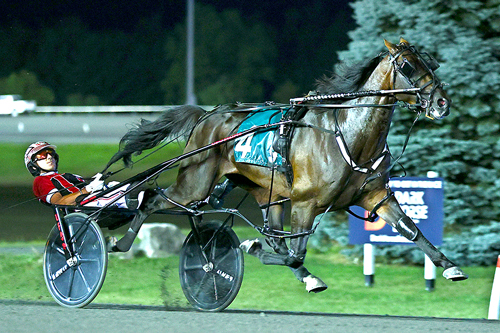
The Gural Rule - three words that almost instantly bring a reaction to most people involved in the Standardbred industry. In theory, almost everyone can agree that the sentiment behind it - which is to keep the male stars of racing on the track through their 4-year-old season - is legitimate, but functionally it has failed to produce the desired results and can leave a bad taste in the mouth of many who purchase rule-restricted yearlings.
Briefly, the Gural Rule says that in order for the progeny of a stud to be eligible to select races - Meadowlands Pace, Stanley Dancer Memorial, Zweig Memorial, etc. - at the Meadowlands, Tioga and Vernon, the stallion must race at age 4 or get an injury exemption. Downbytheseaside is the most recent horse of prominence to be affected by the rule as his son Pebble Beach, the North America Cup winner a few weeks prior, was ineligible to the Meadowlands Pace this past July.
The problem with the Gural Rule is that the financial benefits of joining the stallion ranks often outweigh the gains available on the track. This factor has led to 3-year-olds completely disregarding any negative effects from the rule and going right to stud duty. The evidence has presented itself loud and clear in 2022 as King Of The North, Temporal Hanover, Pebble Beach and Rebuff (injured) all retired. They follow a long line of horses in recent years who never stepped foot on the track as 4-year-olds, like Greenshoe, Captain Corey (excused), Perfect Sting (excused), Tall Dark Stranger, Captain Crunch (excused), and the list goes on.
On top of that, yearling buyers don't seem to be shying away from the sons and daughters of these prohibited stallions. The ineffective nature of the Gural Rule is evident in the actual sale prices of the yearlings. Greenshoe checked in second at the Lexington Selected Sale with an average of $130,792 per yearling and sixth at the Standardbred Horse Sale with $70,297. Downbytheseaside progeny averaged over $80,000 per horse!
While Gural admits that the Stallion Restriction Condition (the technical name of the Gural Rule) isn't working, he has also refused to shift gears and publically said he has no intention of changing it. He partially blames the Hambletonian Society and Woodbine for jumping ship on the restrictions after experimenting with it for just a couple of years. At this point it is irrelevant why the rule has failed to deliver and certainly useless to place blame anywhere. The question should be, how do we solve the problem (assuming you agree there is a problem) with a different solution?
As many new parents from the last 20 years can attest, positive reinforcement is now preferred when teaching kids right from wrong. The days of spankings and negative consequences have been replaced with "timeouts" and other methods. This is perhaps where the Gural Rule goes astray. Rather than creating incentives to race as 4-year-olds, it places punishments for 3-year-olds that chose to sit on the sidelines and become stallions.
The problem is not in the intent of the Gural Rule, it is the details and execution of the plan. We need to reward those that return as 4-year-olds and not shine the light on the punishment that will perhaps exist in the background. With that, I present a plan that every track should be able to embrace if they want, but certainly the Meadowlands, Tioga and Vernon could adopt alone.
Gone are any restrictions on which horses can and cannot compete in certain stakes races at specific tracks and returning is an open system where if you nominate you are eligible. Replacing the restrictions will be a restructuring of the purses to favor those stallions which race as 4-year-olds. Here is an example using the Meadowlands Pace.
Currently, the Meadowlands adds at least $300,000 to the purse of the race. The suggestion is that only $200,000 is added to the final purse and the other $100,000 is split, with $50,000 going to the connections of horses from a stallion that raced as a 4-year-old and the other $50,000 going to the entity which stands the horses (assuming the stallion raced as a 4-year-old).
The above $50,000 payments could be made to all sons or daughters of stallions who raced as a 4-year-olds that competed in the race and distributed at some sort of percentage breakdown – highest finisher gets 50%, second highest 25%, third highest 15% and fourth highest 10%. Assuming that the son or daughter of a qualifying stallion doesn't win, what could be more interesting is if the highest-finishing horse by a 4-year-old stallion got $25,000 and the other $25,000 carried over to the following year to create a jackpot. So, if a son of Downbytheseaside won the 2023 Meadowlands Pace and a son of Tall Dark Stranger won in 2024, there could potentially be $100,000 in bonus funds ($25K from each carryover and $50K from the current year) available to the connections of the winning horse and the breeder of the stallion in 2025.
Now we have a system in place where everyone can compete and there are incentives - for the owners and breeders - to continue racing a stallion as a 4-year-old. Would it be enough to convince horses to stick around for another year if the Meadowlands alone adopts this structure for its stakes? Perhaps not. But at least it creates a more open playing field while incentivizing racing for 4-year-olds, and it introduces a formula that other tracks could install. Think about it, if there was a half-million in bonus dollars available to eligible 2- and 3-year-olds and their breeders, wouldn't that entice someone on the fence to race an extra year?
► Sign up for our FREE DRF Harness Digest Newsletter
Of course the above is just one solution. Perhaps resurrecting an old system is another potential way to fund an expanded schedule of races for 4-year-olds. The Classic Series, which existed in the late 1990s and was disbanded in 2009, created a circuit of races for older horses at a number of tracks and culminated in $250,000 finals.
The purse structure of TCS was in part funded by a 1% surcharge (.5% for the buyer and .5% for the seller) on the sale of horses at auction. Operational expenses were paid by the sales companies. Could an infusion of money like this to fund races for 4-year-olds, or even 4- and 5-year-olds, convince Gural to retire the stallion restrictions he has in place? Reviving this funding structure, which would account for well over $1 million using the 2022 sales, would certainly produce enough purse money to create a viable series of races to supplement the current Graduate Series (as well as a couple of other stakes) for 4-year-olds and incentivize colts to continue racing past the age of 3.
Or maybe the entire system should be reimagined?
What if we took all of the added money from 2-year-old races and used it to create races for 4-year-olds or combination races for 4- and 5-year-olds? Then we could take the sales money and use that to fund the 2-year-old races. Isn't there more of a symmetry to that system? The buyers and sellers of yearlings help to fund the very important 2-year-old races for auctions and the tracks help to fund the older races which tend to entice more people to bet and attend the races.
Doing just a quick count of added money in major 2-year-old races like the Doherty, Haughton, Wellwood, Metro, Matrons and Fall Final Four races from 2022 accounts for at least $700,000 (USD) in extra money. Along with nomination and sustaining payments, that could easily fund a rich new series for older horses that visit multiple tracks. Is it too much to think that Caesars (Hoosier, Philadelphia, Scioto), MGM (Yonkers, Northfield), Bally's (Dover), the Meadowlands, Woodbine and one of the Kentucky properties could get together to make this happen - one leg in each jurisdiction and a rich final that rotates each year?
Certainly now, on the heels of one of the most magnificent 4-year-old season we've ever seen via Bulldog Hanover, it is the right time to consider finding more innovative ways to get 3-year-olds to give it a go for another year. Bulldog Hanover captured the attention of people inside and outside of the industry, increased handle and was a star the sport desperately needed. If the obvious value of his appearances didn't convince you that harness racing needs horses to spend a bit more time on the track in order to capture a wider audience than nothing will.