

Harness: Key indicators pointing way up for Standardbred Racing
If there were a President of Standardbred Racing required to deliver a "State of the Industry" address each year, the 2021 version of such an address would most certainly include these words: "I am here to report on the state of our industry and it is strong."
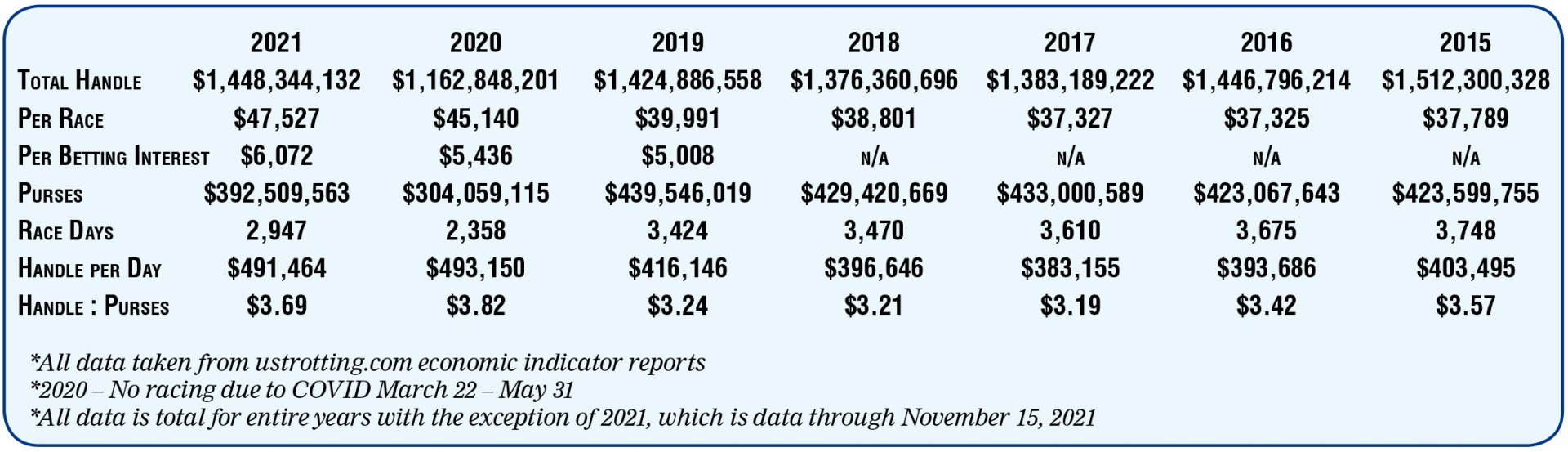
Through November 15, wagering handle is up $450 million from the COVID-impacted 2020 and is up over 7% per-race, which takes into account the days lost to the COVID pandemic. In addition, harness racing is coming off an incredibly successful Breeders Crown, which included a Saturday race program conducted in the afternoon for the first time that handled over $4.1 million. Total handle on the two Breeders Crown programs pushed $7.4 million.
In 2019, the last full year of racing prior to the COVID-19 pandemic, the total amount wagered on harness racing was $1.425 billion. Currently the total handle on harness racing for 2021 (through Nov. 15) stands at $1.448 billion, already surpassing the final tally for every year dating back to 2016, and it is $64 million away from the $1.512 billion wagered in 2015. Given that harness racing is averaging over $31 million wagered per week in 2021, combined with the fact that The Meadowlands is racing through the end of the year and there are six weeks of racing left, handle should easily surpass the 2015 mark and could move past $1.6 billion.
Even more impressive is the amount wagered per-race. In 2015, when over $1.5 billion was wagered, there was an average of $37,789 bet on each race. In 2021, that figure is $47,527, an increase of over 25% from the 2015 season. Additionally, there has been $3.69 wagered for every $1.00 spent on purses in 2021. In 2015, that figure was $3.57, showing that wagering is growing compared to purse money spent, which is a massive positive in terms of economic indicators.
There was a question after 2020: Can harness racing continue its upward trend and sustain the momentum it built when it was one of the few gambling opportunities available throughout the COVID-19 pandemic? Based upon the economic indicators related to handle, the answer is a resounding yes.
The second important factor is the breeding industry. The customers are betting at a higher rate than they have in at least six years, but how are horses selling? The answer is simple . . . very, very well.
The just-completed Standardbred Horse Sales Company auction at Harrisburg concluded with a record for the highest average price for a horse sold at $53,527 and produced the second-highest grossing sale in its history at over $69.4 million. Even more remarkable is the 2021 Harrisburg sale fell only $750,000 short of the highest gross ever in 2007 despite selling 739 fewer horses, hence the massive average price per horse sold. The previous record for highest average price came in 2019 with a mark of $45,292. The 2021 sale smashed that plateau by more than 18 percent. In addition, of the $69.4 million in sales, $42.5 million stemmed from the yearling sale, a near-record as well.
The overwhelmingly positive results in Harrisburg were fairly predictable following the smashing success of the Lexington Selected Yearling Sale the previous month. That sale established new records virtually across the board, including gross sales at $56.69 million and average price at $65,692. The sale also included 159 six-figure yearlings. The first session average at Lexington of $161,217 bordered on the absurd when compared to history.
Is this a harness racing renaissance?
Well, that remains to be seen. But to say there are positive indicators across nearly every metric within the industry is factually accurate. Customers are betting at a higher rate and owners are spending more on the horses being sold. Those are the two key positive indicators that translate to a healthy harness racing industry.
We asked at the end of 2020: "Can harness racing carry the momentum from 2020 into 2021?" Surely that answer has proven to be yes, but the industry also must recognize the opportunity that exists and continue to strike while the iron is hot. This is no time for complacency. It is up to the leaders of the industry to identify what has caused this resurgence and continue to build off that success. This is not the time to put your feet up and ride the wave.
As we approach the Thanksgiving holiday and close out 2021, harness racing certainly has a lot to be thankful for. After years of waning numbers, concerns about horse population and declining handle, the arrow is now pointing upward. Let's all work together to continue that trend and make sure that 2022 is every bit as successful as 2021.
► Sign up for our FREE DRF Harness Digest Newsletter