
Harness: If Major League Baseball can change, so can racing
Major League Baseball has been more than tinkering with its game over the last few years. Some of the changes include adding a universal designated hitter, banning the shifting of infielders to one side of the field and perhaps the most dramatic move, installing a pitch clock to speed up the pace of the game.
Certainly all of the changes have supporters and detractors. The key here is that MLB is tinkering with a nearly 150-year-old sport to make it better and perhaps more modern in a society that prefers instant gratification and action on the field.
Harness racing was once a more popular sport than baseball, and while those days have come and gone, racing is still a billion dollar industry in the United States alone. Just as MLB has a rich history, which perhaps needed tweaking for today's society, racing too is steeped in tradition that wouldn't be wiped away by a few changes.
Some will say that like MLB has sped up the game - by adding the pitch clock and reducing it 20 to 30 minutes from an average of just over three hours - racing needs to follow suit. They will say that programs that last more than five hours are too long and wear people down. They will say that waiting 20 to 25 minutes between races is way too long and turns off the casual fan. There is likely some merit to all of the above. Even I get worn down at times as the clock approaches 11:00 p.m. and I've already watched a dozen races. But the answer is not speed as much as it is cooperation.
We live in a simulcasting world and perhaps the sport should embrace that aspect. Every track has downtime between races. Some fill that space with a bit of in-house commentary or show commercials, but in the end there can be anywhere from two to eight minutes where people are simply stuck with the simulcast feed and no content. With that, the suggestion is that tracks partner-up.
I've given up the idea that all tracks can work together to form a schedule where there is little overlap and the ability to maximize exposure for all. It simply won't work in the U.S. system because there is just no desire to make it happen. But what about the buddy system. What if each track worked with just one other track and propped each other up? Take those few minutes of "dead" air and show the race of your partner track. For instance, on Mondays Monticello (12:10 p.m. post) and Saratoga (12:00 p.m. post) could work in tandem, as could Miami Valley (4:00 p.m.) and Dover Downs (4:30 p.m.), plus Yonkers (7:00 p.m.) and Woodbine Mohawk Park (7:00 p.m.).
Certainly this extra exposure can only improve the content and handle of both tracks. Watching a race while waiting for the next event at your home track has to be preferable to viewing a screen with irrelevant odds, since most of the handle funnels into the pools in the final minutes before post time.
Switching gaits
As a regular watcher of Cal Expo, every once in a while Director of Racing Robin Schadt throws us a curveball (to continue the baseball theme). Dubbed the "Double Down Invite," Schadt has come up with the concept of pitting trotters against pacers. That's right, a mixed-gait race.
Typically the Double Down has some of the second-rung Open trotters on the grounds facing the worst pacers. In the last event of this type on February 24, a trotter won as the 4-5 chalk and two pacers finished behind him at 14-1 and 23-1. Not surprisingly, the trotters, who had better form on paper, took all the money in the race.
"When people come out here they are on an island. There are no other tracks where they can go to find a softer spot, so I have to make it work and find a way to put money in their cards so it is worthwhile for them to be here," said Schadt, who tends to card these races with a few trotters which have been getting just small checks and a few pacers which have been getting little to no money against their peers.
Thinking on a larger scale, why couldn't a trot/pace work at other tracks in the sport as a novelty once a card or once a week? Something different to throw at the audience in order to break up the norm might be well-received.
"We need something different," said Schadt.
On March 2, Yonkers Raceway offered a five-horse Open Trot that went in 1:54 2/5. Certainly throwing a few pacers of similar ability into the mix and offering an eight-horse field would be not only more enticing for the bettors but also create larger handle.
"I think it can be done, but the person carding the races has to be in tune with what level of pacers you can put with the trotters," said Schadt, who admitted there were times when she considered doing it at Hawthorne as well.
This week's Double Down was captured by pacer Infinite Horizon in 2:02 3/5 over a sloppy track. The victory was his first of 2023.
► Sign up for our FREE DRF Harness Digest Newsletter
Different distances
Just because our horses are called Standardbreds doesn't mean they can only race at the distance of one mile. Many tracks - from the Meadowlands to Cal Expo - have experimented with racing shorter and longer races from three-eighths to more than two miles, but it really has never stuck as a regular mainstay at any track.
For a number of years a bit more than a decade ago, Georgian Downs hosted Xtreme Horsepower, showcasing horses at varying distances from an eighth of a mile to a mile and a quarter on the same card. The track even had horses going the wrong way on the track, as well as other innovative ideas. It was a neat card to watch but perhaps too difficult to embrace for handicappers. From the perspective of the wagering dollar, you can't go too far outside the box if you want people to invest their money. But throwing one race that is a little different, maybe a mile and five-eighths event at the Meadowlands or one and three-eighths at Pocono seems like a fun little change of pace once a night.
"People have messed with going different distances, and that doesn't always work so well. Sometimes the problem is that they don't want to let them go on the turns," said Schadt, who has carded some marathon races at Cal Expo. "Every now and then I'll throw a route race on the card, but it is a little harder here. You have some horses that are sound enough to race, but you don't want to be throwing mile and a half races at them too often."
Bring back the women
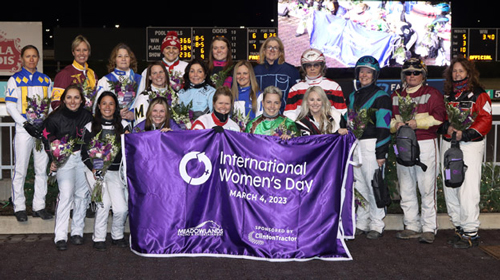
On March 4, the Meadowlands hosted women drivers from all over the globe. The results were a pair of full fields (10 and nine – due to one scratch) and a nice event for the track as they celebrated International Women's Day.
While some people will have you believe that the best drivers in the sport are needed for wagering to remain at the highest levels, the Meadowlands saw over $627K wagered on the two women races, with many participants that you never see in the bike in New Jersey and only race occasionally in their home regions. The fourth race handled $364,938, making it the highest non Pick 4/5 race on the Saturday night card.
I wouldn't mind seeing these fine women come in once a month to race. Perhaps each appearance doesn't require the pomp and circumstance that was well done by Jessica Otten and team at the Meadowlands, but it is nice to see something different.
None of the above changes are going to make harness racing as popular as MLB or any major league sport. That is an unachievable goal. It's all about baby steps.