

Harness: Geldings took charge in 2020
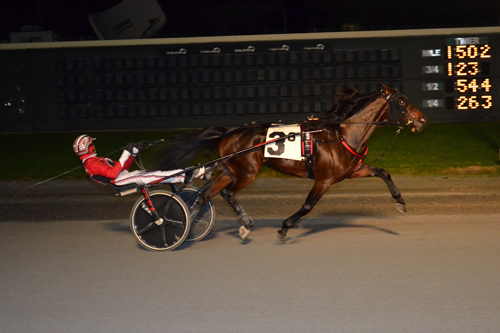
To anyone that's set foot at a harness track in the last 20 years, the presence of geldings in races, whether claiming or conditioned, was a given. The famed Foiled Again was this generation's most recent reminder of the impact geldings have on our sport. The great Rambling Willie set the bar high for Foiled Again back in the 1970's but despite his many travels never quite achieved what Foiled Again did at an advancing age. In 2020 the sport has evolved in many ways. Perhaps the biggest change we've seen this year is the supply of geldings not just racing in aged events, but those who show up in 2 and 3-year-old stakes races and prosper. This is something more unique to the sport now, as greater numbers of trainers and owners give up dreams of stallion-hood in the early stages.
Trainer Richard "Nifty" Norman had a legitimate concern when breaking and training this year's 2-year-old Bee Forever. "I thought he might hurt himself or hurt someone else," said Norman about the Muscle Hill colt out of the Horse of the Year Bee A Magician.
Norman trained Bee A Magician and was entrusted to get her first foal to the races. With Muscle Hill the sire, there's no telling what the colt could have commanded had he gone through the auction ring, especially in concert with a pair of yearlings that brought $1 million plus. Bee Forever was withdrawn from the sale and the reason was another factor in Norman's opinion. "He had surgery on a knee and the x-rays weren't very good," said Norman, defining why Bee Forever did not go through the auction block. "I was definitely concerned that he might injure that knee again."
Needless to say, despite all of the problems Bee Forever faced growing up and the challenges Norman would have breaking him and making a racehorse out of him, the decision to geld him was an easy one. "My job is to get them to the races," Norman said. "It took a while to convince David (McDuffee), but I told him I wouldn't train the horse if I couldn't geld him."
The move ended any potential stallion career for the blue-blooded colt but paved the way for Norman to do everything he could to get the horse to the races. Surprisingly to some, Bee Forever progressed slowly this fall and found his best footing in his final two starts of the year. A solid third while blocked through the stretch in the Kindergarten Classic final at The Meadowlands on November 7, Bee Forever made a prolonged rally to collar favorite and Breeders Crown champion On A Streak in capturing the Valley Victory in a career-best 1:54 clocking to cap off his season.
"I have to give Vic (Kirby) a lot of credit for helping to teach him how to be a racehorse," said Norman of the driver who stuck with Bee Forever when others found horses that were more advanced at the time.
Norman's 2020 season was made all the more special by another gelding that will likely capture divisional honors in Amigo Volo. "He was just an idiot," Norman stated bluntly when asked why the son of Father Patrick was gelded as a 2-year-old.
For the trainer, no matter what the potential talent that may be evident in a trotter, getting to a finished product can either take time and a few more gray hairs or you can cut to the chase. In the case of Amigo Volo, making him into a racehorse required him being gelded and his talent proved out over the past two racing seasons. The sweet part of course was the numerous stakes victories, including back-to-back Breeders Crown titles, and finishing off his sophomore season with a blistering world-record 1:50 2/5 performance in the Matron at Dover Downs on November 12. Through his 27 lifetime starts, Amigo Volo has earned $1.5 million on the track and could be in line to be among the best when he returns as a 4-year-old in 2021.
"I was impressed with his last start," said Norman, who quickly deflected some of that praise of the open-lengths victory to what remained of the sophomore class. Needless to say it was a visually powerhouse performance, putting a wrap on the season with Amigo Volo winning seven of his last eight starts in stakes races.
Amigo Volo is the type of horse that you might not have seen race as a 2-year-old in past years as trainers hoped the horse would outgrow "immaturity" and gain some smarts as a sophomore. Yet today it's really a matter of giving a horse every chance to race at age 2. Given the speed even the freshman has to travel these days, it's hard for an unraced 2-year-old to step into 3-year-old stakes action.
For Norman and a growing number of trainers these days, there is very little to argue about when they see a horse with potential that could be a danger on or off the track. "The way I see it, the upside is you give them a chance to be a racehorse. There's no way Bee Forever would have raced this year if we hadn't gelded him," said Norman. "The plus side is we got him to the races, the down side is that he won't be a stallion. But how many horses turn out to be stallions anyway?"
Away from the Norman stable this season were a pair of exceptional pacers that happen to have been gelded. Trainer Nancy Takter gelded No Lou Zing last year hoping to make a racehorse out of him. That project took a little longer to be finished, with Takter employing Josert Fonseca to drive the son of Sweet Lou through a pair of huge miles in the Adios elimination and final before turning the lines over to Dexter Dunn. It was Dunn who guided No Lou Zing to a Pennsylvania Sire Stakes championship victory and earned over $500K in 2020 following a 2-year-old campaign that proved check-less.
Trainer Ron Burke knew early that Southwind Gendry didn't always behave the way he needed to and the 2-year-old by Always B Miki was gelded with that in mind. Though there were some early breaks in stride, Southwind Gendry quickly learned the ropes and would advance to win 10 of his 13 races and complete his season with a spectacular 1:50 Matron Stakes score at Dover Downs. It's questionable whether he could have earned a fraction of the $583K he hauled in this year had Burke waited for him to develop.
"Ten years ago a lot of trainers wouldn't consider gelding a 2-year-old. I think most of them would today," said Norman.
It's a business for sure and the luxury that some trainers had in years past to miss a 2-year-old season and hope a colt would naturally grow out of certain characteristics appears to have faded. Trainers and owners see the value in racing younger horses. As Norman said, few become stallions. From a racing fan's perspective, it's nice to know that if they stay sound the four horses mentioned above are part of a group we may enjoy seeing on the racetrack for quite some time.