

Giwner: Is the Standardbred horse shortage for real?
Is the glass half-empty or half full? How you respond to that question could uncover whether you feel there is a Standardbred horse shortage in North America.
We all know that numbers can be manipulated to tell the story that we desire to convey. When it comes to the number of mares bred and number of foals in North America over the last 16 years, the figures are indisputable, but depending on who is viewing them they can be interpreted multiple ways.
Nearly half as many mares were bred in 2017 as compared with 2002. That is a FACT – 25,433 (2002) versus 13,525 (2017). That is a mammoth drop-off of 46.8%. The decrease in the number of foals is similar over the same period – 15,082 versus an estimated number of 7,980. That equates to 47.09%.
While the number of horses available has decreased, the population of tracks has not fallen off at nearly the same rate. Harrah’s Philadelphia, Tioga Downs, Miami Valley, Dayton Raceway, Century Downs and Running Aces all opened their doors between 2006 and 2015. Colonial Downs, Hazel Park, Rockingham Park, Windsor Raceway, Lebanon Raceway, Maywood Park and Balmoral Park account for most of the tracks that shuttered during that period. We’ve basically broke even, with maybe a few more track closings compared to openings in the last 16 years.
With about 50 full-time extended pari-mutuel tracks racing in North America currently, the total has dropped only about 5% over the years compared to the near 50% reduction in horses. The industry has compensated for the loss of horses by reducing the number of races. In 2002 there were 74,993 races at pari-mutuel tracks in North America versus just 49,333 in 2017. That’s a dramatic 34.2% reduction in races. Racing dates have declined as well to the tune of 32.8%.
It is worth noting that total purses paid at pari-mutuel tracks has climbed 3.8% from 2002 to 2017. Despite all of the subsidies from casino earnings, that hardly equates to the 36% increase in inflation over the same period that officialdata.org says exists.
There is no doubt that tracks are certainly feeling the pressure in 2018, especially on the east coast, where Monticello Raceway has been forced to cancel multiple Wednesdays, Tioga Downs and Buffalo Raceway have cancelled some Fridays, The Meadowlands has been down to just nine races on some nights, and even the casino-fueled Yonkers Raceway has seen some 10-race cards compared to the 12-race norm.
All of the above information is 100% factual. We have fewer horses than 16 years ago. We have a similar number of tracks than 16 years ago. There are not enough horses to go around and if that is the only way you want to construe the numbers, the glass is most definitely half-empty. It may even be an hourglass, where half the sand is gone and the remainder is still trickling through until the end arrives.
That is one way to look at the “horse shortage” issue, but not the only way.
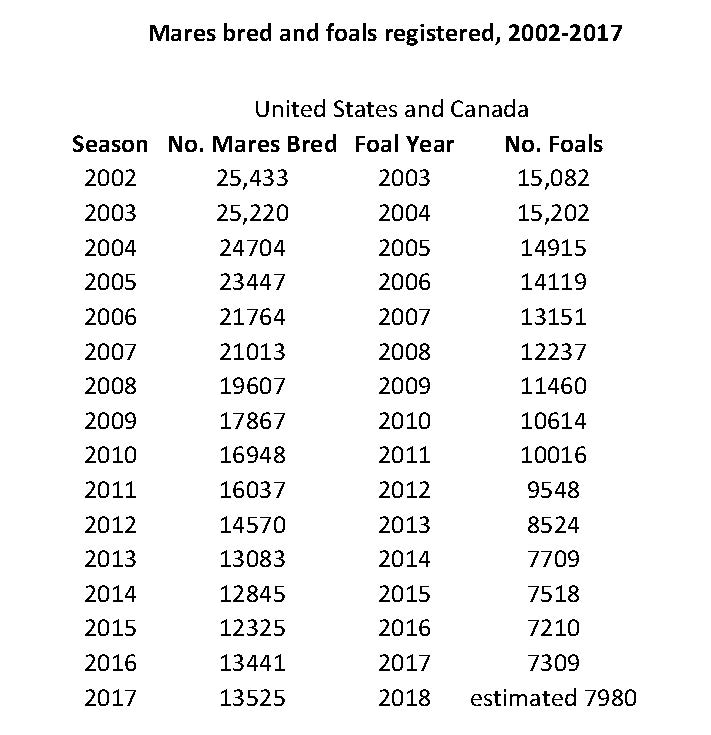
Take a close look at the chart to the right supplied by the United States Trotting Association and focus on the last five years only. The number of mares bred during the period is UP – 13,083 (2013) versus 13,525 (2017). It is only a 3.3% increase, but it went up! The number of foals shows a similar increase from 7,709 to an estimated 7,980, a 3.5% increase.
When totals drop dramatically for a long period and finally stop decreasing, we call that leveling off. When they show some signs of increasing from that low point, it could be a recovery.
Is it possible that the glass is actually half-full?
There are reasons for the increase. The resurgence of racing in Ohio due to casino-fueled purses is certainly one of them. Other factors include the building strength of the Kentucky Sire Stakes program at the Red Mile and dual-eligibility offered in that state. There is also Indiana, which via Hoosier Park has flourished with a strong state program and Grand Circuit offerings.
Of course, just because there were 9.7% more mares bred in 2017 than the low point in 2015, that doesn’t mean everything is coming up roses. Tracks are struggling to fill races because many of the horses who have been racing for years dating back to when the number of foals was higher are retiring from racing and we are not replenishing the supply with an equal number.
We reached out to a number of officials from tracks in the Northeast where the number of available horses is a major issue and asked two simple questions in order to get a birds-eye view of the situation.
1) How has your horse population changed from three years ago?
2) If there has been a change, what do you think is the reason for it?
Peter Koch – Racing Secretary for The Meadowlands
“I would estimate we have between 30-40 percent fewer horses to work with now versus three years ago,” said Koch. “The purses are less than three years ago. Trainers enter out of state to get points for their pensions. The level of competition is still difficult at the Meadowlands. I will give you an example. About a month ago a horse qualified in 1:54 1/5 and fit N/W of 2 lifetime. The horse did not enter and I called the trainer. The N/W of 2 the week before went in 1:50 1/5 with a last quarter in 26 1/5. The trainer said he was not competitive in there and I agreed. We are up against it until we can offer more money and attract the horses that used to race here.”
Shawn Wiles – Executive Director of Racing for Monticello Raceway
“The on-track horse population has not varied much over the past few years, it is the external horse population that we have a problem attracting due to all the tracks in NY racing at the same time and the decline in breeding numbers within the state,” said Wiles.
Bob Miecuna – Assistant Racing Secretary for Yonkers Raceway
“We’ve definitely been affected by the shrinking horse population,” said Miecuna. “In 2015 we averaged 135 entries per day between May 15 and June 15. This year the average is 102. The reasons that I believe contribute to this are: less breeding, more racing, and more racing at tracks with large purses. Look at what is open now: Yonkers, Meadowlands, Pocono, Chester, Plainridge, Monticello, Tioga, Vernon, Saratoga and Woodbine. The list goes on and on. I didn’t list western Pa, Delaware, Ohio or Indiana. Horses ship hundreds of miles on a daily basis. It’s amazing that we have this much racing at the same time.”
Peter Iovino – Racing Secretary Saratoga Casino
“I would say overall we are carding maybe a few less races than three years ago but the drop-off here hasn't been as steep as some other places for various reasons. This year we have actually seen growth in our population from 2016 & 2017,” said Iovino. “The horsemen are allotted 600 stalls for Standardbred horses (including shipping/lasix barns and tack/feed rooms). As trainers have fled some of the other venues that offer smaller purses, we have the ability to house many of their horses to race here. In these tough economic times in our industry, this gives trainers and owners a greater chance to make a profit while saving on shipping and stall rent costs.
“We have a very highly regarded track superintendent (Adam Barger) who maintains the surface impeccably. We were also very fortunate a few years back to be able to implement a New York-Sired Only program for young trotters. These races have served in a positive manner in many ways. It allows an owner who invested in a New York-sired yearling that maybe didn't turn out how they hoped to recover some of the money they put into the horse. Although this is available to all the New York tracks, we have just the right amount of purse money for the season to where we can afford to give these horses a 25% bonus on the purse.
“In this day and age it's all about playing defense,” concluded Iovino.
There seem to be three logical solutions for the future: 1) Breed more horses, 2) Close 1-2 tracks, or 3) Adjust racing schedules.
We are already seeing small increases in the number of horses bred and there really is no way to force the issue without finding many new owners. Fractional ownership is helping to some extent to breathe new life in the form of owners, but the progression is more of a natural one. If it is going to happen, it will take some time.
The most logical course of action would be for a track on the east coast to close its doors. Instantly you’ll have 200 to 300 horses to spread among the remaining tracks. That said, we are kidding ourselves if we think any casino-fueled track is going to give up that revenue (which is tied to mandatory racing). What makes the most sense is if a track in New York could make a deal with all of the other tracks and the state. A track, let’s call it DRF Downs, is allowed to stop racing but continue to run the casino. The funds that would flow to the racing side of the business are equally distributed to the purse accounts of the remaining New York tracks and the horses are freed up to fill out cards up and down the east coast.
Option three would be for tracks to move racing dates to parts of the year when horses are in larger supply. The problem is that racing from December through February on the east coast is not good for track attendance and concession sales. The other issue is that many of the tracks that struggle for horses from April through June, like The Meadowlands and Monticello, already race during the winter months. Could they race more winter dates? Yes, but handle tends to suffer at places like The Meadowlands on non-weekend nights.
Whether you subscribe to a positive or negative understanding of the foal numbers, it is impossible to ignore the fact that a problem exists. While the figures show that the major bleeding has stopped, the health of the industry is still in question as we begin what could be a long recovery that may require some sacrifices and changes.