

Dispute over future of Pimlico overshadows gains by Maryland racing
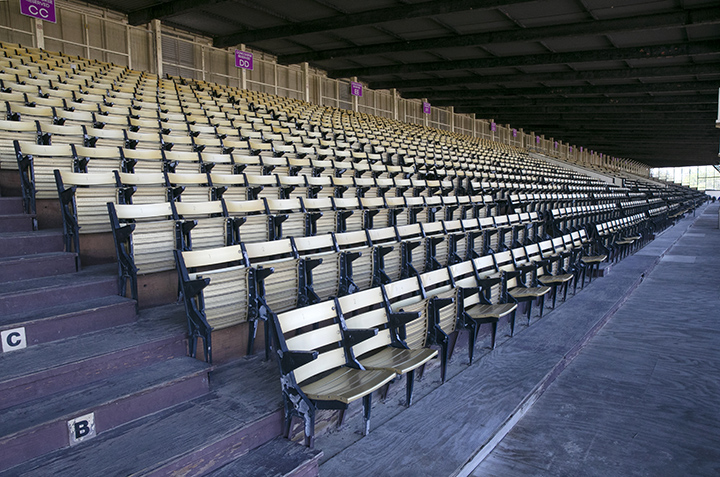
This Saturday, television viewers of the Preakness Stakes at Pimlico Race Course in Baltimore will see something not often, if ever, seen at the track on the day of its biggest race, the second leg of the Triple Crown. Nearly half of the grandstand at Pimlico will be empty.
Pimlico’s owner, The Stronach Group, closed the open-air north end of the grandstand just four weeks ago, announcing that an engineering firm hired by the company had deemed that part of the structure unsafe. And so this year, 6,670 of the 14,000 grandstand seats will be left empty, cordoned off from the tens of thousands of spectators who will once again cram into the dilapidated racetrack on Preakness Day.
That unusual image is perhaps the best metaphor for the status of the sport in Maryland these days. Either half-full or half-empty. Depends on how you look at it.
In many ways, Maryland’s racing and breeding industry is in the midst of one of the U.S. racing industry’s only success stories. Since the sport began raking in millions of dollars in annual casino subsidies nearly 10 years ago, racing and breeding activity in Maryland has been on a sustained and significant upswing, a standout among the plodding and uneven pace of growth or outright stasis in most other racing jurisdictions across the country.
:: Get the Preakness all-access package, including advance PPs
But it is Pimlico and its Preakness that defines Maryland racing for the vast majority of people outside the racing industry, and it is Pimlico and its future that remains the source of controversy in Baltimore and beyond.
“There are two stories dominating the discussion of racing today, and one is the future of the Preakness and Pimlico, and the other is what has gone on at Santa Anita this year,” said Alan Foreman, general counsel of the Maryland Thoroughbred Horsemen’s Association, referencing the spate of deaths at Santa Anita earlier this year that trained a spotlight on racing. “And that is obscuring a very good message about Maryland racing.”
Controversy over the future of the Preakness is not new. While the track’s current owner has recently amplified its lobbying to move the race to its other Maryland track, Laurel Park, discussion about a relocation of the Preakness goes back decades. And that is because Pimlico Race Course has been languishing in a state of profound disrepair for as long as the debate over its future has been going on.
Built in 1870, Pimlico is known as Old Hilltop for its physical location in Baltimore, but now, more often than not, the only part of that nickname that gets regular airplay is the first word. The rundown track has been beset by physical problems for years, from electrical outages to sewer overruns, and it is widely disparaged by both the racing press and the mainstream media when they descend on the track for the days surrounding the Preakness. It also presents a less than impressive television backdrop to the race, especially when compared to the iconic twin spires of Churchill Downs or the enormous cantilevered roof overhanging the gargantuan, bunting-draped grandstand at Belmont Park.
While the physical problems at Pimlico pre-date the sale of a majority share of the two tracks in 2002 to The Stronach Group’s publicly traded corporate predecessor (which went bankrupt), the company has largely let the physical problems at Pimlico fester, to the consternation of Baltimore politicians and citizens. And even though The Stronach Group receives matching funds for capital improvements at both tracks from the state’s casino subsidies, the privately held company has poured its money and attention into Laurel rather than Pimlico, exacerbating the tensions with Baltimore officials.
Earlier this year, The Stronach Group lobbied the state legislature for a bill that would use Pimlico’s capital-improvement subsidies as backing for the issuance of $120 million in state bonds that the company would use to make Laurel a “supertrack” and refurbish the Bowie Training Center. While the plan had pockets of support among state legislators in Annapolis, officials for Baltimore, including its mayor, Catherine Pugh, opposed the plan in unusually harsh terms, and in April the city council filed a lawsuit seeking to condemn Pimlico and transfer the track and the rights to the Preakness to the city. (The Stronach Group recently filed a motion to dismiss the city’s suit.)
Pugh recently resigned as mayor, owing to a scandal involving the sale of a book she wrote to politically connected organizations. But that resignation is not likely to result in a wholesale change in attitude among Baltimore officials toward Pimlico, which sits in a highly disadvantaged area of the city. To those officials, the Preakness is one of the only economic generators for the depressed neighborhood, and any plan to remove the race would represent an abandonment on par with the infamous dead-of-night departure of the Baltimore Colts to Indianapolis in 1984.
Racing officials in the state, however, are almost uniformly in support of The Stronach Group’s plan to center racing around Laurel Park, which lies halfway between Baltimore and Washington, D.C. The rationale is straightforward: Pimlico Race Course is at the end of its useful life and any effort to bring the track up to the standards of a Triple Crown location would cost more money than the industry can afford.
“What we could do for $400 million at Pimlico would cost $100 million at Laurel,” one of The Stronach Group’s top officials, Tim Ritvo, recently said.
The $400 million number referenced by Ritvo comes from a state-commissioned study released late last year from the Maryland Stadium Authority that estimated it would cost $424 million to tear down Pimlico and build up a multi-use facility that would be an “ideal venue to host the Preakness Stakes,” a proposal that also would include the development of sections of the property for retail and entertainment facilities. The study was conducted in consultation with The Stronach Group and called for a mix of private and public funding if the proposal were to succeed.
Racing officials remain frustrated by the bad blood poisoning the Preakness debate because the racing industry in Maryland is in the midst of an unquestionable renaissance. Since hitting a low point in 2012 of 371 foals, the foal crop increased 75 percent over the next five years, to 649 in both 2016 and 2017, according to The Jockey Club, at a time when the overall U.S. foal crop declined by nearly 3,000 foals.
That growth is not entirely surprising given that the average purse in the state, boosted by the casino subsidies, grew 83 percent from 2010 to 2018, from $20,031 to $36,737, even as the number of races held in the state increased 23 percent over that same time frame. Meanwhile, other states that have benefited from casino subsidies have not seen their breeding industries rebound to nearly the same degree, if at all.
“There’s a certain quality of life to what we have built here, and a big upswing in the quality of racing,” Foreman said. “Aside from Pimlico and the dispute over the Preakness, we really have a good story to tell.”
