
Dickinson returns to training with big plans
Michael Dickinson’s decision to resume training after a seven-year absence should not be taken lightly. He does not do things halfway. Dickinson’s goal is for Act 2 of his career to be more successful than his first.
That sets the bar high since Dickinson earned his “Mad Genius” nickname by turning some remarkable feats. Dickinson has 587 victories in North America, a 23 percent win rate, and more than $20 million in purse earnings. As was the case before he stopped training, Dickinson’s operation will be based at his 250-acre Tapeta Farm in Maryland.
“We won eight Grade 1’s in the eight years we had the farm, but I was never happy with the results,” he said. “I want to have another go and prove I can do better. I have a few ideas.”
Dickinson, 65, is best remembered in the United States for Da Hoss, with whom he won the Breeders’ Cup Mile in 1996 and 1998. Da Hoss’s career appeared to be over after his first Breeders’ Cup win, but he returned a month before the 1998 Breeders’ Cup to win a 1 1/8-mile allowance on turf at Colonial Downs. In his next and final start, he won the BC Mile a second time.
Dickinson trained steeplechase horses in his native Britain early in his career. In 1983, he stunned the jump-horse world by sending out the first five finishers in the Cheltenham Gold Cup. After a brief stint training flat runners for Robert Sangster, he moved to the United States, where he began training in 1989.
Dickinson retired from training at the end of the 2007 season to devote more time to Tapeta Footings, a synthetic racing and training surface he developed.
“My wife, Joan Wakefield, requested I stop training so that we could focus on bringing Tapeta overseas,” he said. “I never intended to train again.”
Venues in the U.S. currently using Tapeta include Golden Gate Fields, Presque Isle Downs, and the Fair Hill Training Center. In England, Tapeta is used at Wolverhampton, Godolphin’s training center in Newmarket, and Mark Johnston’s training center in Yorkshire. Tapeta is scheduled to replace the Polytrack surface at Woodbine in Canada for the 2016 season.
The newest version of the surface, Tapeta 10, has been used on Dickinson’s farm to resurface two tracks, one of which is round, and the other is a one-mile run up a hill.
“My wife designed Tapeta 10, which is much improved from our original product, and over the years, we have learned to maintain it better,” Dickinson said. “It will help me be a better trainer.”
Dickinson has only a “few horses” at the moment. He has reached out to owners, some of whom have agreed to send horses, “But you know how that goes,” he said. It will be a while before Dickinson launches his comeback in earnest.
The farm is in top shape, according to Dickinson. In addition to the Tapeta tracks, it has six turf tracks whose use is rotated two at a time.
Dickinson also will make use of cutting-edge technology and has built a performance center. He is waiting for the equipment to arrive.
“There is a lot of technology at our disposal today,” he said.
The performance center will include a hyperbaric chamber, high-altitude stables, a biomechanical analyzer, and a bronchial delivery system, among other things.
Dickinson explained the high-altitude approach this way: “It’s like before the Olympics, when the athletes go to high altitudes to train and learn to function on less oxygen. In these stables, we can control the mixture of air to simulate high altitudes. We can do a number of other things, too.”
Dickinson said he could not go into detail on the bronchial delivery system but said, “It allows horses to take in more oxygen.”
Dickinson also plans to incorporate a more natural element to his training than is possible for trainers based at U.S. racetracks.
“We plan to turn out the horses a lot; in addition to paddocks and pastures, we have movable pens that will allow us to keep them on fresh ground,” he said. “There are four reasons why we want the horses outside: It is good for their brains, they get fresh air, they get green grass, and they get to move around a lot.”
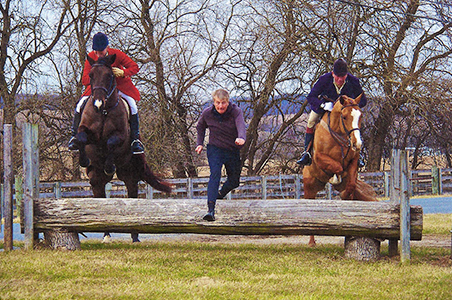
While Dickinson is continuously thinking of new ways to exercise his horses, he also takes an unorthodox approach to his own conditioning. For example, at local fox hunts, while everyone else is on horseback, Dickinson is on foot.
“I have the enthusiasm and drive of a 22-year-old,” he said. “In the winter, I run 10 miles most Saturdays with the local fox hunt. I’m very fit.”