

Can California Chrome pace himself?
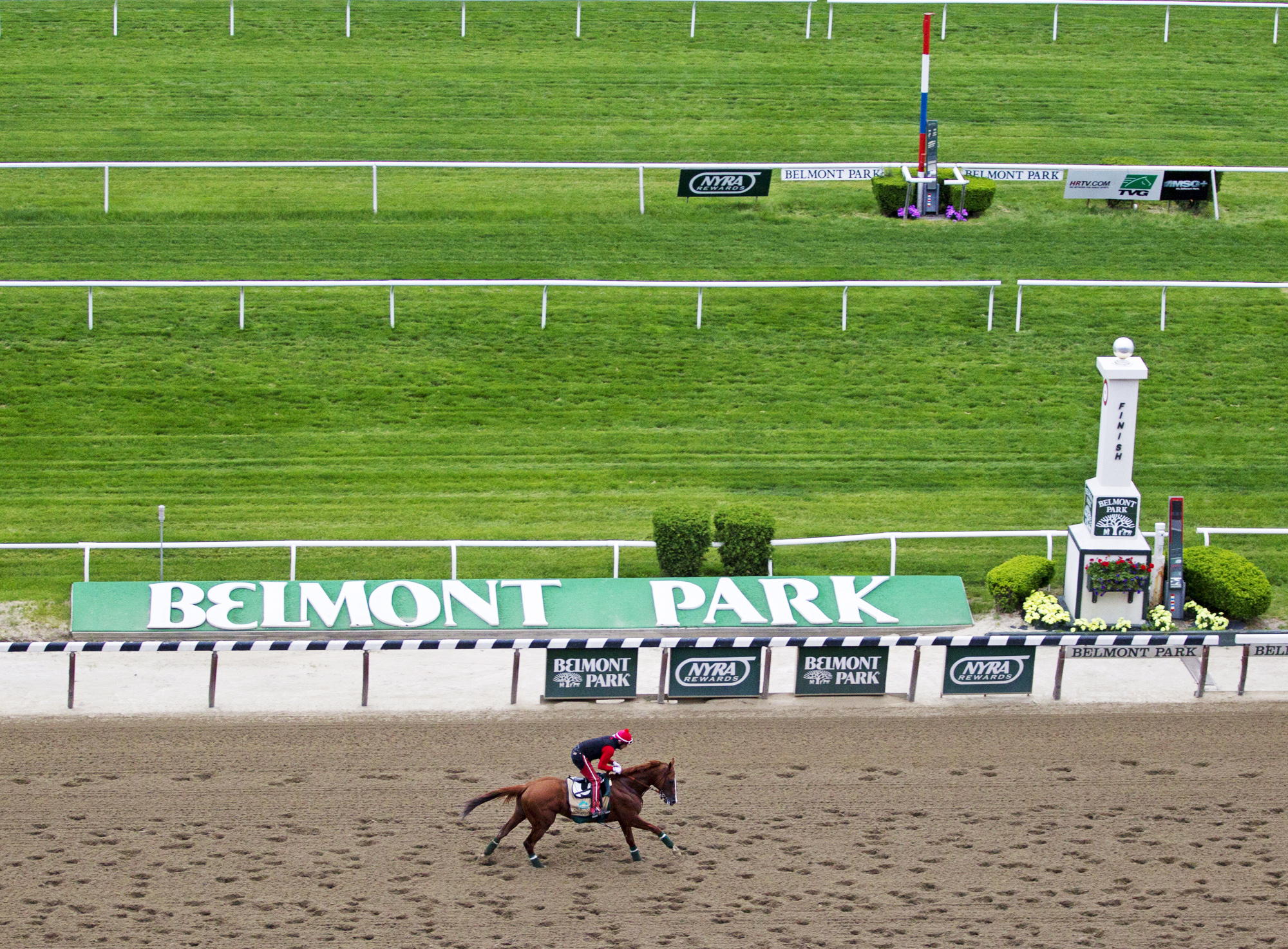
The word “furlong” is Old English and agricultural. The short version: It’s an eighth of a mile, or 220 yards. There will be more than 100,000 people on hand Saturday to watch California Chrome try to win the Triple Crown, and millions more viewing on television. The word will have no meaning to most of them. But in racing, it’s the basic unit of measure. Workouts and races are measured and timed furlong by furlong.
The length of time connected to the racing furlong is typically 12. Twelve seconds per furlong produces a garden-variety 24-second quarter-mile in a route race, a standard-issue 48-second half-mile workout. A horse who can average 12 seconds per furlong in a six-furlong race, North America’s most common distance, finishes in 1:12. That horse can win at a moderate level, and one who can do 12s for a mile, clocking 1:36, could be a stakes horse.
Put together nine 12-second furlongs for 1 1/8 miles in 1:48, and a Grade 1 win is in the conversation. A 3-year-old who can string together 12s for 1 1/4 miles at Churchill Downs on the first Saturday in May would be one of only five horses to clock 2:00 (give or take a tick) or faster in the Kentucky Derby.
::2014 BELMONT STAKES: Latest news, video, and more
The Derby is over, and so, too, the Preakness, a half-furlong shorter at 1 3/16 miles. Now the Triple Crown comes to New York. The Belmont racetrack is immense, a 1 1/2-mile oval, as is the third leg of the Triple Crown it annually hosts. And in the 12-furlong Belmont Stakes, the 12-second furlong takes on a different meaning.
One horse in Belmont history, Secretariat, has averaged 12s for the entire Belmont trip. No other steed has come remotely close.
Oh, almost every year, the horses start out that way, their jockeys thinking this is a regular American horse race. It is not.
The average Belmont Stakes opening quarter-mile over the last 20 years has been 23.88 seconds, quicker than one might expect owing to the decent stretch of straightaway before the first bend and the adrenaline rush triggered by crowd’s roar and starting gate’s clang.
The average half-mile pace in the last 20 Belmonts has been 48.42 seconds, just a shade more than 12s, but after that, the standard American model of pace falls apart, furlong by furlong, quarter-mile by quarter-mile.
Here are the six Belmont quarter-miles clocked by the race leader, averaged over the past two decades: 23.88, 24.56, 24.55, 24.76, 25.34, 25.97.
By the finish, the Belmont Stakes essentially has turned 12s into 13s. Obviously, some horses finish far faster than that: Rags to Riches and Curlin both got their final quarter-mile in about 23.83 seconds in 2007, but that was after one of the slowest early paces of the modern era (the first six furlongs in 1:15.32). It is all give and take. Throw down too many 12s in a row at any point, and the effort eventually will exact its toll.
We have seen the process with the Triple Crown on the line. The middle half of the 1997 Belmont, during which Touch Gold took back and got a breather, might have been just fast enough, 49.58 seconds, to compromise Silver Charm in the final furlong. In 1998, Real Quiet’s fourth quarter in a testing 24.11 led to his defeat. Charismatic was injured during the 1999 Belmont, but too many 12s during the race’s first mile would have left him vulnerable in any case. And in 2004, a middle half-mile in 46.79 turned Smarty Jones rubber-legged in the homestretch.
One might think the ideal way to win a Belmont is nice and steady on the lead, and for a time, it was. Seattle Slew’s front-running victory in 1977 was one of four victories (Affirmed, Conquistador Cielo, and Swale were the others) for pacesetters in an eight-year span. But in the last 30 years – and there have been plenty of slow tempos during that time – only one horse, Da’ Tara, led all the way.
True closers, horses who make their big move in the final straightaway, are almost as rare: Only two in the last two decades. Winning “closers” like Editor’s Note in 1996, Lemon Drop Kid in 1999, and Jazil in 2006 started their move when the race was about half over. They did the heavy lifting on the far turn, reaching contention before the long homestretch.
Six pressers, six stalkers, seven closers, and the front-running Da’ Tara won the last 20 Belmonts. The racing position of the winner fit neatly into the context of the pace – fast pace leading to a closing winner, slow pace to a pressing winner, and so on – with a few exceptions. There was the Rags to Riches and Curlin Belmont, when two superior horses on the day staged their own match race within the race, easily disposing of the slow pacesetters behind them. In 1994, the fast-pacesetting Go For Gin held off everyone but the pressing Tabasco Cat, but there were only four others in the race, and no closer good enough to catch the leaders.
And last year was a strange Belmont indeed. The early fractions – 23.11, 46.66, 1:10.9 – were among the fastest in Belmont history, but Palace Malice stalked near that sizzling pace and won, with the front-running Oxbow second and nary a peep from closers who should have feasted on leaders staggering through a final quarter-mile in 27.58.
Maybe things have changed. Five of the last six Belmonts, regardless of internal fractions, have produced a final time slower than the 20-year par, and the last four have been especially slow, even last year, with the radically fast pace. Critics of the American Thoroughbred might suggest that there are few horses today who can deliver a strong finish – coming home in 12s – at 1 1/2 miles on dirt, regardless of race shape.
But what of our aspiring hero, California Chrome? No doubt he can win, but how should he and jockey Victor Espinoza go about it?
California Chrome does not seem made for the marathon distance. He is no Empire Maker, who derailed Funny Cide’s 2003 Triple Crown bid by laying down solid quarter-mile after quarter-mile, all faster than 25 seconds until the last one. California Chrome appears to have more speed and brilliance and seems less likely to produce a machine-like furlong-after-solid-furlong effort Saturday.
California Chrome could lead if Espinoza so desires. He is faster for a half-mile than any of his foes, yet there are all those front-running failures of recent decades to consider. Whether in front or from just off the pace, California Chrome will trod new ground in the Belmont. When we think about a horse winning a race, we think about how fast he has to run. But California Chrome’s challenge is to run slower than he ever has. In his dozen starts, he never has gone an opening half-mile slower than 47.20. California Chrome is a 12s-and-faster kind of horse, with a tremendous burst of acceleration that has propelled him to victory in the Triple Crown’s first two legs.
But how long can he, or will he, run more slowly? Will he get bored and start champing at the bit? And if California Chrome submits to a slower tempo, can he, at some point in the second six furlongs, lay down a couple of those 12-second furlongs and blow the race open? And in this distance-challenged era, will he even need to?
That is what we’re all watching to see.
The Belmont – this Belmont, especially – is not like other races.
Looking back
Here’s a brief look at how several of the last 20 Belmonts, including all the Triple Crown failures, have played out.
THE SLOW
2000 – 11 ran
Track surface: Rated fast, played average to slow
Race shape: Slow early, slow middle, slow late; presser over closer
Fractional times: 24.12, 49.29, 1:14.39, 1:39.11, 2:05.13, 2:31.19
Quarter-mile times (last half): 24.12, 25.17, 25.10. 24.72, 26.02, 26.06 (52.08)
Pacesetter: Hugh Hefner (8th) led, pressed by Commendable (1st). Aptitude rallied late.
Winner: Commendable pressed, took over before stretch, stayed on
Though the winner’s less-than-awful 101 Beyer speaks to a slow-playing surface, this is what a slow Belmont looks like. Pace clearly made the race. Hugh Hefner couldn’t stay and was overmatched, and Commendable had to expend so little energy taking the lead from him on the far turn that he found enough late energy to see off Aptitude, the better horse. It was the Commendable’s second and last career win. Aptitude, meanwhile, is a reminder that true deep closers usually can’t muster enough speed late in this 12-furlong race to finish off an inferior opponent.
2007 – 7 ran
Track surface: Rated fast, played fast
Race shape: Slow early, slow middle, fast late; middle-moving closers 1-2
24.74, 50.14, 1:15.32, 1:40.23, 2:04.91, 2:28.74
24.74, 25.40, 25.18, 24.91, 24.68, 23.83 (48.51)
Pacesetter: C P West (5th) and Slew’s Tizzy (7th)
Rags to Riches (1st) and Curlin (2nd) moved together a half-mile out
We’re not likely to see another Belmont like this one. The radically slow early pace contributed to the race shape, but there were other slow Belmont paces the last two decades, and no one finished like Rags to Riches and Curlin did. Their final half-mile in 48.51 was off-the-charts fast, and about two seconds quicker than the pair ran their first half. That 23.83 closing quarter, Curlin on the inside, Rags to Riches on the outside, looked more like a turf finish than the end of a dirt marathon. What a race.
THE FAST
1996 – 14 ran
Track surface: Rated fast, played average
Race shape: Fast early and middle, slow late; mainly a closers’ race
23.40, 46.95, 1:10.96, 1:35.87, 2:02.16, 2:28.96
23.40, 23.55, 24.01, 24.91, 26.29, 26.80 (53.09)
Pacesetters: South Salem (eased), Appealing Skier (12th), Louis Quatorze, then Skip Away (2nd)
Winner: Editor’s Note – 12th after a half, commenced run nearly six furlongs out, reached leaders upper stretch
Longshot bombers with speed are dangerous in the Belmont – dangerous to horses with an actual chance. South Salem and Appealing Skier doomed Louis Quatorze in 1996, hanging him wide through a suicidal opening half-mile. Jose Santos probably allowed Skip Away to stick too close to the pace, and when Cavonnier loomed wide with about six furlongs left, Santos made his move to avoid getting trapped. It was premature, and Skip Away already was being taxed by his proximity to the fast pace. He performed amazingly, losing by just one length.
As for Editor’s Note, he rallied from the back, but Rene Douglas was asking for run even before hitting the second turn, and Editor’s Note had reached contention before the quarter pole. His closing half-mile was average by Belmont standards, but Skip Away was on fumes. My Flag was the real stretch runner, but horses like she, trying to make their big move the final three furlongs, nearly always come up short.
2006 – 12 ran
Track surface: Rated fast, played fast
Race shape: Fast early, average to slow middle, fast late; closer over stalker over stalker
23.02, 47.36, 1:12.14, 1:37.53, 2:02.69, 2:27.86
23.02, 24.34, 24.78, 25.39, 25.16, 25.17 (50.33)
Pacesetter: Bob & John (8th) pressed by Deputy Glitters (11th) and High Finance (10th)
Winner: Jazil, last early, started move six furlongs out, reached contention on turn, took over past quarter pole
Check out the opening quarter-mile. The horses racing 1-2-3-4 early in 2006 finished 8th, 10th, 11th, and 12th. Jazil was yet another Belmont “closer” who began his run much earlier in the race than we typically associate with closers. Fernando Jara began letting Jazil move up with more than six furlongs left, and he did the bulk of his passing around the far turn, reaching the lead with a quarter-mile to run. Our eyes told us Jazil was accelerating during his sustained move, but he was just maintaining a relatively steady pace as the horses in front of him slowed – exactly how the Belmont often is won.
2009 – 10 ran
Track surface: Rated fast, played fast
Race shape: Fast early, slow middle, fast late; closer, speed, closer
23.41, 47.13, 1:12.43, 1:37.86, 2:01.66, 2:27.54
23.41. 23.72, 25.30, 25.43, 23.80, 25.88 (49.68)
Pacesetter: Dunkirk (2nd) set very fast pace.
Winner: Summer Bird, 9th after one mile, rallied strongly in the stretch
A complex and dynamic Belmont featuring outstanding performances from Summer Bird, Dunkirk, and Mine That Bird. An opening half-mile in 47.13 seconds is supposed to be a melting Belmont pace, and though Dunkirk had help from a soft 50.73 middle half, it still was remarkable he finished up with a sub-50-second half-mile.
Mine That Bird’s ride was ill-advised. Many horses have won the Belmont making their move during the race’s fifth quarter-mile, but Mine That Bird, in that space, put forth his fastest quarter-mile of the race, and the fastest fifth quarter-mile in the last 20 years, all while racing wide. Unlike, say, Jazil, who was passing slowing horses, Mine That Bird truly was accelerating, and rapidly, and it’s no wonder he failed to sustain his run.
Meanwhile, during that taxing fifth quarter, Summer Bird never increased his tempo. Instead, Kent Desormeaux slid him off the rail before the quarter pole and angled out for a clear stretch run. And Summer Bird delivered, one of only two horses in the last 20 years, along with Victory Gallop, to make their winning move in the final straightaway.
2013 – 14 ran
Track surface: Rated fast, played average
Race shape: Fast early, average middle, slow late; presser over presser over closer
23.11, 46.66, 1:10.95, 1:36.47, 2:03.12, 2:30.70
23.11, 23.55, 24.29, 25.52, 26.55, 27.58 (54.03)
Pacesetter: Frac Daddy (14th) pressed by Freedom Child (13th) for a half. Oxbow (2nd) took up the running.
Winner: Palace Malice stalked, took lead after nine furlongs, won comfortably
The mother of all fast-early, slow-late Belmonts. The race’s last half-mile took nearly 7.5 seconds longer to complete than the first half. Derby winner Orb should’ve whizzed by to win considering the glacial come-home time but could not even get to the tiring Oxbow.
THE FRONT-RUNNER
2008 – 8 ran
Track surface: Rated fast, played fast
Race shape: Average early, middle, and late; wire to wire winner
23.82, 48.30, 1:12.90, 1:37.96, 2:03.21, 2:29.65
23.82, 24.48, 24.60, 25.06, 25.25, 26.44 (51.69)
Pacesetter /winner: Da’ Tara led throughout, won easily
Ironic that the only horse to win the Belmont gate to wire in the last 20 years is considered one of the race’s least memorable victors. Da’ Tara was the footnote, Big Brown the story as his Triple Crown quest ended ignominiously.
TRIPLE CROWNS DENIED
1997 – 7 ran
Track surface: Rated fast, played average to fast.
Race shape: Average early, slow middle, fast late; speed held
23.74, 49.22, 1:13.81, 1:38.8, 2:04*, 2:28.82
23.74, 25.48, 24.59, 24.99, 25.40*, 24.82* (50.02)
Pacesetter: Wild Rush (6th), then Touch Gold, then Wild Rush again
Winner: Touch Gold – led, slipped back behind leaders, rallied late
Touch Gold had one of the strangest winning trips in Belmont history. He was fourth after an eighth of a mile, came through on the fence to lead into the first turn and past the first half-mile, and Chris McCarron, backing up the pace, had a mind to steal the race. But Kent Desormeaux on Free House changed the dynamic, creeping up wide to inject a touch more pace. The jocks on the two horses in front and inside him, Wild Rush and Silver Charm, pushed forward simultaneously to avoid being shuffled out of position, and that was when McCarron made his famous choice to let the other three in the lead pack go. Gary Stevens, seeking the Triple Crown on Silver Charm, did nothing wrong, nor did Silver Charm, who came home faster than par, but Touch Gold laid down a final quarter-mile in about 24.40 seconds, rare air for the end of the Belmont, and just was the better horse on the day.
1998 – 11 ran
Track surface: Rated fast, played average
Race shape: Average early, fast middle, average late; closer over stalker over stalker
23.60, 48.61, 1:13.42, 1:37.53, 2:02.80*, 2:29.16
23.60, 25.01, 24.81, 24.11, 25.27, 26.36 (51.63)
Pacesetter: Chilito (6th) pressed by Grand Slam (7th)
Winner: Victory Gallop – 10th early, started moving on far turn, found best stride in stretch
You can see where and how Real Quiet lost the Triple Crown. The second quarter-mile in 25.01 was fine, and the pace picked up only modestly in the third quarter, but that fourth quarter in 24.11 was the second-fastest in the last 20 years, Real Quiet dueling with the still-running Chillito and Grand Slam while three wide. Real Quiet just wasn’t quite stout enough to overcome. As for Victory Gallop, he did his best work in the homestretch, the rare true late runner to win.
1999 – 12 ran
Track surface: Rated fast, played average
Race shape: Fast early, fast middle, average late; midpack stalker over midpack stalker
23.79. 47.60, 1:12.08, 1:36.57, 2:01.90, 2:27.88
23.79, 23.81, 24.48, 24.49, 25.33, 25.98 (51.31)
Pacesetter: Silverbulletday (7th) pressed by Charismatic (3rd)
Winner: Lemon Drop Kid – tail of midpack, closed steadily from 8th
Not only did Charismatic finish third despite being injured, he ran on through an average final quarter-mile after being involved in a very serious early and middle Belmont pace. Maybe the injury cost him the Triple Crown, but maybe it was the race dynamic, decidedly against him. It feels like history has Lemon Drop Kid “coming from the clouds,” as the national television broadcasters described his trip just afterward, but that’s not correct. Lemon Drop Kidwas eighth down the backstretch but never very far behind the pace, and he had reached the leaders by the quarter pole. A fast, underrated Belmont
2002 – 11 ran
Track surface: Rated fast, played average
Race shape: Average early and middle, slow late; stalker over leader over stalker
24.11, 48.09, 1:12.38, 1:37.01, 2:03.50, 2:29.71
24.11, 23.98, 24.29, 24.63, 26.49, 26.21 (52.70)
Pacesetter: Wiseman’s Ferry (9th) led early; Medaglia d’Oro (2nd) pressed and led middle; War Emblem (8th) briefly led after a mile
Winner: Sarava tracked from 5th, took over in stretch, lasted
Ah, what might have been. The early and middle splits were ordinary, and had Derby and Preakness winner War Emblem, a pure front-runner with a strong gallop, not stumbled at the start, he might have seized command and won the Triple Crown. Instead, Sarava won at 70-1, the last victory of his career. Despite the moderate pace, the last half-mile took forever.
2004 – 9 ran
Track surface: Rated fast, played very fast; closer over presser
Race shape: Slow first quarter, very fast middle, slow late; closer over pressing speed
24.33, 48.65, 1:11.76, 1:35.44. 2:00.52, 2:27.50
24.33, 23.11, 23.68, 25.08, 26.98 (52.06)
Pacesetter: Purge (9th) & Rock Hard Ten (5th) battled early. Smarty Jones (2nd) took over midway through
Winner: Birdstone rallied steadily from 7th early
Crazy race. A slow opening quarter was followed by the fastest early-middle pace in modern Belmont history. The Belmont’s second quarter-mile is mainly run on the turn, and 23.11 seconds for it is just flying. Smarty Jones, pressing on the outside, went a half-mile starting with the second quarter in 46.79, and even as the pace slowed into the far turn, he was hounded first on the outside by Eddington, then inside by Rock Hard Ten. Only an all-time great could have stood the pressure, and Smarty Jones got rubber-legged in midstretch, the race’s final quarter-mile of 26.98 the second slowest in the 20-year period.
Victorious Birdstone didn’t finish especially fast himself, but any horse anywhere near the pace fell apart far worse than Smarty Jones. Birdstone, like Editor’s Note in 1996, was asked to start his move about five furlongs out – another successful “closer” who had reached contention before the homestretch.
THE IDEAL
2003 – 6 ran
Track surface: Started fast, rain came, rated sloppy by Belmont and got slower as it got wetter
Race shape: Average early and middle, fast late; presser over closer over speed
23.85, 48.70, 1:13.51, 1:38.05, 2:02.62, 2:28.26
23.85, 24.85, 24.81, 24.54, 24.57, 25.65 (50.22)
Funny Cide (3rd) led for more than a mile
Empire Maker stalked, took over with half-mile left, won
The plucky gelding Funny Cide attempted the nearly impossible task of leading all the way, but Jerry Bailey on Empire Maker shifted out around the first turn to shadow Funny Cide’s every move. Bailey clearly wanted a test of stamina, attacking early on the far turn, and he was on one of the better stayers in recent dirt-racing history. Before slowing slightly late on a tiring surface, Empire Maker ran his quarter-miles in 24 seconds and change, a metronome at work. He was made for a race like the Belmont.