

Breeders' Cup players will need to make adjustment for deeper, slower main track
ARCADIA, Calif. – Three years have passed since Santa Anita last hosted a Breeders’ Cup. This year, the racing environment changed.
From a handicapping perspective, the biggest change this autumn is the main track. The surface is deep, heavy, and slow. Horseplayers wagering on 2019 Breeders’ Cup dirt races must consider the possibility the slower surface will influence results.
Turf sprints on the unique downhill course were suspended in late March. Turf races at 6 1/2 furlongs on the hill, arguably the most exciting races at Santa Anita, switched to the main turf oval at five and 5 1/2 furlongs.
The change from the hill to the flat affects two Breeders’ Cup races. The Turf Sprint and Juvenile Turf Sprint, initially scheduled for 6 1/2 furlongs, will be five furlongs.
This article will take an abbreviated look at the Santa Anita turf and dirt, and factors that could influence the Breeders’ Cup races, seven on each surface. As for turf, handicappers whose handicapping is based on how the course “plays” are mostly just wasting time.
Santa Anita turf
The turf this fall at Santa Anita is quick. Sixteen of the first 29 turf miles were under 1:35, including six under 1:34. But there is little correlation between course speed and course profile (the running style of winners). Fast does not mean biased. The Santa Anita turf plays fair.
One-mile turf races such as the Mile, Juvenile Turf, and Juvenile Fillies Turf are typically won by forwardly placed horses that also can finish. Through Oct. 20, there were 29 turf miles this fall. They were won by four pacesetters, nine positioned in the middle or back half of the field, and 16 non-pacesetters positioned in the front half of the field.
Running style is not likely to influence Breeders’ Cup turf races at a mile, nor is post position a deal-breaker. Though handicappers prefer inside to outside, five of nine BC Miles at Santa Anita were won from the outside: Goldikova from post 10 in 2008, and post 11 in 2009. Lure in 1993 and Six Perfections in 2003 both won from post 12; Karokontie paid $62 from post 14 in 2014.
More important than what post they leave from is what circuit they come from. Five of the last 11 BC Mile winners, including three of six at Santa Anita, made their previous start at Longchamp in France. European import Circus Maximus, last-out Group 1 winner at Longchamp, might be the right horse this year, regardless of where he draws.
The Juvenile Turf typically is won by an import. Nine of the 12 winners, and five of six at Santa Anita, were Europeans. Trainer Aidan O’Brien won four of the last six. This year’s early candidates include O’Brien-trained Arizona.
Conversely, the Juvenile Fillies Turf typically is won by a domestic – nine of 11 winners were North Americans, including five from the Miss Grillo Stakes at Belmont Park. Trainer Chad Brown has won five Juvenile Fillies Turfs, including the last three. Brown-trained Selflessly recently won the Miss Grillo; Todd Pletcher-trained Sweet Melania scored a sharp win in the Jessamine at Keeneland.
Five furlongs on turf is a relatively new Santa Anita distance; this year it is the distance of the Turf Sprint and Juvenile Turf Sprint. A fair amount of luck is needed to win a large-field five-furlong turf race. Both BC turf sprint races are limited to 12 starters.
Santa Anita course profile data for five furlongs is limited. From April through mid-October, 17 turf sprints at the distance were run with the rails down, the configuration that will be used in the Breeders’ Cup. Of those 17 races, five were won by the pacesetter, seven by non-pacesetters positioned in the first flight, and five from the middle or back of the field. The course seems to be fair.
An early Turf Sprint favorite is Eddie Haskell. His runner-up in the Grade 2 Eddie D Stakes illustrates the inherent chaos in a large field of turf sprinters on the Santa Anita course. Eddie Haskell was shuffled, lost position, finished well, and was best. The only other five-furlong turf stakes this fall was the Speakeasy for 2-year-olds. The winner El Tigre Terrible, who will skip the Juvenile Turf Sprint, rallied from last and paid $49.20.
The longer Breeders’ Cup turf races are the 1 1/2-mile Turf and 1 1/4-mile Filly and Mare Turf.
The BC Turf is undeniably influenced by Europeans. Although U.S.-prepped horses won 12 of the first 21 (including dead-heat Johar), prep origin has flipped. Since 2005, U.S. runners have fallen short as European shippers won the Turf 12 of the past 14 years.
O’Brien-trained shippers from Europe won six BC Turfs, suggesting bettors give a close look this year to possible Turf candidates Anthony Van Dyck and Mount Everest.
What to do with U.S.-based Bricks and Mortar if he runs in the Turf? Though he is 5 for 5 this year, including three Grade 1s, he has never raced beyond 1 1/4 miles. The distance is not a deal-breaker. BC Turf winners racing 1 1/2 miles for the first time include Magician, 2103; Johar, 2003; and Kalanisi, 2000.
A longshot front-runner to consider in the Turf is locally based Acclimate. Although he has been racing in a weak California turf division, he ran exceptionally well when second in a Grade 2 last out after setting a blistering pace. He could be loose, at high odds.
Sistercharlie is the early favorite in the Filly and Mare Turf. She will try to become the first to win the race in successive years (Ouija Board won 2004 and 2006). Favorites have won just one of the last 12. Six of the seven European-based Filly and Mare Turf winners already had won Group 1s, while 2016 winner Wuheida was three-time Group 1-placed.
Santa Anita main track
Notwithstanding an increasingly higher percentage of U.S. grass races and the Breeders’ Cup program, half the BC races are on dirt.
This is where it gets tricky, because the Santa Anita dirt this fall is inordinately slow.
“This is a very demanding, deep, heavy race track. Not only do you have to be really good, you have to be ready,” trainer Bob Baffert told Santa Anita publicity after Bast won the Grade 1 Chandelier, the local prep for the Juvenile Fillies.
Bast won the 1 1/16-mile race in a laborious 1:46.10, about two seconds slower than “normal.” Perhaps she is less effective around two turns. At least Bast has a race over the track.
The two Breeders’ Cup dirt races on Nov. 1 are the Juvenile and Juvenile Fillies, both at 1 1/16 miles. Santa Anita deliberately slowed its main track this season, and many locals believe the deep, tiring surface compromises horses unfamiliar with the footing, with a corresponding advantage to horses who race and train over the track.
Breeders’ Cup shippers arriving late at Santa Anita, with little time to train over the surface, might be in for a surprise if the main track continues to be deep and slow. Based on the limited number of dirt routes the first four weeks of the autumn meet, the Santa Anita track plays fair around two turns.
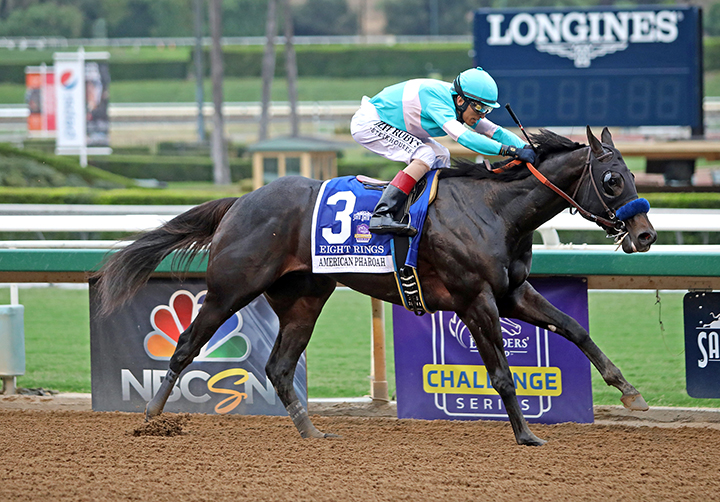
Juvenile contender Eight Rings handles the track. He won the Grade 1 American Pharoah by six lengths and has worked well over the track since.
Midwest-based trainer Dale Romans understands the challenge facing ship-ins. Romans planned to send the exciting Dennis’ Moment from Kentucky to California early, in time for the colt to gallop over the Santa Anita track and post his final workout on the surface.
Romans did the same thing with 2016 Juvenile runner-up Not This Time. He shipped early, the colt worked over the Santa Anita track, and ran super. He finished second, seven lengths clear, and earned a 102 Beyer. Dennis’ Moment will be familiar with the Santa Anita surface, whereas late arrivals could be up against it.
Sprint favorite Mitole will have been at Santa Anita for a month. Mitole has worked well over the surface, while East Coast-based Sprint contender Imperial Hint could be arriving late. If so, he might be surprised by the heavy surface.
As for the six-furlong profile, the track played mostly fair the first four weeks of the meet. Except for an occasional, temporary speed bias, the best horses are winning, regardless of running style.
The Filly and Mare Sprint is perplexing. No leading contender is based at Santa Anita, and the race has the earmarks of a pace meltdown with a bomb winner. It happened last year at Churchill Downs, where Shamrock Rose rallied from last and paid $53.80. Two years ago, at Del Mar, Bar of Gold paid $135.40.
Dirt Mile favorite Omaha Beach is locally based and proven over the Santa Anita track in workouts and his comeback race. He is tactical and versatile. But so are locally based Giant Expectations and Improbable, at higher odds.
Distaff favorite Midnight Bisou, like her stablemate Mitole, arrived early and has trained well for nearly a month over the Santa Anita surface. The Distaff is among the most predictable Breeders’ Cup races. Favorites have won 16 of 35, including four of the last eight.
Horse-for-course Paradise Woods has scored all five of her wins at Santa Anita, including her final prep. If she draws in the outer half of the field, she has a big look. If she draws inside, Paradise Woods might be a bet-against. She does not like the inside.
McKinzie is the early Classic favorite with consistently high figures, though he finished second as the favorite in his prep and is uncertain at 1 1/4 miles. Locally based Higher Power finished third in the prep, after he stumbled at the break. McKinzie, Higher Power, and Mongolian Groom benefit from racing and training over the slow surface.
Every out-of-state shipper to a Breeders’ Cup dirt race faces the question of footing, and odds always are a key consideration. For a longshot late arrival, price might compensate for added wagering risk. But low-odds late arrivals face an increased layer of uncertainty.
Will they handle the dirt, or not? It is one of the biggest questions of Breeders’ Cup 2019.