

All eyes on Santa Anita as fall meet opens
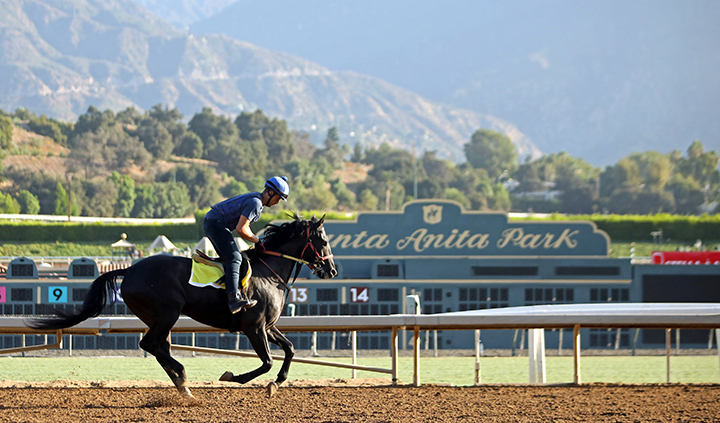
ARCADIA, Calif. – Santa Anita will be the subject of international attention beginning Friday and through its 23-day autumn meeting, and not just because of the 10 graded stakes on the opening two weekends or the Breeders’ Cup races on Nov. 1-2.
Each racing program, even the quiet Thursdays and Fridays through October in advance of closing day on Nov. 3, will be followed with heightened interest after a tumultuous first six months this year when 30 equine fatalities in racing or training at Santa Anita led to widespread negative publicity for racing, more than three weeks of cancellations, and significant changes in the ways horses are prepared for racing and which runners are allowed to compete.
The safeguards put in place at the insistence of California politicians in early June were largely successful in the final two weeks of the Santa Anita winter-spring meeting and at the high-profile Del Mar summer meeting, which ended on Labor Day. During that span, there were no fatalities during racing and four in training at Del Mar.
There were two fatalities in races at the three-week Los Angeles County Fair meeting at Los Alamitos that ended Sunday, but none during that track’s three-week summer meeting in June and July.
Aidan Butler, acting executive director of Santa Anita, has taken a leadership role in the track’s day-to-day management in recent months. That is in addition to his role as chief strategy officer for the track’s parent company, The Stronach Group.
Butler has assumed command of Santa Anita from Tim Ritvo, the chief operating officer of The Stronach Group. In November, Breeders’ Cup president Craig Fravel will begin a job as executive officer of racing operations for The Stronach Group.
In a recent interview, Butler emphasized Santa Anita’s position as “safety first.”
“We’ll have a laser-focused pinpointed approach on safety and getting the best product we can,” he said. “Unfortunately, accidents happen. My charge is to make sure we do everything in our power to stop that.
“As I look back at Del Mar and what they did, it gives confidence and hope that we’ve turned the corner and can have the best racing in the country.”
Last March, Santa Anita launched a series of measures related to equine safety, including enhanced inspections for horses entered to race, a reduction in the permissible dosages of the anti-bleeder medication Lasix, and an increase in out-of-competition testing.
In late spring, Santa Anita enacted additional protocols, notably the development of a panel of veterinarians and stewards who review the racing, training, and medical records of all horses entered to race.
The panel was formed after California Gov. Gavin Newsom put pressure on the sport to curtail the fatalities. Newsom has not backed down. He was highly critical of racing’s management and regulatory board in an interview with the New York Times earlier this week.
“I’ll tell you, talk about a sport whose time is up unless they reform,” Newsom told The New York Times. “That’s horse racing.”
The review panel of veterinarians and stewards was in place for the final weeks of Santa Anita’s spring meeting and at subsequent race meetings. The California Horse Racing Board said last week that the panel will be a permanent fixture in Thoroughbred racing.
Independently, Santa Anita has a team of seven veterinarians who will observe morning training, review race and medical records, and conduct physical inspections on horses entered to race as well as random inspections of other horses.
The track launched that program in the spring after racing was halted for three weeks in March to inspect and renovate the main track following a series of fatalities in late February and early March.
Santa Anita operated largely on a three-day racing week from mid-April to the closing of the spring meeting in June. There are four-day racing weeks scheduled for most of the autumn meeting.
Butler said some programs in the next month may have seven races to ensure the track can fill cards four days a week. There are fewer Thoroughbreds in Southern California than at this time last year.
“I need Santa Anita to show it’s a viable and functioning property,” Butler said.
There have been no sprints on the hillside turf course following a two-horse spill on March 31, and there will be none at this meet. In the final months of the spring meeting, turf sprints were run at five furlongs. For the autumn meeting, a new distance of 5 1/2 furlongs on turf will be introduced in addition to five-furlong races.
The hillside portion of the turf course will be used only for the starts of longer turf races.
While safety is at the forefront of discussions surrounding racing in California, Santa Anita officials are hoping to direct some of the focus in the next six weekends on the sport of racing and the build-up to the Breeders’ Cup, which will be held at Santa Anita for a record 10th time.
The ontrack attendance this weekend will indicate whether casual fans will still support racing or whether the track has an even greater task ahead to regenerate public interest. Last year, the track drew audiences of 4,515 for the opening-day program on Friday, 16,801 on Saturday, and 9,693 on Sunday, according to figures the track released to the media.
There are indications Santa Anita may have a difficult time drawing as many fans. Del Mar ended its summer meeting with an 18 percent decline in ontrack attendance compared to the corresponding meeting last year.
“I’m hoping that we get anyone that truly understands what we’re facing as an industry to come out to support us,” Butler said.
