

After long opening arguments, Baffert hearing will continue into second day
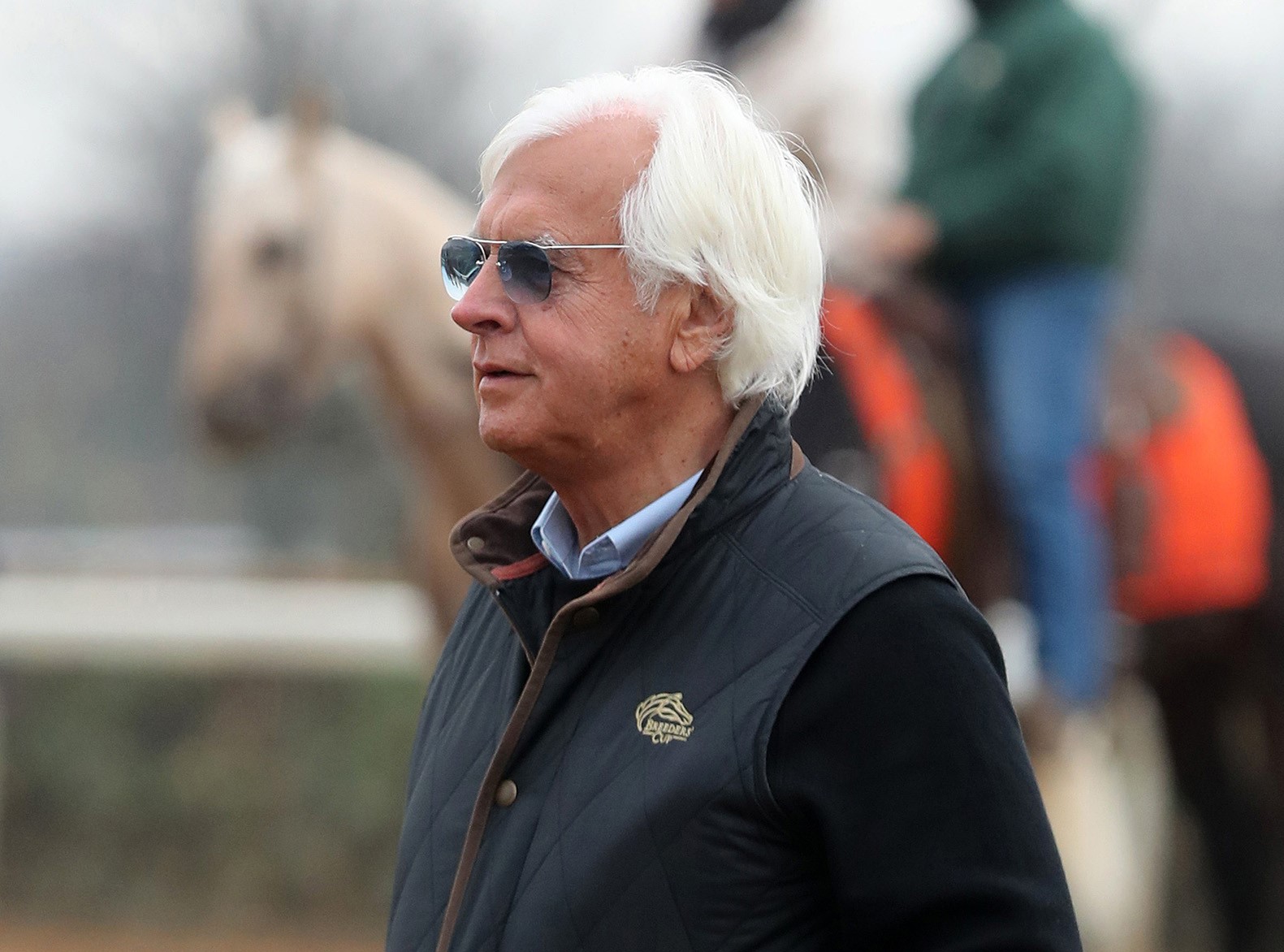
LOUISVILLE Ky. -- A hearing on Thursday afternoon in a Louisville courtroom to consider a motion for preliminary injunction that would prevent Churchill Downs from banning the trainer Bob Baffert from this year’s Kentucky Derby was continued into Friday after the sides were unable to conclude their arguments.
The hearing will resume on Friday morning at the behest of Judge Rebecca Grady Jennings, who had initially given each side in the hearing two hours to present their cases. On several occasions during the Thursday afternoon hearing, she warned the participants that their presentations had “gotten far afield of the legal issues for a preliminary injunction” and told attorneys for both sides that she wanted their cases wrapped by “lunch time” on Friday.
Baffert filed suit against Churchill Downs in December of last year, after initially withdrawing a suit seeking a lifting of the ban earlier in 2022. Churchill banned Baffert through the 2023 Derby after the 2021 winner, the Baffert-trained Medina Spirit, tested positive for a regulated medication after the race. Churchill has also modified its qualifying system to prevent any horse trained by Baffert from earning points toward a start in the Derby while under his care.
The motion for a preliminary injunction is a last-ditch effort by Baffert to seek a court action that would allow him to participate in this year’s Derby, at a time when the trainer’s barn is stocked with promising 3-year-olds. The Baffert-trained Arabian Knight, owned by Amr Zedan, also the owner of Medina Spirit, is the 6-1 early favorite for the Derby on Daily Racing Form’s Derby Watch, and six other horses trained by Baffert appear on the 20-horse list, including Cave Rock, the third choice at 12-1, and National Treasure, the co-fifth choice at 15-1. Zedan also owns two other horses on the list, the 30-1 shot Hejazi and Arabian Lion, who is listed at 50-1.
Baffert’s legal team did not get through its opening statement in their two-hour window, leading Churchill’s attorneys to object. Jennings called a brief recess, after which she allowed Churchill to present their opening statement, which concluded in 20 minutes. Churchill then called a witness, their equine medical director, Bill Farmer, who after 20 minutes of testimony was cross-examined by Baffert’s main attorney, Clark Brewster, for 30 minutes. Jennings then began issuing the warnings about the arguments drifting far from those germane to the consideration of a preliminary injunction.
After a brief discussion with both sides, she asked the parties to reconvene at 10:30 a.m. Eastern in the same courtroom to hear witnesses. Baffert is expected to take the stand tomorrow, as both sides had put the trainer on their witness lists.
Earlier in the hearing, Brewster spent the vast majority of his opening statement contending that Baffert did not break any Kentucky Horse Racing Commission rules, and if he did so, that those rules were misguided. The arguments were similar to those that Brewster employed in an appeal of a 90-day suspension handed down by the KHRC last year because of the Medina Spirit positive, and in an appeal of a separate ban put in place by the New York Racing Association.
:: Bet the races with a $200 First Deposit Match and FREE Formulator PPs! Join DRF Bets.
Another lawyer on Baffert’s team, Joey DeAngelis, then attempted to outline what he called a “nexus” between Churchill Downs and the state of Kentucky, in a legal strategy that would call into question Churchill’s ability to impose its own ban without due-process protections. The right to exclusion for racetracks has been generally upheld over the past five decades as long as the racetrack is not closely “entwined” with the state and the ban is not based on protected rights, such as sex, age, or skin color.
DeAngelis also briefly touched on an issue that Jennings had asked Baffert’s attorneys to address at the start of the hearing – why Baffert was seeking redress now, 17 months after the ban had been handed down. DeAngelis explained that Baffert had delayed legal action against Churchill due to “more immediate problems as they arose,” referring to the New York ban, preparation for a hearing before the Kentucky stewards, and his appeal of the Kentucky decision.
In their own opening statement, Churchill’s legal team directly addressed the issues that Jennings had asked to be included in their cases at the start of the hearing.
Thomas Dupree, a Washington, D.C.-based lawyer who delivered the entire opening statement on behalf of Churchill, said that Baffert could not argue that he was facing “irreparable harm” because purse earnings are not a guarantee in racing. In addressing the 17-month gap in seeking redress, Dupree hinted that Baffert had waited until late last year to pressure the court to issue the injunction.
“Aggrieved parties do not sleep on their rights for a year and a half,” Dupree said.
Dupree also pushed back against the idea that Churchill is “entwined with the state,” and he maintained that Churchill, as a private company, was well within its rights when it issued the ban, even if it conducts a highly regulated business.
“Extensive regulation does not transform the regulated industry into the government,” Dupree said.
Jennings is likely to rule on the motion for a preliminary injunction within the next 10 days, according to officials involved in the case. Under one of the modifications Churchill adopted this year to its qualifying system for the Derby, any horses trained by Baffert must be transferred out of his barn by Feb. 28 in order to earn any points in Derby prep races.
:: Want to learn more about handicapping and wagering? Check out DRF's Handicapping 101 and Wagering 101 pages.