

West Coast flying below the radar in strong trio
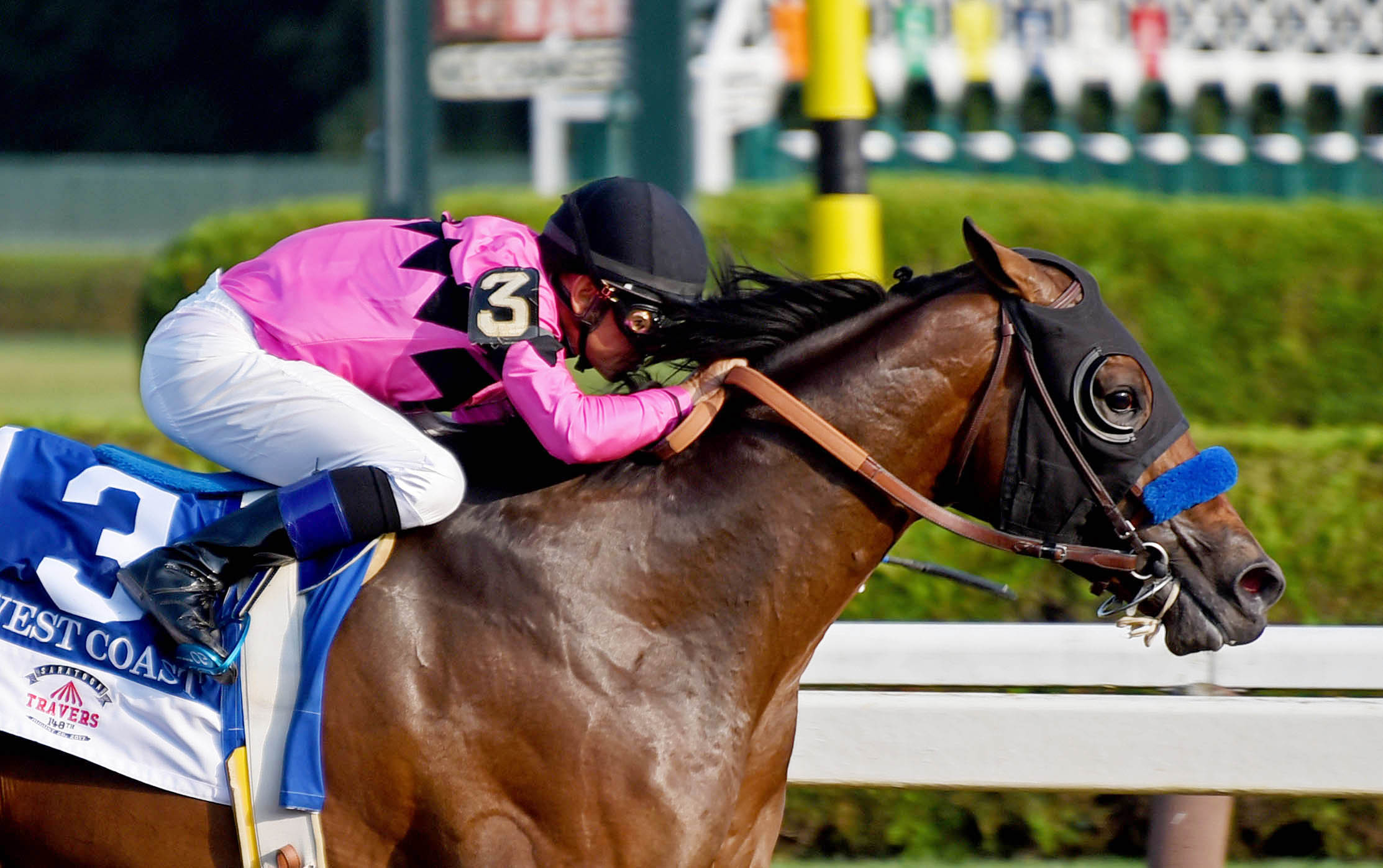
A powerhouse field lined up for the 2017 Travers Stakes at Saratoga. For the first time since 1982, the historic race lured the three different winners of that year’s Triple Crown races – Kentucky Derby winner Always Dreaming, Preakness Stakes winner Cloud Computing, and Belmont Stakes winner Tapwrit.
It was a measure of the depth of the field that West Coast, never worse than second in his career and winner of back-to-back stakes, was sent away at 6-1. He led throughout to win by 3 1/4 lengths.
It is now a measure of the depth of the young stallion class at the Farish family’s Lane’s End Farm in Versailles, Ky., that West Coast again finds himself somewhat overlooked. Lane’s End debuted a trio of new stallions for the 2019 season, with Breeders’ Cup Classic winner and Eclipse Award champion Accelerate and Breeders’ Cup Dirt Mile and Pegasus World Cup winner City of Light drawing the lion’s share of the attention.
Behind those two powerhouses is, quietly, another tiger. West Coast followed his Travers victory with another Grade 1 score by 7 1/4 lengths in the Pennsylvania Derby. He was then third behind Horse of the Year Gun Runner in the Breeders’ Cup Classic, securing himself the Eclipse Award as the season’s outstanding 3-year-old male. West Coast did go winless in 2018, but was second to Gun Runner in the Pegasus World Cup, and then was second to Thunder Snow in the Dubai World Cup. He retired with a record of 13-6-5-1 and more than $5.8 million in earnings.

Despite his consistent record, multiple Grade 1 victories, and his Eclipse trophy, West Coast has flown decidedly under the radar in this year’s first-crop yearling class, which is headlined by the likes of Triple Crown winner Justify, and by his own Lane’s End stablemates. All three of the Lane’s End newcomers in 2019 are from sirelines that have been tremendously influential to the farm, and West Coast is no exception. He is by Flatter, quietly one of the most consistent sons of the late breed-sharping sire A.P. Indy, who died at his longtime Lane’s End home in 2020.
“Obviously have a lot of respect for the Flatter-A.P. Indy sireline,” said Allaire Ryan, Lane’s End’s director of sales. The West Coast yearlings “are workmanlike horses, and they’re just going to have to prove themselves on the track to really gain a following.”
Ryan said that the West Coast yearlings display some of the characteristics of their grandsire Flatter, who stands at Claiborne Farm.
“They’re a lot like Flatter,” Ryan said. “They’re not flashy horses, but they all have a tremendous sort of constitution. Every West Coast that we have or that we’ve seen has a great amount of natural substance. They have tremendous depth in their girths. They’re not flashy – some you might even call sort of a plain brown wrapper. But they look like horses that want to work and want to get the job done. They have that gritty, rugged sort of attitude, and it’s almost like they look how they act.”
Flatter has a career yearling average price of $82,967. After starting his career with modest figures, he has averaged six figures every year since 2015, as his racetrack success has become consistent. This year, Flatter added Grade 1 winner Search Results to his résumé, his fifth top-level winner, joining West Coast, Taris, Flat Out, and Paola Queen. His current 2021 yearling average is $128,128 from seven sold.
Like his sire, West Coast appears to be facing a long battle to prove himself in the commercial arena. The stallion averaged $64,765 from his first weanlings sold in 2020, conceived on a debut stud fee of $35,000. This year, he has been represented by 16 yearlings sold for an average of $56,375.
Ryan again praised the attitude his yearlings have shown when confronted with their first assignments, believing that that mindset will lend well to the work of being a racehorse.
“I think, commercially speaking, he’s going to have to do it the hard way, because they’re not flashy, stylish, sort of commercial-looking yearlings,” Ryan said. “But we have one, and he’s just a solid, durable, rugged-looking horse, and he never gets tired. Starting the sale prep program with him was the best thing for him, because he just wanted a job.
“You watch them walk, and you watch their attitudes with the handlers and around the barns. They’re here to work. . . . I think they’re going to prove themselves on the track.”
Lane’s End’s other two incoming stallions certainly proved themselves on the track. Accelerate – by Lookin At Lucky, a son of late Lane’s End sire Smart Strike – was a multiple graded stakes winner who had finished third in the 2016 Breeders’ Cup Dirt Mile. He hit his stride as an older horse in 2018, winning five Grade 1 route races in the Santa Anita Handicap, Gold Cup at Santa Anita, Pacific Classic, Awesome Again, and finally, shipping away from his California base to take the Breeders’ Cup Classic at Churchill Downs.
“The definition of a sound, hard-knocking individual with an incredible amount of heart and try,” Ryan said. “His record is a testament of that. And the Accelerates are very useful-looking horses. They’re strong, good-bodied. They’ve got good natural substance. They stand over a good amount of ground. They’re not all tall. I think you see a lot of Smart Strike coming through in them. They’re good-minded individuals, and they move well. They look workmanlike. They’re the kind of horse where you could have 10 in your barn and be completely happy with them.”
About the only horse who could get the measure of Accelerate in his championship year was City of Light. Winner of the Grade 1 Malibu Stakes to end 2017, he opened 2018 by winning the Grade 1 Triple Bend. He defeated runner-up Accelerate in the Grade 2 Oaklawn Handicap before that one turned the tables in the Gold Cup, in which City of Light was third. City of Light got the last laugh, winning the Breeders’ Cup Dirt Mile before taking the Pegasus World Cup, in which Accelerate was third in the career finale for both.
City of Light now stands alongside his sire, Quality Road, at Lane’s End.
Of the farm’s three newcomers, City of Light is sporting the highest yearling average, at $247,068 from 22 sold, more than seven times his introductory stud fee of $35,000. Among Kentucky first-crop sires, he is second only to Justify, who is averaging $577,806 from eight yearlings sold. However, Justify’s introductory fee was in a different bracket, at $150,000, making his average about 3.8 times the stud fee.
“Out of our three, these ones have the most style,” Ryan said. “And that’s what you’ve seen reflected at the sales. . . . To me, they just come out and they look like a very classic, two-turn, just quality individuals. It’s very hard to pick them apart.
“I think you see the frames that you see in Quality Road from the City of Lights, but City of Light had more style. Quality Road can get you a big, imposing individual, but they can be rugged as well.
“I’d say [the City of Light yearlings] are more smooth-looking.
“I’ve always said that I think City of Light is a better-looking version of his sire, and I think that rings true of his yearlings. . . . They’ve got that style factor.”