

Watchmaker: War of Will a deserving Preakness winner
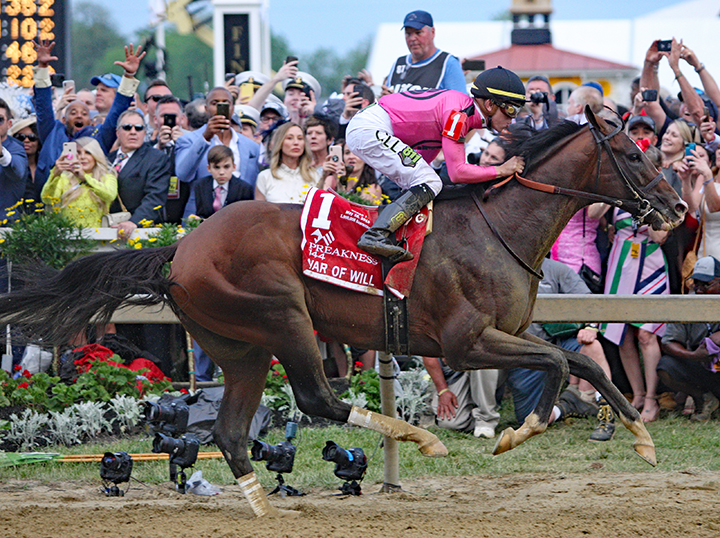
Yes, War of Will had an absolutely perfect trip in Saturday’s Preakness at Pimlico. The kind of trip one would only dare dream about.
Guess what? He deserved it. He had this one coming to him.
In a weird, déjà vu-like experience, there War of Will sat, on the inside, just off the Preakness pace, exactly like he did in the Kentucky Derby two weeks ago. Only this time, instead of getting wiped out by Maximum Security like he did when he moved off the rail to lodge his bid in the Derby, War of Will and jockey Tyler Gaffalione stayed inside and waited. When pacesetter Warrior’s Charge drifted ever so slightly turning for home, War of Will poured right on through on the rail. And even though there was still approximately three-sixteenths of a mile left to go in this Preakness, it was game over.
Bodexpress dumping jockey John Velazquez out of the gate aside, this Preakness was mercifully without the overt controversy of the Kentucky Derby. We will never know what War of Will may have done in the Derby if he weren’t so badly fouled. But most reasonable people know he never had a fair chance to show what he could do. The fact that War of Will had as fair chance to show what he could do Saturday – actually more than a fair chance – and cashed in on it, to me, evens the scales. Granted, the Preakness isn’t the Kentucky Derby, but it is a Triple Crown race and an American classic event. It’s not a bad make-good prize.
But even as one who liked, publicly picked, and wagered on War of Will in the Preakness, I do come away with some reservations as to how to assess this colt going forward. Obviously, there is the ideal trip War of Will drew. No horse can expect to pull a trip like that all of the time. And while War of Will is the sort of horse who, with his positional speed and ability to stalk and pounce, puts himself in the position of drawing favorable trips, he has not yet shown the capability of overcoming adversity. I’m not talking about the ridiculous stuff he encountered in the Derby. But I am thinking about what he can do, if anything, when things don’t break exactly his way.
Moreover, as the folks on the national telecast alluded to, I do think the Pimlico main track became a little more tilted toward inside runners as the long day wore on. To me, the biggest piece of evidence of how inside-y the main track became was the fact that the overmatched Everfast (who somehow went off at half of the 50-1 he should have been) rallied up the inside to get second. As noted, War of Will was on the inside all the way. Third-place finisher Owendale was not, and I believe his wide rally effort should be moved up going forward.
It was nice to see Mark Casse, trainer of War of Will, suggest that the Belmont Stakes makes sense as a next start for his colt. This stands in stark contrast to the connections of Maximum Security, who showed zero interest in the Preakness and Belmont after their colt was disqualified from first in the Derby.
I still can’t fathom why the connections of Maximum Security, who are suing to restore Maximum Security as the “rightful” winner of the Kentucky Derby, would not have taken their shot at the Preakness and a possible sweep of the Triple Crown if they really thought their suit had merit. But it’s nice to see War of Will potentially targeting the Belmont, which would almost certainly make him the only colt this year to compete in all three legs of the Triple Crown. And despite some perfect trip and bias-aided factors that might not make him a perfect play from a handicapping perspective, it does make him extremely easy to root for.
Preakness weekend notes:
► It’s time to be officially concerned about the older dirt male division.
Friday’s Pimlico Special, a $300,000 event with a glorious history, was won by Tenfold, who prevailed by a neck over You’re to Blame, who finished another neck ahead of Cordmaker. Tenfold did have to squeeze his way through a couple of narrow openings while rallying, but he won primarily because he saved far more ground than both You’re to Blame and Cordmaker.
These three were clearly best in this Pimlico Special, and they were also three of only four in the 13-horse field who closed at single digit odds. And while I would love to own any of the three as they are honest, hard tryers, it is important to note that Tenfold was the only member of the field who previously won an event ranked as highly as a Grade 2. He did that last summer in the Jim Dandy, a race that was, to put it nicely, not pretty.
In fairness, Tenfold did finish third in last year’s Preakness, although that was the weakest race Triple Crown winner Justify ever ran. But Tenfold was badly beaten in the Travers, and after a long rest, his first two races this year weren’t much better.
You’re to Blame’s main claim to fame was a narrow win in the Grade 3 Greenwood Cup last September at Parx. And as for Cordmaker, as sharp as he was going into the Pimlico Special, the only unrestricted stakes race he ever won was a hundred grander over the winter at Laurel.
Okay, some might say that it would be a mistake to employ the Pimlico Special as a measure of the strength of the older dirt male division. Fair enough. But I think the top to bottom weakness of this Pimlico Special field was a flashing neon sign depicting how desperately shallow the older dirt male division currently is.
Sure, we have Santa Anita Handicap winner Gift Box, who couldn’t get beyond being an allowance horse in New York in his younger days, and who is now targeting another big score in The Gold Cup at Santa Anita. And we have smashing Alysheba winner McKinzie, who is pointing to the Met Mile, in which he will face a very talented group of stretch-out sprinters.
We do also have Catholic Boy, who won last year’s Travers, crushing Tenfold. Catholic Boy was able to win the Dixie on the Preakness undercard without being unduly pressed in what was his first outing since being eliminated at the start of last fall’s Breeders’ Cup Classic.
This was a prep Catholic Boy’s connections had to be thrilled with. But Catholic Boy is the rare bird who is equally effective on both dirt and turf. So while he could go back to dirt in something like a Suburban-Whitney type of schedule, there is the ever-present possibility the focus could switch back to grass for, say, the Arlington Million.
Catholic Boy’s connections are in an enviable spot with loads of options, but that doesn’t necessarily mean he’s a savior for the older dirt male division.
And after Catholic Boy we have … um … well, who else do we have in this division that we can really count on?
The long-term implications of a weak and shallow older dirt male division are significant, especially when coupled with a 3-year-old male division that many view as being softer than others we’ve seen in recent years. Unless some additional faces emerge in a big way from both divisions, consider how this current situation could manifest itself in the Breeders’ Cup Classic. It’s an unsettling prospect.
► There are no concerns about the depth and quality of this year’s 3-year-old filly sprinters. This group already had real power at the top with the unbeaten and untested Eight Belles winner Break Even, and Bellafina, a big talent who is supposed to target shorter races after being the beaten favorite in the Kentucky Oaks.
Into this mix comes Covfefe, a spectacular winner of Friday’s Miss Preakness Stakes. Covfefe took the Miss Preakness by 8 1/2 lengths in track-record-shattering time that equated to a heady Beyer Figure of 107, and improved her career record to three wins from four starts.
This is an exciting crew.
► Covfefe was so impressive that she upstaged Point of Honor’s determined victory three races later in the Black-Eyed Susan. But while Point of Honor fell a bit short on style points Friday, she has now won 3 of 4 starts, has improved her Beyers from start to start (she got a 90 for her Black-Eyed Susan win) and, most importantly, she is a true distance filly who is in as good a position as any of her contemporaries to make noise this summer in the 3-year-old filly division’s champion-making events.
