

Watchmaker: Stewards got it right in Monmouth Stakes
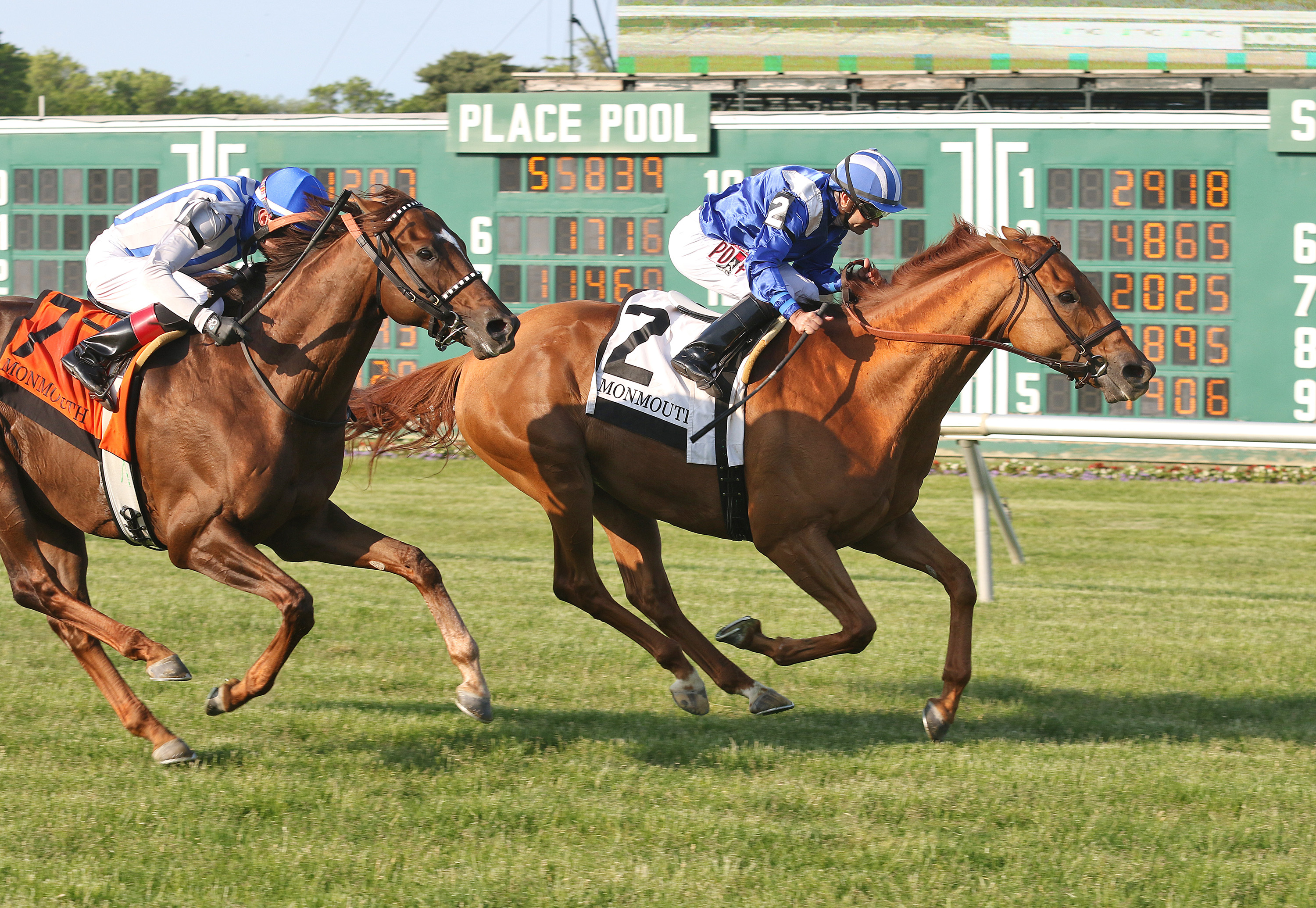
As was the case in the Kentucky Derby three weeks ago, track stewards were involved probably more than they, you, or I would want them to be in the outcome of one of Saturday’s biggest stakes races.
In this instance, the race was the Monmouth Stakes. Unlike in the Derby, there was no change to the Monmouth’s original order of finish. But like the Derby, I firmly believe the stewards made the correct call.
Here’s how I saw the contested stretch run of the Monmouth unfold. Almanaar, who had already made what appeared to be a winning sweep to the lead, began to drift out in upper stretch. Synchrony, who was rerallying, briefly steadied behind Almanaar. Almanaar continued to drift out several paths in deep stretch and prevailed by a neck over Synchrony, who was gaining on his outside.
Not surprisingly, Trevor McCarthy, who rode Synchrony, claimed foul against Almanaar and jockey Joe Bravo. It was a legitimate claim of foul but one that was ultimately and rightfully dismissed.
Here’s why, or at least why I think why, after repeated viewings of all video angles shown: When Almanaar first drifted out and Synchrony was briefly steadied, Almanaar was at least 1 1/2 lengths clear of Synchrony. When Almanaar came out again a couple of strides later, he was still clear of Synchrony. And though Almanaar, despite right-handed urging, continued to drift a couple of paths after Synchrony started to pull up alongside, so did Synchrony. Almanaar may have drifted, but there was always considerable daylight between him and Synchrony.
The point here is that what happened in the stretch run of the Monmouth Stakes would be extremely difficult, if not impossible, to codify in any attempt to standardize how stewards might address incidents that often occur in races. This was a situation that required human judgment from smart, seasoned, dedicated, and impartial racing officials who obviously (and correctly, in my view) concluded that a horse who is clear of other horses is entitled to any part of the track he wants.
The real problem here – one that has existed for all of my racing life – is finding enough truly smart, seasoned, dedicated, and impartial racing officials to staff tracks across the country.
And before anyone becomes tempted to label yours truly an apologist for stewards, I refer you to a column that appeared in this space last Sept. 9. In it, I noted that (unfortunately) one of the things the 2018 Saratoga meet will be remembered for was “maddening inconsistency out of the stewards stand,” and proceeded to detail a handful of egregious calls and non-calls during that meet.
One thing that is beyond dispute coming out of this Monmouth Stakes is that both Almanaar and Synchrony are by far at their best on firm ground. In particular, Almanaar, who probably should have won last year’s Arlington Million and who was making his first start of 2019 on Saturday, has a chance to make some noise in a male turf division that right now has more rich races than legitimately good horses to go after them.
Almanaar and Synchrony both ran well in the Monmouth, and not only because they finished a gaping 4 1/4 lengths ahead of the third-place finisher. I thought Synchrony, who has always done his best work from well off the pace, was too close in laying second early and did very well to rerally the way he did after Almanaar blew by him late on the backstretch.
As for Almanaar, he moved far too early Saturday. He gained almost eight lengths in a third quarter-mile that, if the teletimer is to be believed, was run in 23.11 seconds. Almanaar has always had a big, big, brush in him. It’s one of the things that makes him such an intriguing performer.
• I’ve started to dig into the upcoming Belmont Stakes, and it is obvious that of the 10 currently projected by DRF as Belmont starters, Preakness winner War of Will will be the clear favorite. Sorry, we won’t be getting the 6-1 we got on him a week ago.
That said, I do wonder how strong a favorite War of Will will be considering every wise guy on the planet will likely be lining up against him. Everyone knows War of Will had as perfect a trip in the Preakness as he had a nightmarish one in the Kentucky Derby. He got a dream run on the rail – a rail that became so live as Preakness Day wore on that it propelled the implausible Everfast to a second-place finish in the Preakness.
Since just about everyone will be salivating at the prospect of betting against a favorite coming off a perfect-trip, bias-aided victory, it will be interesting to see how it impacts the price on War of Will.
:: MEMORIAL DAY SALE: Save 50% on Formulator PPs, DRF Plus access, and handicapping reports
Tacitus, the Wood Memorial winner who was fourth under the wire in the Derby, was already a leading alternative in the Belmont to War of Will. It will also be interesting to see how anti-War of Will sentiment impacts Tacitus’s odds, or how such sentiment will affect the price on, say, Owendale, who rallied against the bias to finish third in the Preakness.
• As the game we love struggles to take control of the message it wants to convey to the general public, I fear the job might be even bigger than we realize.
I say that because of an article recently brought to my attention on the website of The Berkshire Eagle newspaper. The article concerned the potential of Thoroughbred racing returning to the Great Barrington Fairgrounds, perhaps by the fall of next year.
This is big news for racing fans in New England. With this year’s handful of dates being the last ever to be run at soon-to-be-developed Suffolk Downs, Great Barrington looks right now like the only real hope for the continuation of Thoroughbred racing in New England, where once one could enjoy the game day AND night all year round.
Day. Night. All. Year. Round.
I lived it. It’s how I came up, and I wouldn’t trade those days for anything.
Of course, many hurdles must be cleared before racing becomes a reality again at Great Barrington. But according to the news story, one such obstacle comes as a bit of a shock – some townspeople are concerned about horse racing and its “effect on horses.”
This is a stunner because horse racing is in Great Barrington’s DNA. As the article noted, horse racing was conducted there from 1859 to 1983, and in 1997-98. When I was coming up, Great Barrington was the crown jewel (so to speak) of the notorious Massachusetts fair circuit.
I understand that times change, and so do people. But given the history, that some of the good folk of Great Barrington would oppose a return of horse racing despite the welcomed revenue that would come along with it underscores how badly misunderstood our sport is by a segment of the general public.
