

Watchmaker: Sistercharlie, Elate show true class in big wins
No less of an institution than the U.S. Supreme Court codified the concept of knowing something that otherwise lacks a clear definition to be something when you see it.
At the time over five decades ago, the Supreme Court was wrestling with the question of obscenity, and what it is, exactly. But the court could just as easily have been talking about perhaps the most nebulous and difficult-to-quantify factor in horse racing – class.
Everyone in the game has a concept of what constitutes class, but no one in the game has yet satisfactorily defined precisely what it is. And yet when you see real class in Thoroughbred racing, it is as obvious as day.
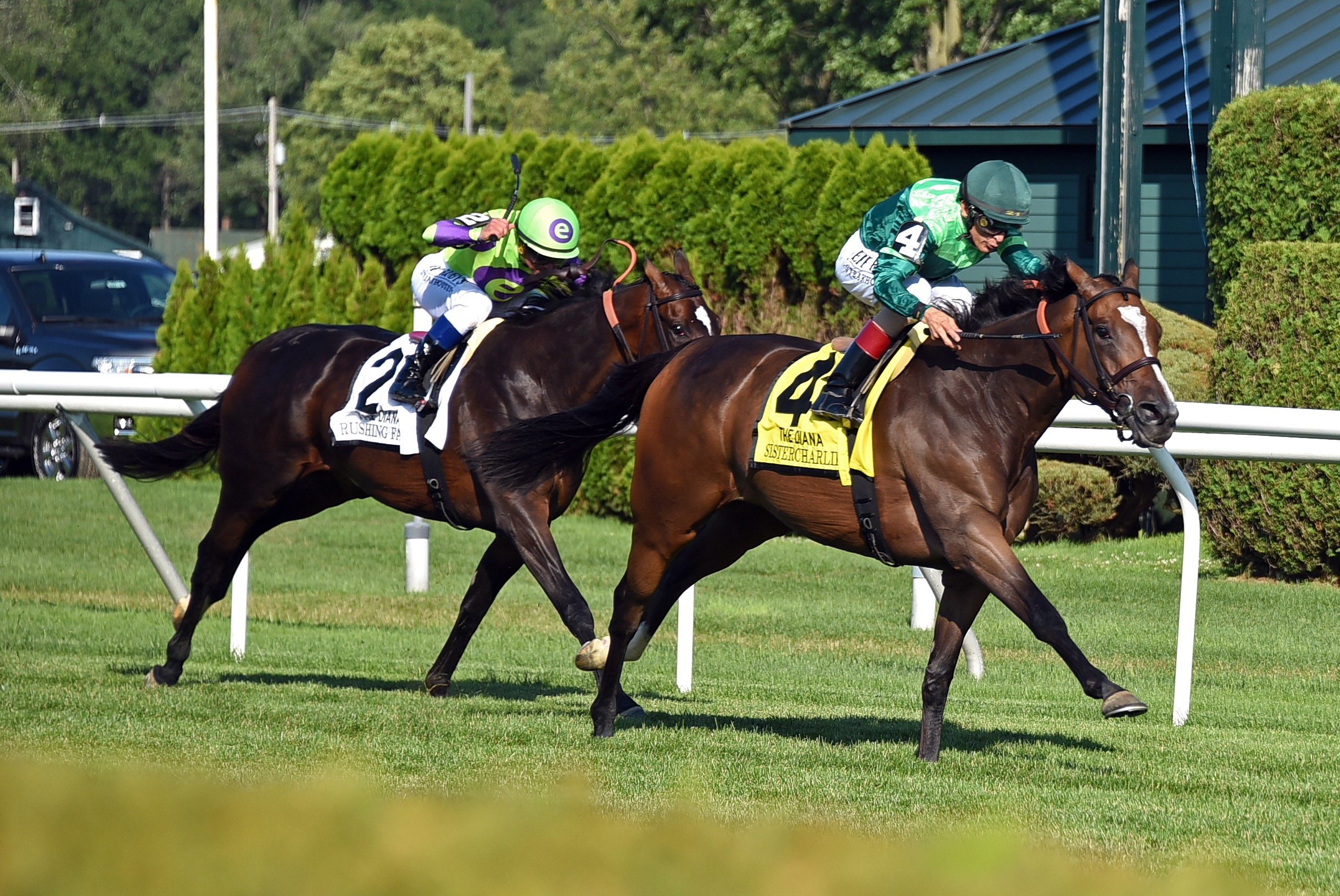
On Saturday, we were treated to two stellar performances by two racemares who are indisputably top class. Sistercharlie was tremendous in winning the Grade 1 Diana at Saratoga, and Elate was brilliant in winning the Grade 2 Delaware Handicap at Delaware Park.
It’s difficult, if not impossible, to say what it is exactly that makes Sistercharlie and Elate so good. Obviously, both have an abundance of talent and are in the finest of hands – Sistercharlie resides in Chad Brown’s barn, while Elate is trained by Bill Mott.
Sistercharlie and Elate also have to have sharp minds and big, giving hearts. But what is it that makes them stand out so much from the crowd?
It’s hard to say. We just know they do from what we see them do.
:: Get PPs, Clocker Reports, picks, and more from DRF's Saratoga One-Stop Shop
Sistercharlie was so good in the Diana it’s silly. In her first start since winning the Breeders’ Cup Filly and Mare Turf eight long months ago, which was her fourth Grade 1 win of 2018 and the victory that propelled her to the Eclipse Award as last year’s champion turf female, Sistercharlie charged from off a blistering early pace set by Thais, took command inside the eighth pole and scored going away.
That, however, is only a small part of why Sistercharlie was so special Saturday. It doesn’t address the context of the Diana. What made Sistercharlie’s Diana a true “Wow!” performance is that she did what she did against two terrific opponents who also reside in the Brown barn – Rushing Fall and Homerique.
Rushing Fall went into the Diana with a record of eight wins (seven in graded stakes) and one second from nine career starts, and off the best performance of her career – a stellar score in the Grade 1 Just A Game stakes on the Belmont Stakes undercard.
Homerique, who, like Sistercharlie, was a high-class performer in France early in her career, went into the Diana off two compelling graded stakes victories in her first two U.S. starts.
Both Rushing Fall and Homerique had an enormous recency edge on Sistercharlie on Saturday. That alone should have meant something. Maybe it did. Maybe Sistercharlie would have won even more impressively had she had the benefit of a recent outing, though it’s difficult to envision she could have been any more impressive than she was. But these are trivial matters to the special ones like Sistercharlie, and with the way she comfortably outkicked Rushing Fall and Homerique in the final furlong, she made them look rather ordinary. And one thing we know for sure is that the last thing Rushing Fall and Homerique are is ordinary.
Elate didn’t have to face the level of competition in the Del Cap that Sistercharlie did at Saratoga, though she did have to deal with the Grade 1 stakes winner Blue Prize and the Grade 1-placed Escape Clause. That’s why Elate went off at 1-5 (for the record, Sistercharlie went off as the 9-5 second choice to Rushing Fall).
For Elate, it was all about how she won on Saturday, and she absolutely dominated. In a matter of only 20 strides going into the far turn, Elate went from seventh to co-leader. It was a very fast move that the rest of the field wasn’t prepared for and couldn’t have answered even if they were. It was a flash of pure brilliance, very reminiscent of the 2017 version of Elate, when she was as good as any 3-year-old filly in the country and was actually sent off the 2-1 favorite in that year’s Breeders’ Cup Distaff.
But Elate, a true nine- and 10-furlong horse who relished the Del Cap’s 1 1/4 miles, wasn’t done showing off. She opened up into the stretch, and after turning the race into only a contest for second, she was taken well in hand for the last sixteenth of a mile. I don’t know why the chart has Elate a “driving” winner, but she was in a common gallop for the last sixteenth and still won by 4 1/2 lengths.
Clearly, Elate and Sistercharlie are poised for big late-summer and fall campaigns – Sistercharlie because she’s fresh as well as being so darn good, and Elate because she’s so good and because many of the upcoming best races for older dirt females are at distances she might appreciate more than some of her main divisional rivals. Either way, the promise is these two will provide more glimpses of what real class looks like.
• We also had two top 3-year-old males win on Saturday – Game Winner in the Los Alamitos Derby and Mr. Money in the Indiana Derby.
Game Winner was much too good for only three opponents at Los Alamitos and won off at odds of (and one doesn’t get the chance to say this very often) 1-20. But this was still an important race for Game Winner.
After winning all four of his starts last year, including the Breeders’ Cup Juvenile, and being voted champion 2-year-old male, Game Winner was 0 for 3 this year. However, he was given anything from bad to brutal trips in all three losses and easily could have won a division of the Rebel and the Santa Anita Derby instead of being a narrowly beaten second in both, and he could have been right there in the Kentucky Derby instead of finishing sixth under the line. So, in one respect, the Los Alamitos Derby was a good confidence builder for Game Winner.
The Los Alamitos Derby for Game Winner was also a perfect prep for the Travers on Aug. 24 at Saratoga. As we all know, the 3-year-old male division is wide open for the taking, and Game Winner has as good a chance as any to make a winning move for the title, starting in the Travers.
Unlike Game Winner, Mr. Money is a relative newcomer to the 3-year-old picture, emerging off impressive victories in the Pat Day Mile and Matt Winn Stakes. But both of those wins, as well as his maiden victory (his only other career score) all came on the main track at Churchill Downs. So, the Indiana Derby at Indiana Grand was important for Mr. Money in that it would settle the matter of whether his ascendency was a function of surface preference.
Consider the matter settled. Mr. Money, who was not parked as wide in the run around the first turn as I feared he might be, was still three wide around both turns and bothered a touch by a loose horse. Yet he still proved clearly best and is a possibility to join the cast for what threatens to be a critical renewal of the Travers.
