

Watchmaker: Rebel Stakes thriller a welcomed bright spot for racing
It’s been a rough few months for our sport – the sport we love. And some of the blows have come from quarters one would hope would know better. I mean, a major racetrack owner legitimizing PETA, whose stated mission is to end horse racing? Seriously?
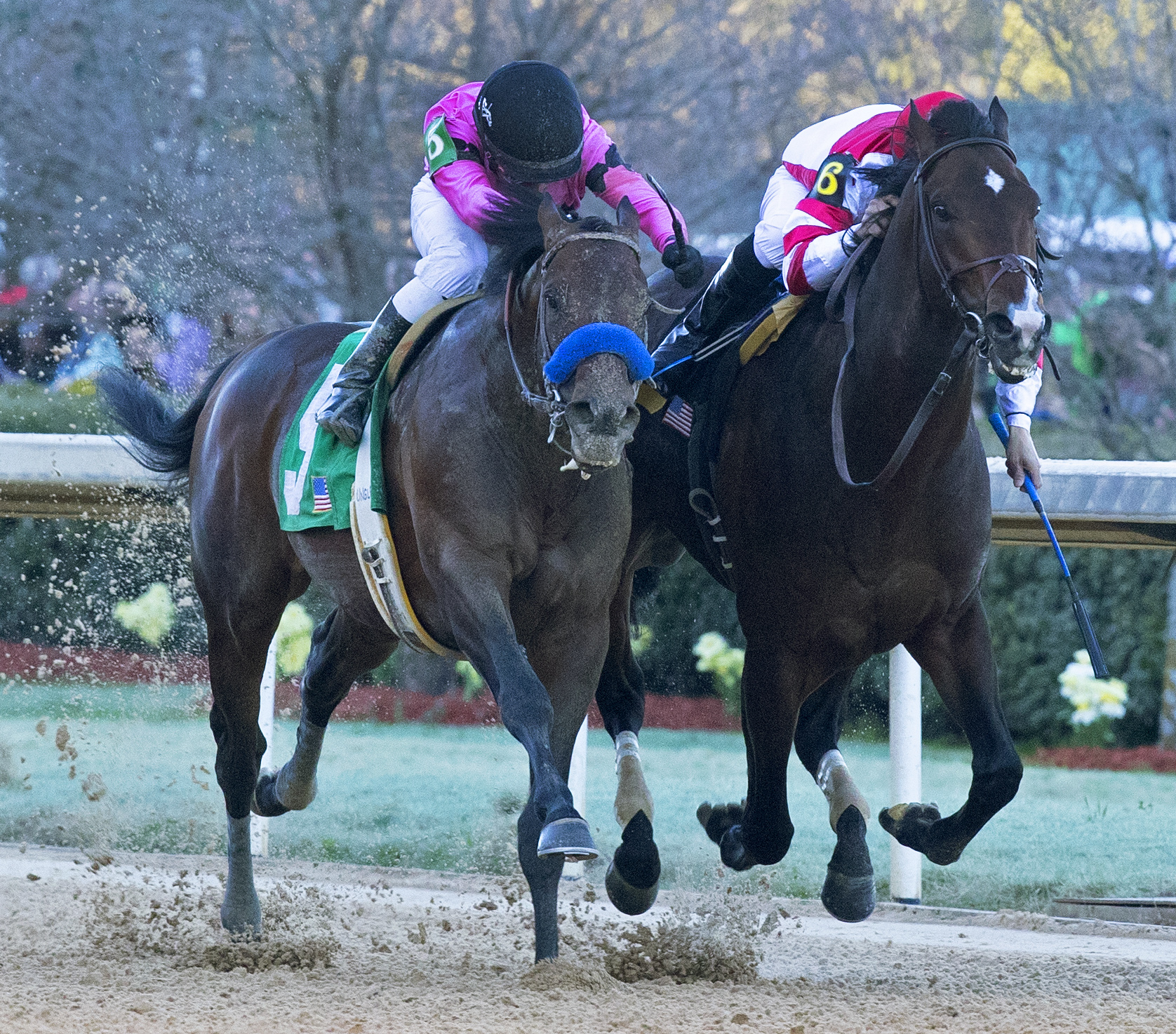
But just when you’re about to start praying that things won’t get any more troubling and bizarre, events occur to remind you of all that is great about our game. And such a major reset occurred Saturday in the second division of the Rebel Stakes at Oaklawn.
Simply put, the second division of the Rebel was a great horse race. And that comes from someone who does not use the term “great” loosely. It was an old-school throw-down between two obviously highly talented colts – one a champion and the other an up-and-comer – in an important semifinal-round Kentucky Derby prep.
The battle in this division of the Rebel between Omaha Beach and Game Winner instantly made any fan with a pulse look toward the future with much anticipation. It exponentially raised interest in a 2019 Kentucky Derby picture that had previously been distinguished by its lack of distinction. And that the second division of the Rebel was able to do this in a toxic climate is really saying something.
Game Winner, of course, was the champion who ran in the second division of the Rebel. Last year’s Eclipse Award-winning 2-year-old male was making his first start since winning the Breeders’ Cup Juvenile 4 1/2 months ago, and he ran his race, rallying strongly from off the pace. Omaha Beach just ran a race that was an inch better.
Omaha Beach was coming off only a maiden win sprinting in the slop and was not just leaping in class, he was also stretching back out to two turns. But he has always been highly regarded and always ran well, even through a series of narrow losses.
Yet Omaha Beach’s maiden win was so explosive, it was taken as an unmistakable sign that he had put it all together, and it was the reason he was the clear-cut second choice in the Rebel betting at 4-1 to Game Winner’s 1-2 favoritism. Omaha Beach made his sweet, pace-stalking trip stand up, but he drew that sweet trip because he has more natural speed than Game Winner, and he’s going to draw that trip nine times out of 10.
Everything about the second division of the Rebel rang with legitimacy. Omaha Beach and Game Winner finished more than eight lengths ahead of their closest pursuer. And you don’t have to guess about the value of their final time of 1:42.42 for the 1 1/16 miles.
(As an aside, I know Oaklawn not having a turf course is a huge factor here, but it was very nice to see a race card constructed with several other races at the same distance and surface as the important feature race. It certainly makes for more reliable speed figures.)
Omaha Beach and Game Winner’s final time was the fastest of seven (out of 11) races run at 1 1/16 miles at Oaklawn on Saturday. It was marginally faster than the first division of the Rebel (1:42.49) and was faster than what older males went in the Essex Handicap (1:42.66). It was faster than a strong-on-paper allowance race for 3-year-olds and the split divisions of a 3-year-old maiden race. It was also faster than what top-class mares went in the Azeri Stakes, but only in a technical sense.
The early pace of the Azeri – specifically the opening quarter- and half-mile – were significantly slower than the other 1 1/16-mile races on the card. That made the Azeri an outlier and, indeed, the Beyer Speed Figure folks treated it differently in making their preliminary Saturday figs for Oaklawn. The second division of the Rebel received a 96 Beyer (the first division got a 95), while the Azeri was assigned a 99.
:: DERBY WATCH: Top 20 Kentucky Derby contenders with comments from Jay Privman and Mike Watchmaker
Game Winner’s fate in his end of the Rebel turned out to be the same one that befell his Bob Baffert barnmate Improbable in the first division. Improbable, at 2-5, was nailed late by Long Range Toddy, who was a distant third choice at 8-1.
Much was made after the first division of the Rebel about trips being responsible for the outcome. I guess when the margin is only a neck, it probably is meaningful that Improbable was four-wide-ish throughout and Long Range Toddy saved much more ground before angling out into the stretch.
However, Oaklawn is a track where being wide often seems to hurt less than at other tracks, where ground loss really and truly does matter. And, of course, it could also be said that if Improbable was as good as everyone (including yours truly) thought he was, he should have won even if he was six wide throughout.
I still think Improbable is plenty good. In fact, despite their first career defeats on Saturday, I think Game Winner and Improbable remain the future-book favorites for the Kentucky Derby, in that order. But regarding Improbable, I do think he’s a bit quirky. That’s not exactly what you would want in a top-tier Derby candidate, but it is also why I think we haven’t yet seen what he is really capable of.
I’ve always felt that way. Improbable appeared almost offended at being asked to perform his job in his debut last fall and did the bare minimum to grind out a victory. His Street Sense Stakes on the Breeders’ Cup Friday undercard in his second start looked like it was going to be another grind-fest until he suddenly applied himself in the late stages and, in a blink, ran off from his opposition. And Improbable’s Los Alamitos Futurity was much like his Street Sense. He only really decided to run late, and that was when he turned that one into a romp.
On Saturday, Improbable ranged up to take command in upper stretch, and just when he appeared poised to turn his division of the Rebel into a smashing win, I thought he started to idle and lose focus. Improbable had his head cocked to the right as if he was counting the crowd, and that opened the door just enough for Long Range Toddy to capitalize.
Yours truly is not making excuses for Improbable, but I do believe he’s the type who will benefit from more racing. He’d better, with Omaha Beach and Game Winner out there.
Notes:
• Midnight Bisou got the best of Elate by a length in that strong renewal of the Azeri, and those convinced that ground loss was the big player in Improbable’s defeat would have to apply the same thinking to Elate as she had a wide trip and Midnight Bisou did not. I suspect recency played a part in the outcome. Midnight Bisou’s last start was in late January. Elate had not raced since Travers Day.
Midnight Bisou is an interesting filly. She is now 6 for 6 in 1 1/16-mile races but is 0 for 4 in longer races. I don’t think that’s a fluke.
• Horseplayers need some standardization in result charts, from which past performances are born. On some circuits, if a horse is breathed on coming out of the gate, you’ll see a “Start good for all but …” in the chart. In that 3-year-old allowance race on the Rebel undercard, heavily favored Dessman walked out of the gate, spotting the field by conservative estimates some three lengths. Yet there was no “Start good for all but …” in the chart, where one was warranted.
