

Watchmaker: Not jumping on War of Will's bandwagon just yet
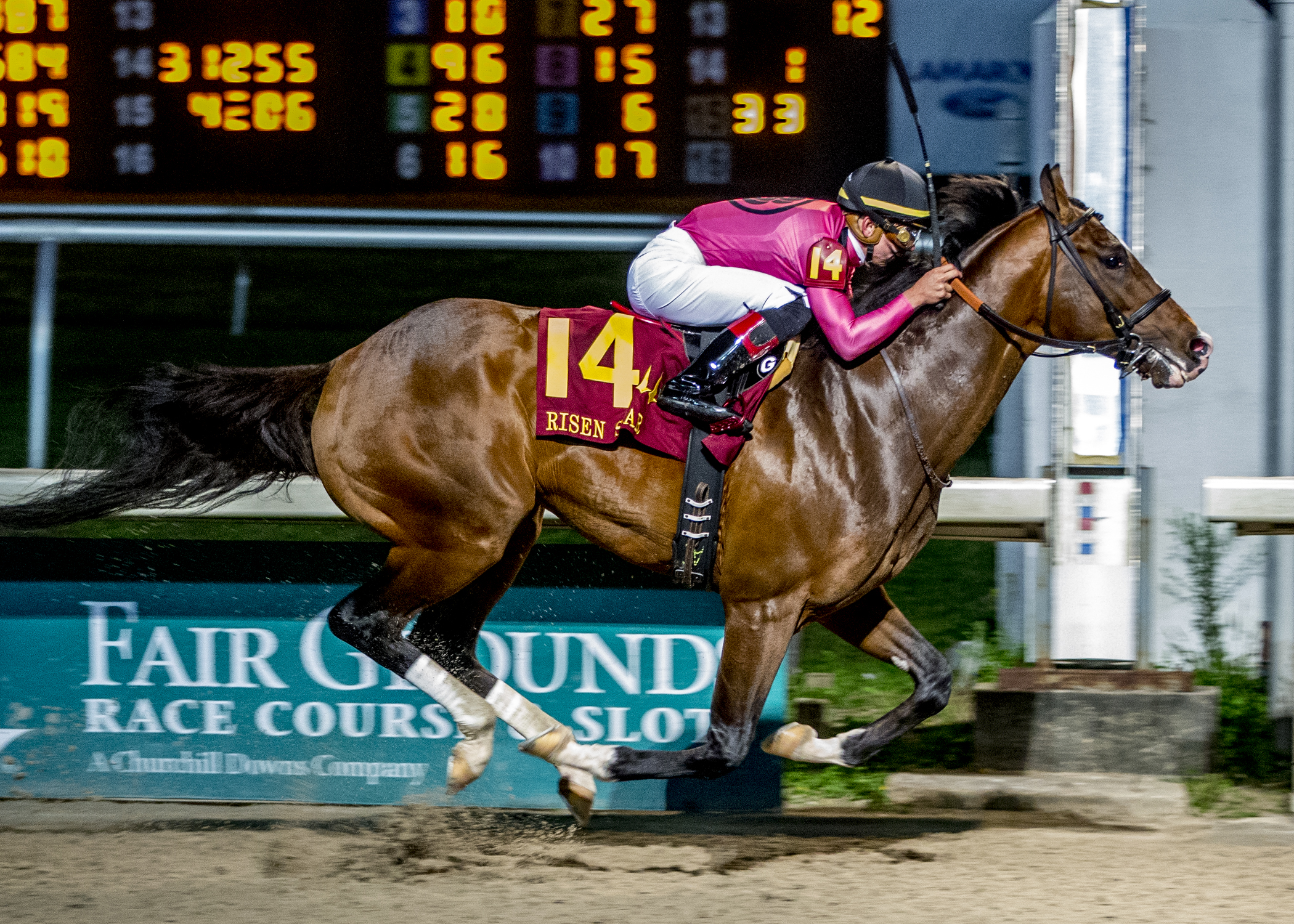
War of Will’s decisive victory in Saturday’s Risen Star Stakes at Fair Grounds was a good example of how hot takes immediately after a race might not age very well.
I understand why there was some gushing over War of Will in the time between his gallop-out and when the last patron left the Fair Grounds dining room. I mean, War of Will scored by just more than two lengths, which was his third straight decisive victory since moving to dirt last fall, and he did so after prompting a pace that otherwise fell completely apart.
For example, early pacesetter Gun It wound up finishing 12th of 14, beaten just more than 17 lengths. And Dunph, Manny Wah, and Mr. Money, who were closest behind War of Will through the first six furlongs, wound up 11th, beaten just more than 15 lengths; sixth, beaten eight lengths; and seventh, beaten 8 1/4 lengths.
Moreover, the 50 Kentucky Derby points War of Will earned for dominating the Risen Star (an add-on to the 10 he already had for winning last month’s Lecomte) mean that no matter what else happens, if he stays healthy, he will safely be in the Derby starting gate.
But after having a night to sleep on it and reflect, I propose that maybe it would be a good idea to dial back the reaction to War of Will’s Risen Star, if only just a bit.
For one, the preliminary Beyer Speed Figure for War of Will in the Risen Star of 92 was actually two points less than what he received for the Lecomte. That 92 is only an okay number and was, in fact, just one point higher than what Serengeti Empress, the filly every wise guy in America loved to hate (including yours truly), got for winning the Rachel Alexandra in the race immediately preceding the Risen Star.
And it’s not like the pace War of Will attended is a real excuse for him not doing better Beyer-wise. The Risen Star pace (23.71 seconds, 47.36, and 1:12.20) was actually quite comparable to the pace of the Rachel Alexandra (24.02, 47.81, and 1:12.45). And unlike Serengeti Empress, who set her pace under pressure, War of Will comfortably tracked the Risen Star pace, laying two to three lengths off it in the early stages.
Look, while these are reasons for folks to temper their assessments of War of Will in the wake of the Risen Star, it does not meaningfully change his status vis a vis the Kentucky Derby. He remains a prominent and popular Derby candidate. But it will be interesting to see how that holds up after the likes of Game Winner, Improbable, and Instagrand begin their 3-year-old campaigns and Hidden Scroll makes his stakes debut.
Notes:
• It’s pretty safe to say that Serengeti Empress has made a good transition from 2 to 3. The Rachel Alexandra, her 3-year-old debut, was by far her best race yet and improved on her previous-best route Beyer by 13 large points.
• It’s anyone’s guess what Anothertwistafate’s seven-length romp in the El Camino Real Derby at Golden Gate means, if anything. Anothertwistafate won his two prior starts on Golden Gate’s synthetic main track by four and five lengths but was beaten 15 lengths in his one start on dirt and in Southern California.
• Late Night Pow Wow represents everything that is good about the game. This West Virginia-bred daughter of Fiber Sonde, who stands for $1,000, took on a Grade 1 stakes winner from Southern California and, among others, a couple of New York stakes winners in the Barbara Fritchie at Laurel, and beat them all. And what’s even greater about it is that Late Night Pow Wow did so as the favorite because she had won 10 of her prior 11 starts, with only five of those wins at the expense of fellow West Virginia-breds.
• Uncontested was very good in winning the General George at Laurel in the race immediately before the Fritchie after setting a pace that was significantly faster in the middle stages than the Fritchie pace.
Unfortunately, fellow male sprinter Imperial Hint was not good in defeat at 1-5 in the Pelican Stakes at Tampa Bay Downs, finishing third, beaten five lengths, without an apparent excuse. Imperial Hint was one of the best in his division the last two years, but the 83 Beyer he came away with from the Pelican was his lowest since July 2, 2016, when he got a 74 in finishing second in an allowance race at Monmouth Park.
• Last Wednesday, the New York Racing Association introduced the $5.25 million Turf Triple Series for 3-year-olds.
The Turf Trinity comprises three $1 million races – the existing Belmont Derby, the new Saratoga Derby, and the new Jockey Club Derby, which will be run back at the Belmont “fall” meet. The Turf Tiara for fillies comprises three $750,000 races – the Belmont Oaks, the new Saratoga Oaks, and the new Jockey Club Oaks, also to be run back at Belmont.
Interestingly, the distances of the Trinity mirror the distances of the Triple Crown. The Belmont Derby is at 1 1/4 miles, the Saratoga Derby is at 1 3/16 miles, and the Jockey Club Derby is at 1 1/2 miles. The first two legs of the Tiara are run at the same distances, but the Jockey Club Oaks will be run at 1 3/8 miles.
Clearly, the reason for the distance difference in the Jockey Club Oaks is to make it more of a serviceable prep for the Breeders’ Cup Filly and Mare Turf than a 1 1/2-mile race would be.
Although I believe series in our sport do much more good than harm since they are easily marketed and have a better chance of resonating with the general public than isolated races, that little distance difference noted above highlights how these new series might not be completely innocuous.
For one, I suspect there is now less of a chance that a good 3-year-old turf horse of either sex will go up against older horses in the Joe Hirsch Turf Classic or the Flower Bowl, New York’s two big fall turf-distance events. I’m sure NYRA will carefully position the Joe Hirsch and Flower Bowl so that running in the final Trinity or Tiara event, then the Hirsch or Flower Bowl, and then the Breeders’ Cup is doable. But whether anyone will actually do it in a game today where the ruling philosophy is that less racing equals more is a real question. And given how starved the Hirsch and Flower Bowl were last fall in terms of numbers and/or talent, potentially taking away the participation of some 3-year-olds in those races could be damaging to the future health of those long-standing events.
Perhaps as important, I wonder if these were the right divisions to throw this much money at. In particular, it is unusual when successful 3-year-old males go on to real, legitimate, sustained success as older horses. I suppose in recent years you could say maybe Beach Patrol and Highland Reel, who wasn’t even based in this country, were exceptions. But before them, you’d have to go back a decade or so to maybe Artie Schiller, but certainly Kitten’s Joy.
Kitten’s Joy in 2004 was the last 3-year-old to be voted champion turf male, and a huge reason for his title was his victory over older horses in the Joe Hirsch, a race that he might eschew for the Jockey Club Derby were he a 3-year-old today.
